


The 2026 FIFA World Cup is expected to be the biggest tournament in football history. It may also become the most polluting.
A new study from Loughborough University, the University of Bristol, and the University of Manchester estimates that the tournament could produce over 9 million tonnes of carbon dioxide equivalent (CO₂e). This would be the highest-emitting FIFA World Cup ever. Its footprint is nearly double the average from 2010 to 2022.
The warning comes as FIFA prepares for its first 48-team World Cup, hosted across 16 cities in the United States, Canada, and Mexico. The tournament will feature 104 matches, up from 64 in the previous format.
The findings raise broader questions about the environmental impact of major sporting events. They also highlight a growing contradiction: football is contributing to climate change while becoming increasingly vulnerable to its effects.
Bigger Tournament, Bigger Carbon Footprint
The main driver behind the projected emissions increase is expansion. For the first time, the World Cup will feature 48 teams instead of 32. The number of matches will increase by more than 60%, from 64 to 104.
At the same time, the tournament will span three countries and thousands of miles of travel between host cities.
Researchers estimate that air travel emissions for the 2026 World Cup will rise by 160% to 325% compared to past tournaments. Similar increases are expected for the 2030 and 2034 World Cups under the expanded format.
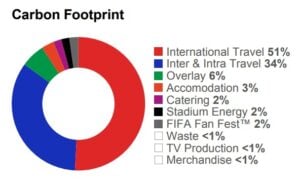
Transportation has long been the largest source of emissions for major sporting events. International flights are hard to decarbonize. In contrast, stadium operations can increasingly use renewable electricity.
The study argues that tournament expansion is now becoming one of the biggest climate challenges facing global football. The scale of the event illustrates the issue. FIFA expects the 2026 World Cup to attract millions of fans and become the most-watched tournament in history.
- RELATED: World Cup 2026: How Stadiums Move Beyond Sports Venues and Turn Into Clean Energy Hubs for the Grid
The 2022 World Cup in Qatar reached about 5 billion viewers globally, while the final alone attracted around 1.5 billion viewers, according to FIFA. The larger 2026 event is expected to exceed those numbers.
Record Revenues Come With a Rising Carbon Bill
The environmental debate comes as football’s commercial success reaches new heights.
According to FIFA’s financial reports, the 2022 World Cup generated approximately $7.6 billion in total revenue. Broadcasting and media rights accounted for about 83% of FIFA’s total revenue, amounting to $6.3 billion, during the 2019-2022 cycle.
The organization expects revenues to keep growing from 2023 to 2026. Larger tournaments will bring more chances for sponsorship, broadcasting, and ticket sales.
Critics argue that this growth model has environmental consequences. The new study points to expanding competitions, rising travel demand, and increasing commercial activity as key factors behind football’s growing carbon footprint.
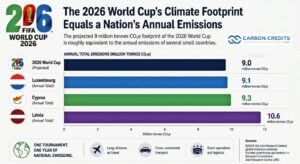
A report titled FIFA’s Climate Blind Spot by the New Weather Institute outlines that the 2026 World Cup will generate at least 9 million tonnes of carbon dioxide. This is roughly equivalent to the entire annual carbon emissions of countries like Luxembourg, Cyprus, or Latvia.
University researchers also raise concerns about the role of fossil fuel sponsorships in sport. In particular, the report highlights FIFA’s sponsorship agreement with Saudi Aramco, one of the world’s largest oil companies. The authors further proposed that UEFA should restrict
fossil fuel ownership, saying:
“We therefore recommend that actors with an active interest in football not becoming more sustainable should be hindered from owning clubs. This issue should be of particular interest to UEFA, given their interest in sustainability.”
The authors argue that football’s global influence gives it a unique responsibility to align with climate goals. They question whether continued tournament expansion is consistent with efforts to reduce emissions.
Climate Change Is Also Threatening the Game
While football contributes to emissions, it is also becoming more exposed to climate risks. A climate risk assessment for the 2026 World Cup showed that many host cities may face dangerous heat in the coming years.
Researchers predict that by 2050, 14 of the 16 stadiums in the tournament may reach temperatures that require cooling breaks for players and officials. More concerning, 11 venues could face heat conditions considered unsafe for human activity during parts of the year.
The risks are not limited to future decades.
A recent study by World Weather Attribution found that about one-quarter of matches planned for the 2026 World Cup might face heat levels above safety limits set by FIFPRO, the global players’ union.
Five matches could take place under conditions considered unsafe for play. Miami emerged as one of the most vulnerable locations. Researchers described dangerous heat levels there as “near certain” during parts of the tournament.
These findings highlight a growing challenge for global sports. Rising temperatures are already affecting player performance, fan safety, and event operations around the world.
From Flooding to Heatwaves: The Growing Price of Climate Disruption
Heat is only one part of the problem. The climate risk assessment also examined flooding, storms, and water stress across the tournament’s host cities. The results suggest that climate-related costs could increase significantly over the coming decades.
Annual flood-related damages at World Cup venues are projected to rise from approximately $10.9 million in 2025 to $15.6 million by 2050. Meanwhile, annual wind-related damages could increase from about $7 million to $7.7 million over the same period.
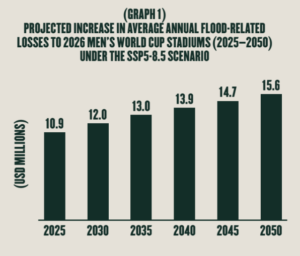
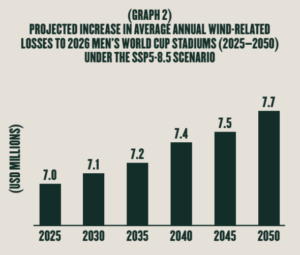
Several host venues face particular exposure to flooding risks. Researchers say that six stadiums might flood. The water could rise from one to over two meters during big storms.
Water availability may also become a challenge.
The study found that almost one-third of World Cup venues might have water needs that outstrip local supply by mid-century. This raises concerns about maintaining playing surfaces and supporting large numbers of visitors during major events. These risks show that climate change is now a direct issue for global sports organizations.
Can Football Become More Sustainable?
Football’s climate footprint is attracting growing scrutiny. Many clubs, leagues, and governing bodies have introduced sustainability initiatives in recent years. Efforts include renewable energy installations, waste reduction programs, sustainable stadium design, and low-carbon transportation plans.
FIFA has also announced climate strategies and sustainability commitments. However, researchers argue that operational improvements alone may not offset emissions generated by larger tournaments and increased international travel.
The report suggests several actions, including.
- First, it advises ending fossil fuel sponsorships.
- Next, it recommends skipping future tournaments in major oil-producing states.
- Finally, it urges a rethink of expanding global competitions.
Others suggest that future host selection could place greater emphasis on geography, transportation networks, and climate resilience.
Technology can help cut emissions. This includes using sustainable aviation fuels, cleaner transportation systems, and better energy efficiency. Yet, most experts agree that aviation remains one of the hardest sectors to decarbonize.
That means travel-related emissions will likely remain a major challenge for future World Cups.
A Defining Test for Football’s Climate Ambitions
The 2026 World Cup represents a milestone for football. It will feature more teams, more matches, more host cities, and likely more viewers than any tournament before it. But the same factors driving that growth are also increasing its environmental footprint.
At the same time, climate change is creating new risks for players, fans, and infrastructure. The result is a growing tension that football can no longer ignore.
Whether FIFA and other sports organizations can reduce emissions while adapting to a warmer world may become one of the defining questions for the future of international sport.
The 2026 World Cup will not answer that question alone. But it may become the tournament that forces the conversation onto center stage.