


As FIFA prepares for its upcoming World Cup tournaments from June 11 to July 19, 2026, its climate strategy is facing closer attention, too. The organization has set a goal to reach net zero emissions by 2040. It also aims to cut emissions by 50% by 2030.
These targets are part of FIFA’s long-term sustainability plan, which aligns with the UN Sports for Climate Action Framework and the Paris Agreement. FIFA first announced its climate strategy in 2021 and has since applied it across major tournaments.
However, the challenge is not setting targets. The real challenge is reducing emissions in a global event that depends on international travel. The World Cup is one of the most complex events to decarbonize because most emissions come from sources outside direct control.
FIFA’s Climate Commitments and Official Emissions Targets
FIFA’s climate strategy follows a structured pathway based on global climate standards. It includes measuring emissions, reducing them where possible, and offsetting what remains.
The organization has committed to three main actions:
- Reduce greenhouse gas emissions by 50% by 2030.
- Achieve net zero emissions by 2040.
- Align operations with international climate frameworks.
FIFA reports emissions using standard greenhouse gas accounting. This includes tracking emissions across tournaments, host cities, and operational activities.
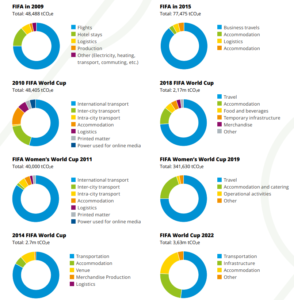
In past tournaments, FIFA has introduced sustainability measures such as energy-efficient stadiums, waste reduction programs, and public transport planning. For example, several recent World Cup venues have used renewable electricity and modern cooling systems to reduce energy demand.
FIFA also works with host countries to improve infrastructure planning. This includes encouraging the use of existing stadiums and limiting new construction where possible. These steps aim to reduce emissions linked to building materials and long-term infrastructure.
Still, these efforts mainly affect operational emissions. The larger challenge lies beyond stadiums and facilities.
How Emissions Are Measured in the World Cup
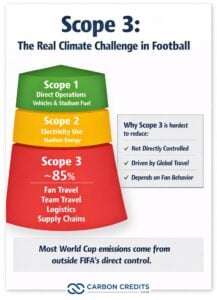
FIFA measures emissions using the widely accepted Scope 1, Scope 2, and Scope 3 framework.
Scope 1 emissions come from direct sources such as fuel use in vehicles and on-site operations. Scope 2 emissions come from purchased electricity used in stadiums and facilities. These emissions can be reduced through renewable energy and efficiency improvements.
Scope 3 emissions include all indirect emissions linked to the event. These are the most complex and the largest category.
In the World Cup, Scope 3 emissions come from these sources:
- International and domestic travel by fans,
- Team and staff transportation,
- Accommodation and hospitality services,
- Supply chains and merchandise production, and
- Broadcasting and logistics operations.
In large global events, Scope 3 emissions often account for more than half of total emissions. The share is even higher due to the scale of international travel in football tournaments.
This structure shows that most emissions do not come from FIFA’s direct operations. They come from the wider system that supports the event.
By the Numbers: Inside the 3.7M Ton Carbon Footprint of 2026 World Cup
The FIFA World Cup is one of the largest global sporting events. The 2022 tournament in Qatar drew over 3.4 million spectators, according to FIFA, and reached billions of viewers worldwide. This level of participation creates a large environmental footprint.
For the 2026 FIFA World Cup, hosted by the United States, Canada, and Mexico, total emissions are projected at around 3.7 million tonnes of CO₂ equivalent (CO₂e). This estimate comes from the United 2026 bid’s environmental impact assessment. It reflects the full lifecycle footprint of the event, including travel, operations, and infrastructure.
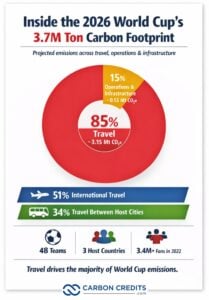
Transportation is the main driver of these emissions. About 85% of total emissions are linked to travel, especially air travel. This includes both international flights and travel between host cities.
The scale of the 2026 tournament adds to this challenge. It will feature 48 teams, up from 32 in previous editions, and will span multiple countries and cities. This increases travel demand, distances between matches, and overall logistics complexity.
The structure of emissions can be summarized as follows:
- ~85% from travel-related activities (~3.15 million tonnes CO₂e)
- ~15% from operations, energy use, and infrastructure (~0.55 million tonnes CO₂e)
Travel emissions alone include:
- 51% from international journeys
- 34% from travel between host cities
Compared with more compact tournaments, this format leads to higher emissions due to increased reliance on long-distance flights.
Scope 3 Emissions: The Core Climate Challenge
The emissions profile of the World Cup highlights a clear imbalance. Most emissions fall under Scope 3, which includes indirect sources such as travel, logistics, and supply chains.
Scope 1 and Scope 2 emissions, which cover direct operations and energy use, represent only a small share of the total footprint. These can be reduced through renewable energy and efficient design.
Scope 3 emissions are different. They come from activities outside FIFA’s direct control. These include fan travel, team transport, global logistics, and services linked to the event. This creates a structural challenge. Even if FIFA reduces emissions from stadiums and operations, total emissions can remain high due to travel demand.
- In simple terms, the World Cup’s carbon footprint is driven more by movement than by infrastructure.
Scope 3 is also the hardest category to reduce. It depends on global travel patterns, geography, and individual choices. FIFA cannot fully control how fans travel or how often they move between cities.
This is why Scope 3 emissions are central to the climate challenge. They account for the largest share of emissions and the biggest barrier to reducing the World Cup’s overall footprint.
Cuts vs. Credits: The Ongoing Offset Debate
To meet its climate targets, FIFA uses both emissions reduction and carbon offsetting. Reduction focuses on lowering emissions at source. This includes improving energy efficiency, using renewable electricity, and optimizing event operations.
Offsetting is used to balance emissions that cannot be eliminated. This involves investing in projects that reduce or remove carbon emissions elsewhere.
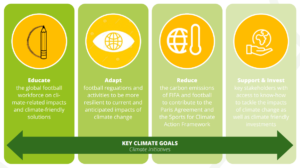
FIFA’s approach includes:
- Reducing energy use in stadiums and facilities,
- Increasing the use of renewable electricity, and
- Supporting carbon offset projects for remaining emissions.
Carbon offsets can include projects such as reforestation, renewable energy development, and carbon capture. However, their effectiveness depends on project quality, verification, and long-term impact.
This has led to debate in climate policy. Some experts argue that offsets should not replace real emissions reduction. Others point out that offsets can support the transition when used carefully.
The key issue is transparency. Clear reporting and verified data are needed to ensure that net-zero claims reflect real outcomes.
Why Net Zero Is Difficult for Mega Sports Events
Mega sporting events like the World Cup have unique challenges. They are temporary, global, and highly mobile. Their emissions come from:
- International travel,
- Temporary infrastructure,
- Large-scale logistics, and
- Global audience participation.
Even with strong sustainability measures, these factors create a high baseline of emissions.
Take for example, the Paris 2024 Olympics. The event’s total footprint hit 1.7 million tonnes CO₂e. Travel caused 72%, that’s 1.2 million tonnes, from 720,000+ international visitors. Stadiums run on 100% renewables, but aviation emissions? Untouched.
Super Bowl LIX in 2025 told the same story. The event generated 400,000 tonnes CO₂e, with 85% coming from 150,000+ out-of-state fans flying to New Orleans. The NFL bought 400,000 offsets for carbon-neutral claims. Still, travel cuts? Zero.
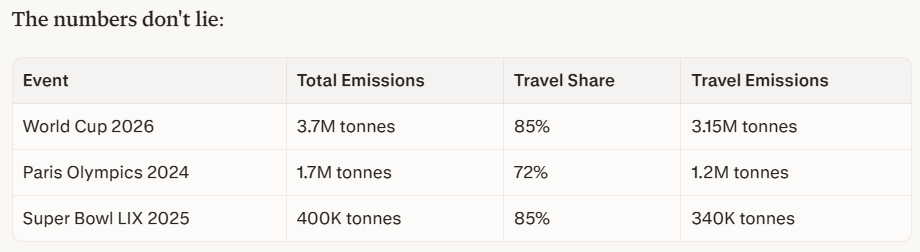
This pattern is industry-wide. Organizers control stadium power. Fans control flights. These mega-events lean on offsets, not aviation reductions. FIFA faces the same problem that other organizers couldn’t easily resolve.
Thus, decarbonization becomes more complex. It also means progress may be slower compared to sectors with more direct control over emissions.
What a Credible Net Zero World Cup Requires
For FIFA’s net-zero goals to be credible, several conditions need to be met.
- Emissions must be clearly measured and reported across all scopes. This includes full disclosure of total emissions before offsets are applied. Transparency is essential for trust.
- There must also be a stronger focus on reducing emissions at source. While offsets can play a role, long-term progress depends on real reductions.
- Independent verification of emissions data can improve credibility. Better coordination of travel and logistics can also help reduce unnecessary emissions.
- In the long term, advances in low-carbon transport, including sustainable aviation fuels, may help reduce travel-related emissions.
Final Whistle: Can FIFA Turn Climate Targets Into Reality?
FIFA has set clear climate targets, including net zero emissions by 2040. These targets reflect growing pressure on global organizations to reduce their environmental impact.
However, the data shows a clear challenge. Most emissions from the World Cup come from indirect sources, especially global travel. Scope 3 emissions dominate the total footprint and remain difficult to control. This makes them the key factor in any net-zero strategy.
As the World Cup continues to grow in scale, emissions challenges will also increase. Operational improvements can reduce part of the impact, but they cannot fully address the larger system.
The future of football’s climate strategy will depend on how this gap is managed. The goal is not only to set targets, but also to achieve measurable and transparent progress in a global, complex system.
In this field, will FIFA lead or lag? We will watch this space closely.