


Mining giant BHP delivered stronger-than-expected financial results for FY2026 as surging copper prices drove growth and lifted shareholder returns. However, the company also reported that its operational emissions edged higher.
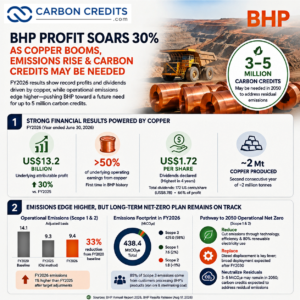
Copper played a bigger role in the result. BHP reported that copper made up over half of its underlying operating earnings for the first time. The company also produced around 2 million tonnes of copper for the second straight year.
At the same time, BHP’s FY2026 Annual Report shows that its operational greenhouse gas emissions rose slightly year-on-year on an adjusted basis. The company reported 9.4 million tonnes of CO2e (MtCO2e) in Scope 1 and Scope 2 emissions from its operated assets.
BHP has cut adjusted operational emissions by 33% from its FY2020 baseline. However, it still finds some emissions hard to eliminate. The miner says it might need 3 million to 5 million tonnes of carbon credits to help tackle residual emissions and meet its 2050 operational net-zero target.
The contrast highlights BHP’s two-track challenge: growing its business around copper and other future-facing commodities while cutting emissions across a large and complex mining portfolio.
Copper Powers BHP Profit and Dividend Growth
BHP’s strong FY2026 financial results give the miner more room to invest in growth and its long-term decarbonization plans.
The company reported US$13.2 billion in underlying attributable profit, a 30% increase from FY2025 and above the US$12.66 billion analyst consensus cited by Reuters. BHP also reported US$9.8 billion in attributable profit for the year.
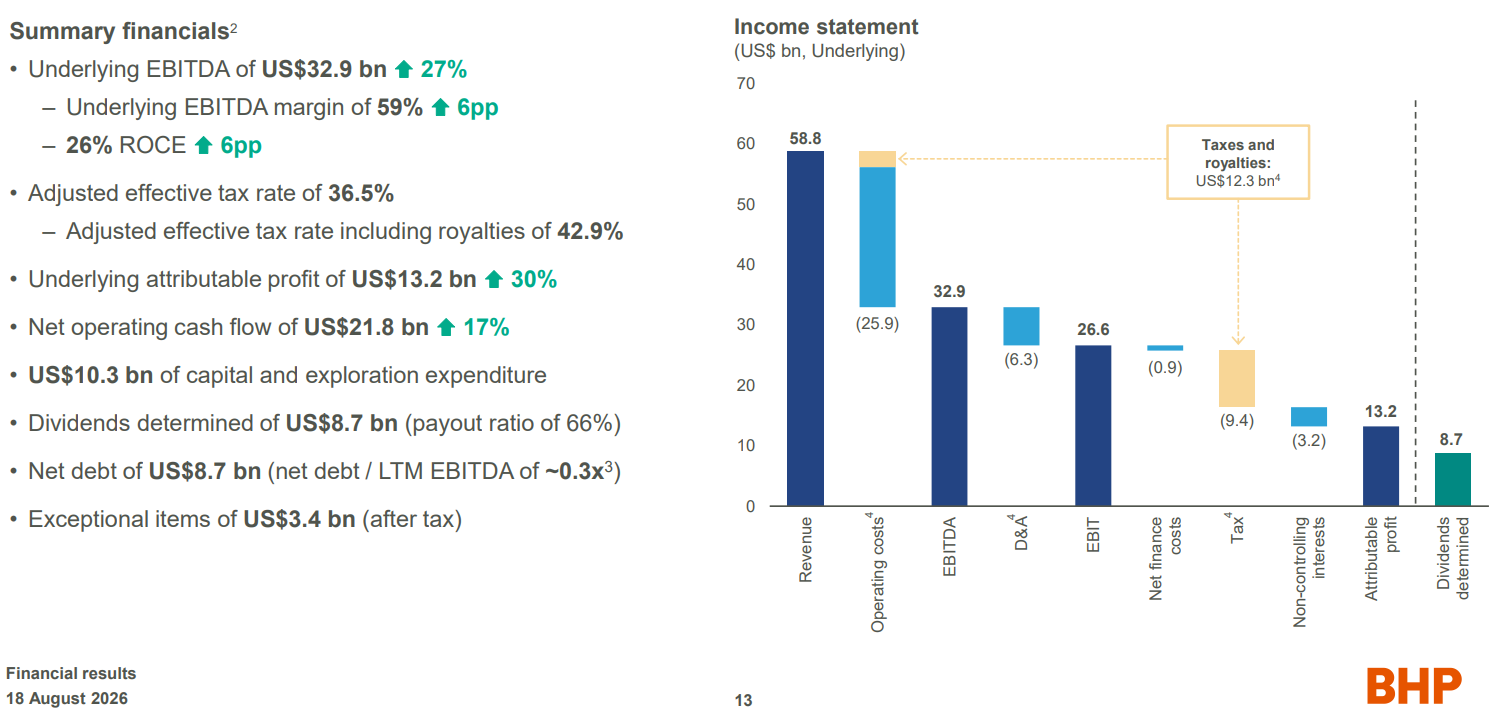
Copper drove much of the improvement. Copper, including gold and uranium byproducts, generated US$18.19 billion in operating earnings, compared with US$14.53 billion from iron ore, making copper BHP’s largest earnings contributor.
BHP declared US$1.72 per share in dividends, its highest payout in four years. The company said total shareholder dividends reached 172 US cents per share, or US$8.7 billion, equal to 66% of underlying attributable profit.
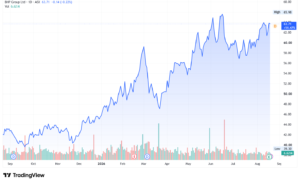
The stronger result comes as BHP increases its focus on copper, which it expects to play a growing role in the global energy transition. BHP shares rose 2.65% to A$63.85 on August 18. Investors responded positively to the stronger-than-expected FY2026 results and higher dividends.
However, the Australian miner also reported rising GHG emissions in its 2026 Annual Report.
BHP’s Operational Emissions Tick Higher
BHP’s adjusted operational emissions fell from 14.1 MtCO2e in FY2020 to 9.4 MtCO2e in FY2026, a 33% reduction from its baseline. However, progress was not linear.
BHP reported higher emissions at BHP Mitsubishi Alliance (BMA) because of increased material movement and more methane-intensive mining areas. Emissions at New South Wales Energy Coal (NSWEC) also increased because of higher production and a revised methane emissions model.
Stable performance at Western Australia Iron Ore and Escondida helped balance some of those increases. The temporary suspension of Western Australia Nickel also contributed.
BHP also changed how it calculates Scope 2 emissions at its Australian operations by using a national residual mix factor (RMF) where available. Applying the new method changed the reported FY2025 comparison from a 36% reduction against the FY2020 baseline to 34%.
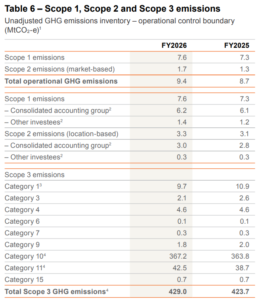
That makes the adjusted year-on-year comparison important. BHP says FY2026 emissions were 1% higher than FY2025 after applying the adjustments used for its climate targets.
Scope 3 Emissions Dwarf BHP’s Operational Footprint
BHP’s wider emissions footprint is much larger when it includes its value chain. The company reported 429.0 MtCO2e of Scope 3 emissions in FY2026, up 1% from 423.7 MtCO2e in FY2025. Most of those emissions come from customers processing BHP’s products.
The downstream processing of iron ore and steelmaking coal accounted for 85% of reported Scope 3 emissions. Energy coal combustion contributed another 10%, while direct suppliers accounted for 2% and upstream and downstream shipping for 1%.
BHP has a separate long-term goal to reach net-zero Scope 3 emissions by 2050. The company says reaching that goal is uncertain. It relies on customers using lower-emissions steelmaking technologies.
Its 2050 operational net-zero goal is different. That goal covers only Scope 1 and Scope 2 emissions from BHP’s operated assets.
BHP May Need 3–5 Million Carbon Credits
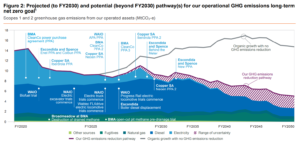
The biggest new carbon market figure in the report comes from BHP’s long-term operational emissions pathway. BHP says it intends to reduce emissions through structural measures wherever technology is mature, commercially available, and viable. It expects carbon credits to address emissions that remain after those measures.
The company now estimates that 3 MtCO2e to 5 MtCO2e of emissions could remain in CY2050. BHP says it would need carbon credits to offset those emissions and achieve its net-zero operational goal.
- That range translates into roughly 3 million to 5 million carbon credits, as each credit represents one tonne of CO2e.
BHP stresses that this is an estimate, not a firm future purchase commitment. The company says its estimate could change as low- and zero-emissions technologies improve.
This distinction matters. BHP does not plan to use offsets as a substitute for cutting its operational emissions. Instead, it expects credits to cover the residual emissions that it cannot eliminate.
Technology Delays Could Increase Reliance on Offsets
BHP says diesel displacement remains its largest future lever for cutting operational emissions. The company has made progress on renewable electricity. It reported 80% renewable electricity usage across its operated assets globally. BHP also says its BMA mines in Queensland moved to 100% renewable power from July 2026.
The harder challenge is replacing diesel in heavy mining equipment.
BHP began trials of battery-electric haul trucks and locomotives during FY2026. At Jimblebar in Western Australia, it started testing two Caterpillar battery-electric haul trucks in March 2026. It also began trials involving two Wabtec FLXdrive battery-electric locomotives at Port Hedland.
However, BHP does not expect broad deployment of battery-electric mining systems across its operations until after FY2030. The company says some technologies needed for diesel displacement remain under development. It also faces challenges around charging infrastructure, power systems, mine planning, maintenance, and workforce skills.
BHP expects its continued operational decarbonization work to require at least US$4 billion of incremental nominal spending in the 2030s.
Methane Remains Another Challenge
Diesel is not BHP’s only difficult emissions source. Methane accounted for 12% of BHP’s Scope 1 and Scope 2 emissions in FY2026. The company says it can capture and abate drainage methane at its underground BMA steelmaking coal mine when it is safe and practical to do so.
Open-cut mines present a harder problem. BHP says no proven technology can currently abate fugitive methane from open-cut mines at scale. The company started a proof-of-concept trial for novel methane gas drainage at an operating open-cut mine during FY2026. It will continue that work in FY2027.
These technology gaps help explain why BHP expects some residual emissions to remain in 2050.
Carbon Credits Could Become BHP’s Net-Zero Backstop
BHP’s latest financials and emissions data show both progress and a growing challenge. The company has already cut adjusted operational emissions by 33% from FY2020. It has also expanded renewable electricity use and started testing technologies that could eventually replace diesel.
Yet, emissions increased slightly in FY2026, while some of the technologies needed for deeper cuts remain immature. That leaves carbon credits as part of BHP’s long-term pathway.
The company now thinks that 3 million to 5 million tonnes of residual emissions might still exist in 2050. This could lead to a future need for a similar amount of carbon credits.
For carbon markets, the figure is significant. It shows how even major miners pursuing large operational reductions may still depend on high-quality carbon removals or other eligible credits to address hard-to-abate emissions.
The next decade will determine how large that gap ultimately becomes. If electrification, renewable power and methane technologies advance faster than expected, BHP could reduce its reliance on offsets. If technology deployment falls short, the company’s need for carbon credits could grow.