

Global nuclear power is entering a new period of expansion as governments look for reliable, low-carbon electricity to meet rising energy demand.
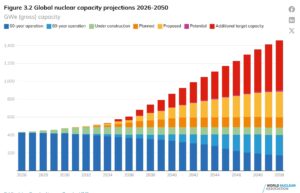
The World Nuclear Association’s (WNA) World Nuclear Outlook Report 2026 finds that national nuclear targets are collectively strong enough to support more than a tripling of global nuclear capacity by 2050. If those ambitions are delivered, global capacity could reach 1,457 GWe by the middle of the century.
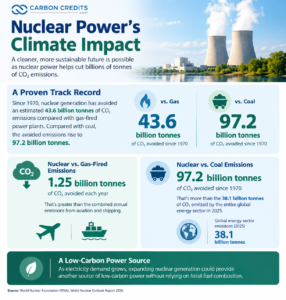
The growth would build on nuclear power’s existing contribution to emissions reductions. Since 1970, nuclear generation has avoided an estimated 43.6 billion tonnes of CO₂ emissions compared with producing the same electricity from gas-fired power plants. Compared with coal, the avoided emissions rise to 97.2 billion tonnes.
However, the report makes clear that reaching the 2050 target will depend less on setting new ambitions and more on delivering reactors at a much faster pace.
Nuclear Generation Reaches a Record High
Nuclear power already supplies a significant share of global electricity.
- Worldwide nuclear generation reached a record 2,702 TWh in 2025, up from 2,667 TWh a year earlier. That was enough to provide about 9% of global electricity.
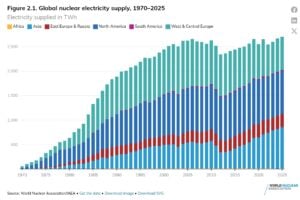
The increase was driven largely by Asia. Nuclear generation across the region has risen by approximately 2.5 times since 2012, with China accounting for much of the expansion alongside growing output from countries including India, Pakistan and the United Arab Emirates.
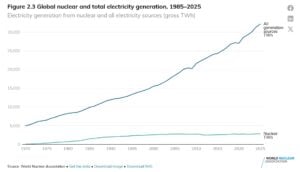
At the same time, nuclear’s share of global electricity has fallen from around 17% in the mid-1990s. That does not mean nuclear generation has declined. Instead, global electricity production has expanded faster than nuclear output.
- The existing fleet is also performing strongly. The global average reactor capacity factor rose to 83.7% in 2025, compared with 82.9% in 2024.
- The report found no general decline in performance among reactors operating for more than 40 years.
That strengthens the case for keeping existing plants online while new capacity is built.
Nuclear’s Climate Contribution Is Already Significant
Nuclear power’s role in reducing emissions extends well beyond its current electricity output.
Nuclear vs. Gas-Fired Emissions: At today’s generation levels, nuclear power avoids roughly 1.25 billion tonnes of CO₂ emissions every year compared with gas-fired generation. WNA says that is greater than the combined annual emissions from aviation and shipping.
Nuclear vs. Coal Emissions: The comparison with coal is even more significant because coal has a higher carbon intensity.
The report estimates that nuclear generation has avoided 97.2 billion tonnes of CO₂ compared with coal-fired electricity since 1970. That cumulative figure is larger than the 38.1 billion tonnes of CO₂ emitted by the entire global energy sector in 2025.
A Low-Carbon Power Source: As electricity demand grows, expanding nuclear generation could provide another source of low-carbon power without relying on fossil fuel combustion.
Here’s the summary of nuclear’s climate impact in the infographic below:
2050: Global Nuclear Capacity Could Reach 1,457 GWe
The report’s central outlook is based on a combination of existing reactors, projects already moving through development, and additional capacity linked to national government targets.
Under its projection, global nuclear capacity reaches 1,457 GWe in 2050. The calculation assumes existing reactors operate for up to 80 years where appropriate, current projects enter service, and additional reactors needed to meet national targets are constructed.
The project pipeline is gradually becoming more concrete.
Capacity under construction increased from 76 GWe to 82 GWe, while planned capacity rose from 107 GWe to 114 GWe. Meanwhile, proposed capacity declined from 294 GWe to 289 GWe and potential capacity dropped from 24 GWe to 13 GWe.
That shift is important because it suggests some projects are moving toward more advanced stages of development.
Still, a substantial gap remains. The report estimates that another 559 GWe would be required beyond identified projects to meet governments’ stated nuclear targets.
China, India and New Nuclear Markets
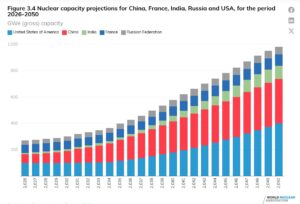
Most of the projected growth will come from countries that already operate nuclear reactors. Existing nuclear countries are expected to account for 1,303 GWe of the projected 2050 capacity. New nuclear entrants could contribute another 154 GWe.
Five countries — China, France, India, Russia and the US — are projected to account for a combined 986 GWe by 2050.
China is particularly important to the near-term outlook. Nine of the 11 reactors that began construction in 2025 were in China, with the remaining two in Russia.
India also has ambitious plans. The country currently has around 8 GWe of nuclear capacity, providing approximately 3% of its electricity. Its government is targeting 100 GWe by 2047, which would require a major increase in construction and industrial capacity.
Meanwhile, new entrants are beginning to expand the geographic reach of nuclear power. The report expects countries without operating reactors in 2026 to collectively reach 154 GWe by 2050.
The Nuclear Buildout Needs to Accelerate
This is where the outlook faces its biggest challenge.
The industry started construction on 11 reactors in 2025, matching the previous year’s total. However, the World Nuclear Association estimates that construction starts would eventually need to reach around six times current levels by the mid-2030s to achieve the tripling objective.
Construction times also vary considerably.
China’s Zhangzhou 2 reactor reached the grid after 62 months, while India’s Rajasthan 7 took 163 months. The report links China’s shorter construction period to its active programme of standardized reactors built in series.
That difference illustrates one of the central lessons of the report: building reactors repeatedly can preserve expertise, strengthen supply chains and allow developers to apply experience from one project to the next.
Countries that build reactors only occasionally face a different challenge. Long gaps can result in the loss of skilled workers and institutional knowledge, while each new project can effectively become a first-of-a-kind undertaking.
Keeping Existing Reactors Online Matters
New construction is only one part of the nuclear expansion strategy.
Currently, 401 GWe of the 423 GWe of nuclear capacity are operating. It could still be in service in 2050 under its operating-life assumptions. Of that amount, 230 GWe would come from reactors operating between 60 and 80 years.
That makes lifetime extensions particularly important.
Furthermore, 46 reactors had already been operating for more than 50 years as of August 2026. Their continued performance demonstrates that reactor age alone does not necessarily prevent reliable operation.
For countries seeking to increase low-carbon electricity quickly, extending the life of existing reactors can therefore complement new construction.
Financing, Fuel and Supply Chains Are Critical
Despite stronger government support, nuclear projects face high upfront costs and long development timelines.
The report argues that financing must move beyond one-off project structures toward repeatable programmes. Governments can reduce investment risk through long-term policy commitments, revenue frameworks, public-private partnerships and appropriate risk-sharing mechanisms. Multilateral development banks and export credit agencies could also help attract private capital.
At the same time, the nuclear supply chain will need to expand. Tripling capacity would require additional manufacturing, construction, specialist engineering, transportation and nuclear-qualified suppliers.
Uranium supply is another potential bottleneck. The report warns that nuclear expansion will require significantly more uranium and says exploration and mine development must accelerate because new projects can take years to develop. Fuel-cycle capacity for conversion, enrichment and fabrication will also need to grow ahead of demand.
SMRs Could Broaden Nuclear’s Role
Small modular reactors could eventually complement large conventional reactors.
The report says SMRs may simplify project delivery, reduce capital requirements per unit and support more flexible financing models. Factory manufacturing and modular construction could also encourage standardization and potentially shorten construction schedules.
However, most SMR designs still require further licensing, demonstration, and first-of-a-kind deployment. Therefore, large reactors are expected to provide most of the capacity added through 2050, even if SMRs become increasingly important.
Nuclear’s role could also extend beyond electricity. Advanced reactors could provide industrial heat, district heating, desalination and energy for synthetic fuels and other hard-to-abate applications.
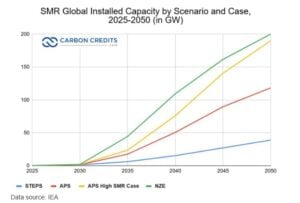
The International Energy Agency (IEA) also expects strong long-term growth. In its Announced Pledges Scenario, the IEA predicts over 1,000 SMRs to be used worldwide by 2050. This would add up to about 120 gigawatts (GW) of capacity. It also estimates SMR investment could rise from about $5 billion today to more than $25 billion by 2030.
Nuclear’s 2050 Goal Depends on Delivery
The World Nuclear Outlook 2026 presents a clear contrast between ambition and execution.
Governments have established enough targets to support a tripling of nuclear capacity. The pipeline is also becoming more concrete, with more capacity moving into construction and planned categories.
But those targets will only translate into operating reactors if countries can solve the practical challenges of financing, licensing, construction, fuel supply, manufacturing and workforce development.
For the energy transition, the potential payoff is significant. Nuclear already provides a large source of low-carbon electricity and has helped avoid tens of billions of tonnes of CO₂ emissions over the past five decades.
The next stage will depend on whether the industry can turn that established climate contribution into a much larger fleet.
The nuclear industry has set the target. Now it needs to build the capacity to deliver it.