Deep Sky & Mission Zero Partner to Turn Canada into A Carbon Removal Hub

Deep Sky, a Canadian carbon removal project developer, and Mission Zero Technologies (MZT), a UK-based Direct Air Capture (DAC) company worked together to deploy DAC facilities in Canada.ย 

The deal marks a significant milestone for the emerging carbon removal industry in Canada. Deep Sky aims to turn the country into a world-leading hub for carbon removal.

First-of-a-Kind DAC Demonstration

The Montreal-based carbon removal company is building the world’s first gigaton-scale carbon capture. They seek to remove billions of tons of CO2 from the atmosphere and permanently store it underground.

Deep Sky’s partnership with Mission Zero starts with a first-of-a-kind (FOAK) demonstration of the latter’s DAC technology that captures 250 tons of COโ‚‚ each year. The ultimate goal is to develop commercial facilities that capture 100,000 to 1 million tons of CO2 annually.

The FOAK facility follows successful demonstrations of Mission Zero’s DAC technology in London. The same tech will also be used later this 2023 to produce synthetic aviation fuels and building materials at 2 sites in the UK.ย 

The FOAK demonstration plant will tap into Quebec’s massive source of renewable hydroelectric energy. It will be up next year.ย 

Speaking for their agreement, Deep Sky CEO Damien Steel noted that:

“Mission Zero is a pioneer, establishing a modularized DAC technology that is projected to reduce both energy consumption and cost. With the addition of Mission Zero’s tech,โ€ฆ commercialized carbon removal at scale is within reach.”

Deep Sky will leverage Mission Zeroโ€™s DAC system as part of its Alpha Lab test facility.ย 

DAC is a carbon removal technology recognized globally and identified by the Intergovernmental Panel on Climate Change (IPCC) as critical for meeting global climate targets. By replacing fossil fuels as a source of carbon, it generates both environmental and economic benefits.

How Does Mission Zero’s DAC Tech Work?

Mission Zero Technologies has rapidly grown from lab to pilot by getting support from the worldโ€™s renowned climate VC Breakthrough Energy Ventures and the famous XPRIZE Foundation. Other large companies like Stripe and Anglo American, as well as the UK Government, are also backing up the DAC company.ย 

Mission Zero’s DAC system is also easy to integrate with renewable power sources. It produces high-grade CO2 via its dynamic electrochemical separation technology.ย 

A study revealed that electrochemical methods are a more efficient way of capturing CO2. They use special liquids that can hold more carbon at once, making it even more efficient.

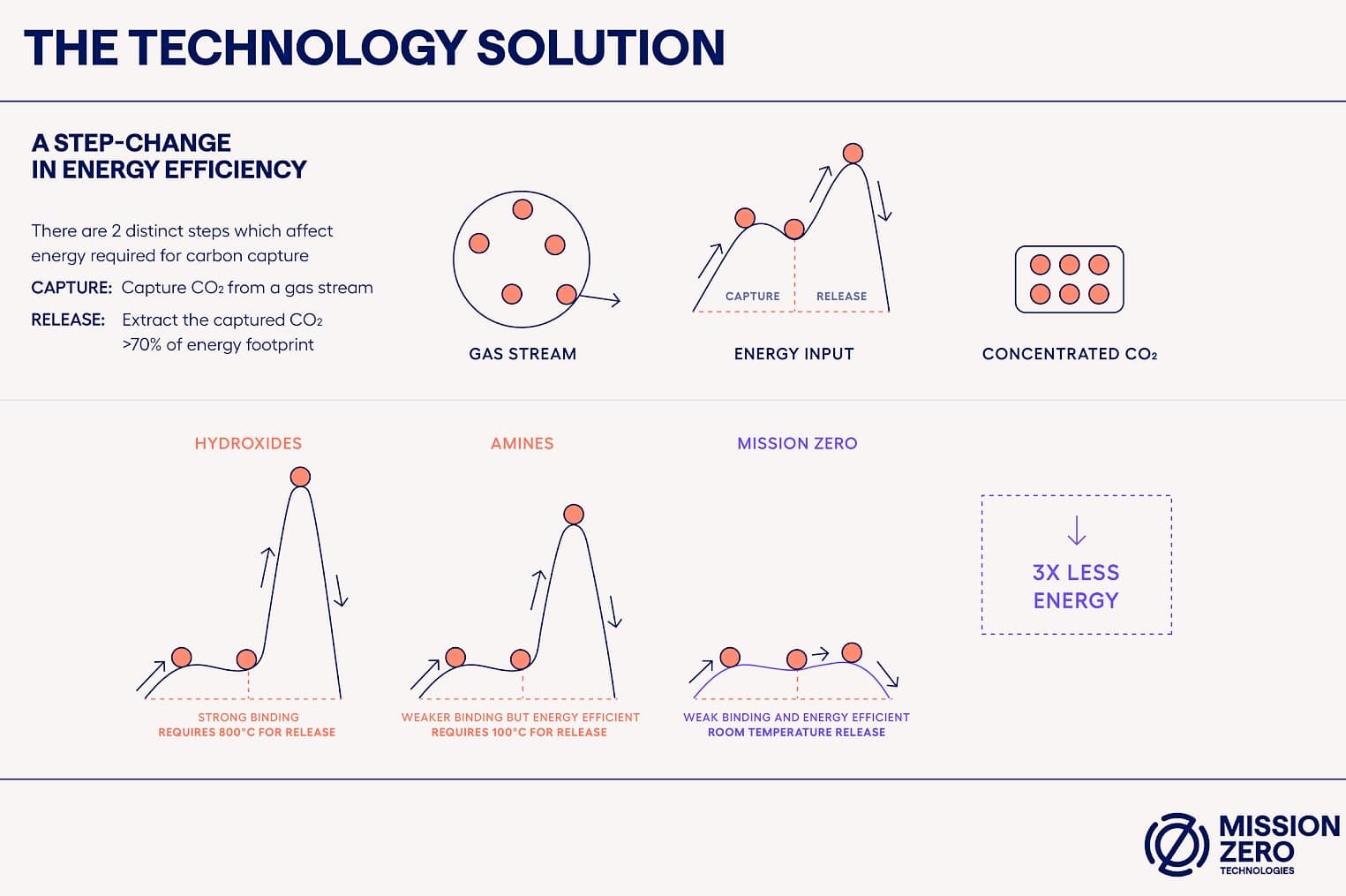
Mission Zeroโ€™s DAC process also leverages existing, scaled and mature technologies, including electrochemical water purification and cooling towers. It also doesnโ€™t need heat, further reducing total energy consumption and uses 3x less energy than other approaches.ย 

Mission Zero DAC technologyMission Zeroโ€™s DAC process is:

Optimized for deployability: itโ€™s compact, modular, electrically-powered, and works under ambient conditions.ย 

Energy-efficient: the process units consume less than 800 kWh/tCO2.

Off-the-shelf: components are off-the-shelf, made in large volumes already.ย 

These properties make Mission Zeroโ€™s DAC technology an ideal choice for Deep Skyโ€™s Lab test facility.ย 

By utilizing mature, off-the-shelf units in a heat-free system, the companyโ€™s technology eliminates supply chain uncertainties while delivering the necessary energy efficiency to rapidly scale this kind of carbon removal after demonstration.ย 

  • Mission Zero Technologies believe that permanently locking COโ‚‚ away into rock through mineralization is the gold standard for carbon removal.ย 

Combining their energy-efficient electrochemical DAC technology with mineralization at scale offers one of the most effective ways to tackle historic carbon emissions. What it needs is to pair it with existing carbon removal systems strategically positioned in the right places.ย 

Deep Sky fits into that requirement.ย 

Per Mission Zero CEO Dr. Nicholas Chadwick, their partnership with the Canadian carbon removal company enriches their โ€œown industry’s understanding of operating DAC in diverse climates and geographies.”

It will also help them expand the application of this crucial carbon removal technology to maximize positive climate impact.ย 

Just last month, Deep Sky announced collaboration with Svante Technologies to study carbon sequestration in Quebec. Itโ€™s the companyโ€™s first venture to assess carbon capture and storage (CCS) technologies as a technological climate solution.ย 

Deep Sky’s collaboration with Mission Zero underscores the growing importance of carbon removal technology in combating climate change. Their joint efforts seek to establish Canada as a significant player in carbon removal, showcasing the potential of DAC for a cleaner, more sustainable future.


Behind Closed NYSE Doors at ICEโ€™s Climate & Capital Summit

Last week, ensconced behind the ornate wood trim molding of the New York Stock Exchange’s 7th floor, luminaries in the realm of climate finance convened for the ICE Climate and Capital Conference, which was in partnership by FINTECH.TV, Accenture and Gitterman Asset Management.

The “AIR” We Should Breathe

This year’s agenda was woven around three pillars aptly acronymed “AIR”: Adaptation, Innovation, and Regulation.ย 

These are the cornerstones that will define the response to the multifaceted challenges ahead: the tangible threats of climate change, impending biodiversity losses, mounting human migrations, and the maelstrom of ever-shifting regulatory edicts.

Jeff Gitterman of Gitterman Asset Management set the stage, unveiling a series of insightful panels and dialogues with leading figures.ย 

The objective was singular and urgent: furnishing attendees with strategies not only to mitigate risk but also to spur innovations. Innovations geared toward reducing emissions and buttressing the world’s most vulnerable against the advancing climate menace.

From the array of expert speakers, three stood out, each illuminating a facet of the way forward.

Lisa Larroque Alexander of SEMPRA weighed in on the financing aspect.

As one of the most prodigious issuers of sustainable debt, SEMPRA feels the pulse of capital costs. Alexander anticipates methane mitigation to be a cornerstone discussion at the upcoming COP28 conference.

She evocatively quoted Churchill, “Weโ€™ve run out of money, now itโ€™s time to think.” This crystallizes the drive to strategize when resources dwindle.ย 

She also expressed keen interest and foreshadowing in how carbon credits might be used post the Inflation Reduction Act (IRA) โ€“ a critical juncture that will mold our financial strategies.ย 

  • With the International Energy Agency forecasting a staggering $10 trillion for essential grid enhancements in the forthcoming years, the roadmap is unmistakable: innovate or stagnate.

Hanh Nguyen of OCI Global articulated her vision for a recalibrated carbon economy. She envisions the Carbon Model Adjustment Mechanism emerging as a pivotal catalyst, much like the EU’s carbon tax.ย 

Her firm belief in the hydrogen economy’s potential resonated.ย 

  • According to OCI, green methanol will surge until 2030, post which e-ammonia, with its pristine zero-emission credentials, will likely reign supreme by 2050.

Lastly, Lesley Biddle, a senior advisor at the U.S. Department of Energy, gave a primer on the tools at the U.S. DoEโ€™s disposal to drive decarbonization.

The Infrastructure Bill, with its potent mix of debt and equity, alongside the Inflation Reduction Act’s provisions of credits and grants, earmarks an impressive $90 billion for deployment by summer 2024. Biddle hinted at a brisker rollout of “Hydrogen Hubs” and underscored the need to augment storage for hydrogen and capture.

The Triad For Fighting Climate Change

As the curtain fell on this year’s ICE Climate and Capital Conference, the takeaway was unequivocal. The triad of Adaptation, Innovation, and Regulation will not only guide but also drive our responses toward encroaching climate adversities. And there is A LOT of money available to companies and entrepreneurs willing to take on and solve these challenges.

It’s not just about grappling with known demons but also about anticipating the unknown, sculpting strategies in real-time, and ensuring a world where vulnerabilities are minimized and resilience is the watchword.

To watch the conference, click here: https://www.ice.com/events/virtual/climate-and-capital-conference-2023

HSBC Commits $1B to Climate Tech Startups Going to Net Zero

HSBC has committed $1 billion to finance climate technologies including carbon dioxide removal globally, helping startups grow and scale their clean solutions. This aligns with the global financier’s pledge to bring its financed portfolio to 2050 net zero emissions.

This funding will support startups focusing on various ranges of climate tech solutions, including electric vehicle (EV) charging, battery storage, sustainable food and agriculture, and carbon removal technologies.

Unlocking Critical Finance for Climate Techย 

The new investment follows two similar programs of HSBC aimed at advancing the cleantech space: HSBC Innovation Banking and HSBC Asset Managementโ€™s Climate Tech Venture Capital. The latter seeks to provide financial support to tech startups that address climate change across sectors like energy, transportation, and agriculture.

The UK-based universal bank and financial services group has also invested $100 million in Bill Gatesโ€™ Breakthrough Energy Catalyst Fund last year. This fund supports green projects worldwide.

Remarking on the $1B pledge, HSBCโ€™s global commercial banking CEO Barry Oโ€™Byrne said:ย 

โ€œAccess to finance is critical for early-stage climate tech companies to create and scale real world solutionsโ€ฆ With HSBCโ€™s global reach, in-house climate tech expertise, we can offer these pioneer companies unrivaled support.โ€

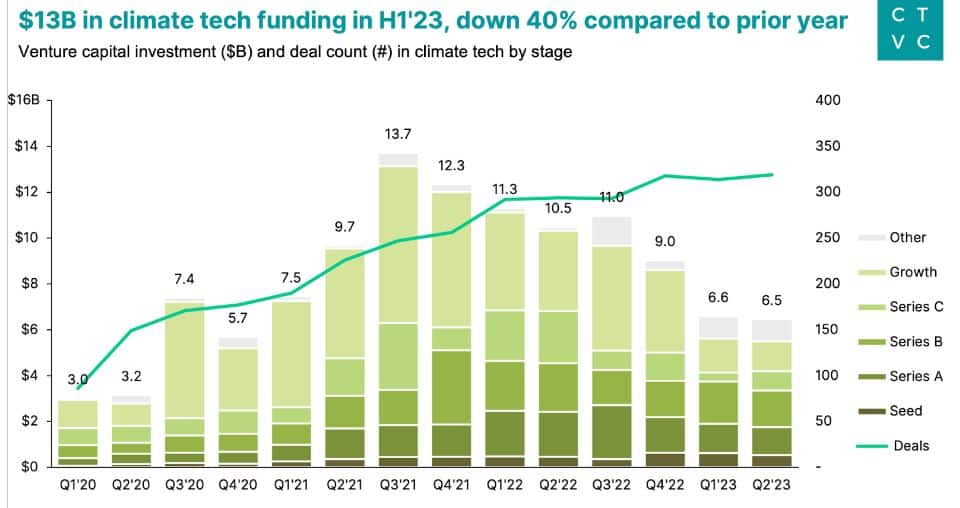
Study shows thatย venture capital (VC) funding for climate startups declined by 40% in the first half of 2023, HSBC noted.ย 

climate tech funding down 40% H1 2023Though it sounds depressing, zooming out to the bigger picture will put things into perspective. There is a total of $117B of venture funding raised by around 2,500 climate tech companies since 2020. The slower growth rate in quarterly results indicates a relative slowdown in overall industry growth. It does not suggest an all-out retreat.ย 

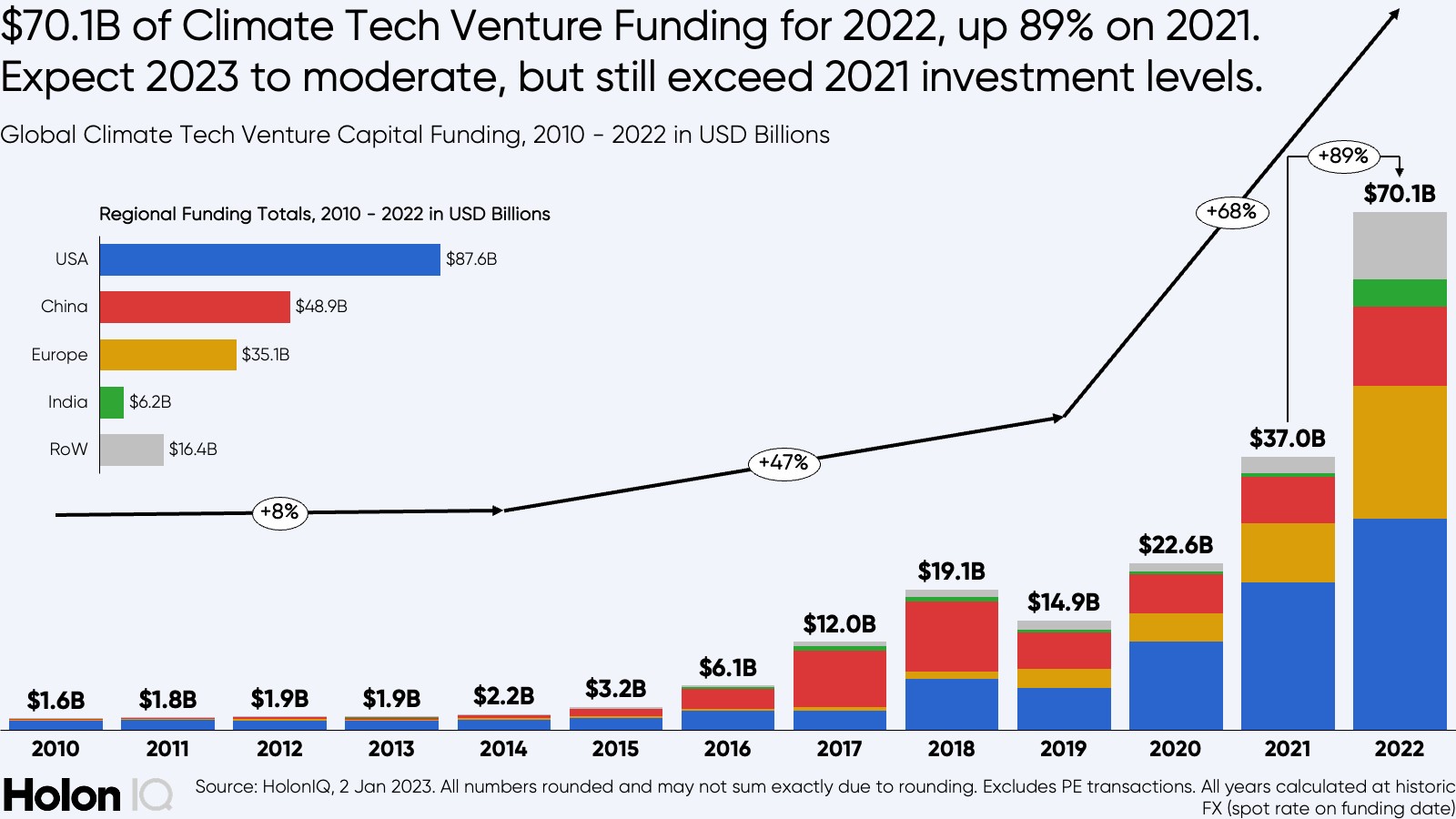
Itโ€™s also worth noting that before this year’s dip in climate tech VC funding, it skyrocketed up to last year. According to HolonIQ, climate tech VC funding reached over $70 billion in 2022.ย 

climate tech VC funding 2022As the bridge to capital markets, VC investors are crucial in helping startups to develop, commercialize, and scale up. While there are various factors at play, supportive policies such as the EU Green Deal Industrial Plan and the U.S. Inflation Reduction Act help ramp up early-stage investments.ย 

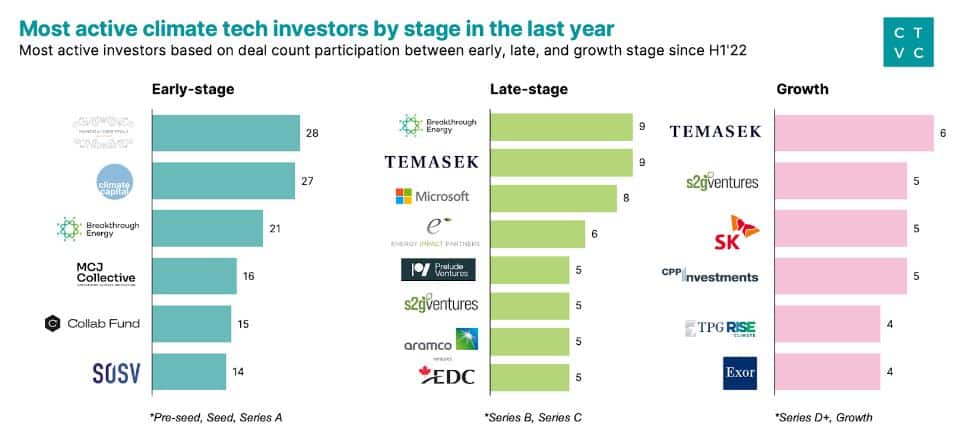
According to CTVC analysis, the most active climate tech investors by stage in 2022 are the following:

top climate tech investors 2022Key strategic investors, such as Microsoft, Aramco Ventures, and SK are frequently participating in Late-stage and Growth funding rounds.

Climate tech startups are in dire need of these investors, especially since the IEA estimated that about 50% of carbon reductions needed to reach 2050 net zero emissions depends on how fast their technologies develop at scale. HSBCโ€™s climate tech VC initiative aims to fast-track the adoption of these crucial technologies.

HSBCโ€™s Climate Action Efforts

The $100M that HSBC allocated will particularly support four major technologies – Direct Air Capture (DAC), clean hydrogen, long-term energy storage, and sustainable aviation fuel.

Earlier this year, the universal bank also joinedย the World Bankโ€™s Private Sector Investment Lab. It focuses on amplifying financing for renewable energy and infrastructure projects.

Last year, it also supported Hong Kongโ€™s Exchanges and Clearing Ltd (HKEX) in developing a global carbon market. In the same year, the banking giant also declared that it would not support projects involving the development of new oil and gas fields.ย 

All these efforts are geared towards HSBCโ€™s commitment to the net zero transition. The bank aims to achieve net zero in operations and supply chain by 2030 and in the financing portfolio by 2050.ย 

To meet these climate targets, HSBC aligns its financed emissions – emissions generated by customers and funded projects – to net zero. And the $1 billion pledge in climate tech startup funding will help make that happen.

HSBC’s financial support for climate tech startups reflects its commitment to tackling climate change. By supporting early-stage businesses and project financing, the bank contributes to developing innovative and clean tech solutions such as carbon removal.

Scaling the Carbon Removal Industry: The Urgent Push for a Greener Future

An analysis by the carbon removal market platform CDR.fyi shows that only 0.5% or 32 companies with Science-based targets have bought durable carbon removal. A separate report by the BCG showed that demand for carbon removal credits must reach 40 to 200 million tonnes of CO2 a year in 2030, or $10 to $40 billion, to meet climate goals.ย ย 

CDR.fyiย is the largest open data platform dedicated to tracking high-permanence carbon dioxide removal (CDR). Their goal is to provide accurate data on CDR to help guide investment decisions and scale up the industry.ย 

The Need to Scale Up

Carbon removal is an emerging industry but is an important component of the fight against climate change.

Businesses need some amount of carbon removals to achieve their net zero goals. Yet, only a number of large companies are onboard the CDR sector and charging to help it scale. Out of almost 6,000 companies with Science-based targets, only 32 of them have bought CDR credits.ย 

Last year, only over 45,000 tonnes of permanent carbon removal credits were delivered, according to the CDR platform. So, to bring it to the level required by 2030, at 40 million tonnes, that figure has to increase by around 1000x.

The growth seems to be lofty to achieve but it’s possible because several companies have existing plans to develop and build facilities that can remove carbon in megatonne level.

Today’s CDR purchases of future tonnes are much higher than deliveries. And these are mostly offtake deals where carbon credit delivery will be for several years. To achieve the 2030 target, CDR credits have to be ordered by 2026 at the latest.ย 

Forecasting the long-term requirement for carbon removals is not easy but the lowest estimates suggest it would be in billions of tonnes by 2050.

In a separate analysis by BCG, the CDR market will continue to be dominated by voluntary demand from large corporations.ย 

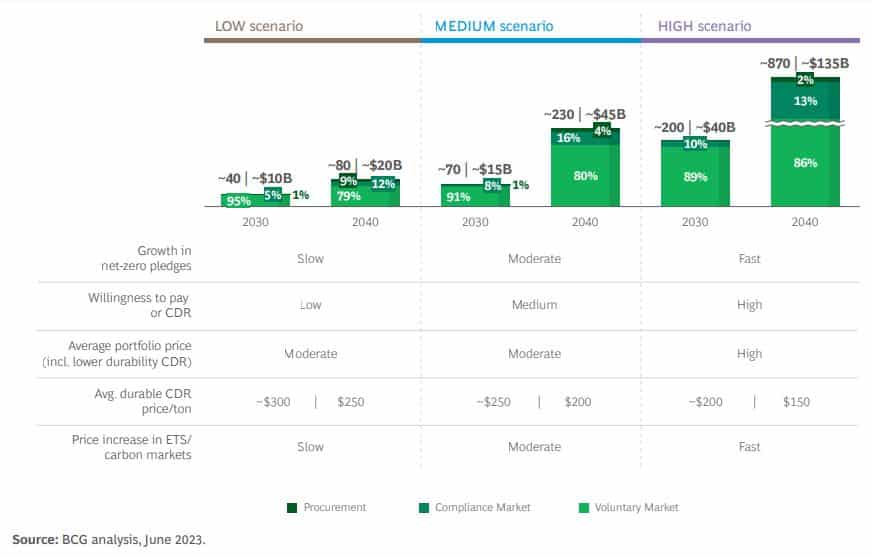
They estimated that demand for durable CDR is projected at 40 – 200 Mt CO2/yr worth $10 billion to $40 billion in 2030, increasing significantly to 80 – 870 Mt CO2/yr or $20 billion to $135 billion in 2040. But thatโ€™s the low scenario projection.ย 

The high scenario, as seen in the chart below, calls for a demand of 200 – 870 MtCO2/yr in 2030 to 2040. That is equivalent to $40 billion – $135 billion market value.

BCG carbon removal demand projection 2030-2040It is, therefore, apparent that thereโ€™s a high need to scale up the CDR industry to meet those projections. The BCG analysis also indicates that while voluntary demand will take up the CDR market, compliance demand will also grow. It will reach around 15% in 2040.ย 

The Pivotal Role of CDR Buyersย 

To achieve the 40 million tonnes of carbon removal capacity by 2030, investment in CDR should be over $100 billion.ย 

However, according to CDR.fyi data, only around 4.8 Mt of CO2 have been purchased to date. But if the growth in CDR purchases this year (10x) and beyond is maintained, it would be possible to reach the 40 Mt capacity.ย ย 

That means the number of large corporate buyers has to increase significantly. From todayโ€™s 6 buyers ordering an average of 100k tonnes, it must grow to 4,000 CDR purchasers.ย 

In this case, buyers of carbon removal credits play a critical role in helping ramp up market growth as well as spur innovation necessary to build a diversified CDR supply chain.ย 

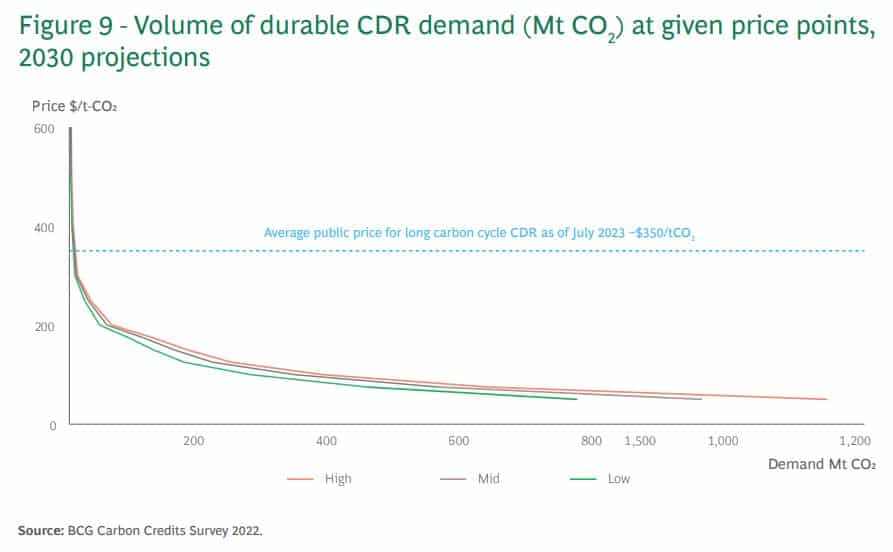
As per BCG report, there will be more diverse buyers as the price of carbon credit drops. Currently, early buyers with corporate net zero pledges such as Microsoft and J.P. Morgan primarily drives CDR demand.

But by 2030-2040, the CDR market can expect to see a broader range of industry buyers if average prices decrease.ย 

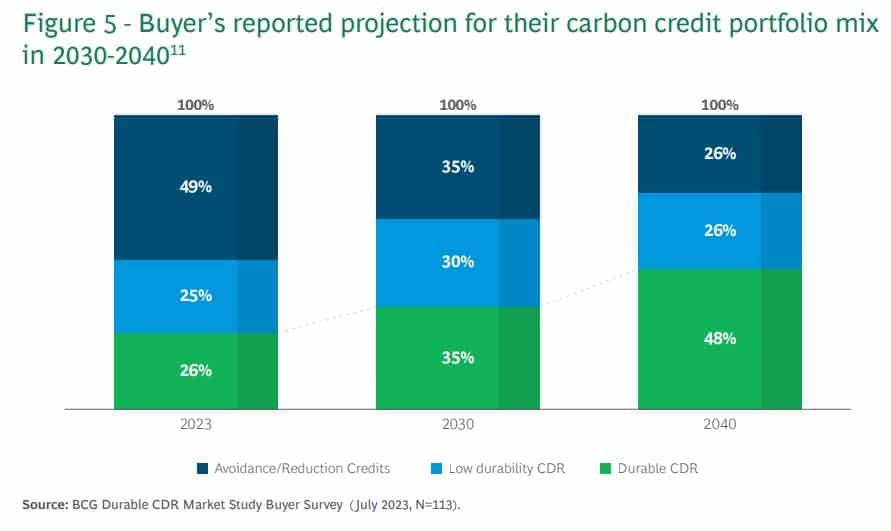
CDR demand volume at given price points 2030 projectionsThe same BCG study revealed that the key driver for most CDR buyers is the quality of the credits. From the current 26% share of durable CDR in carbon credit portfolio mix, it will grow to 35% in 2030 and 48% in 2040.ย 

buyers carbon credit portfolio 2030-2040Moreover, about 70% of them said that they will increase CDR purchases if thereโ€™s guidance from scientific or standard setters.
Recognized bodies such as the Science-based Target Initiative (SBTi) and VCMI can impact purchasing behavior by providing guidance on how carbon removals be included in corporate Net Zero targets. The standards can help facilitate faster project lead times and carbon credit issuance.ย 

Thereโ€™s also a need for clear incentives to attract more buyers of carbon removal credits. In particular, 80% of the surveyed CDR buyers said that their spending will increase with government incentives.ย 

The carbon removal industry is vital for climate goals, but only 0.5% of companies with science-based targets invest in it. Scaling the industry needs more corporate support, government incentives, and guidance from leading organizations.

US Saw $213B Investment in Clean Technologies, Paving the Way for Net Zero

0

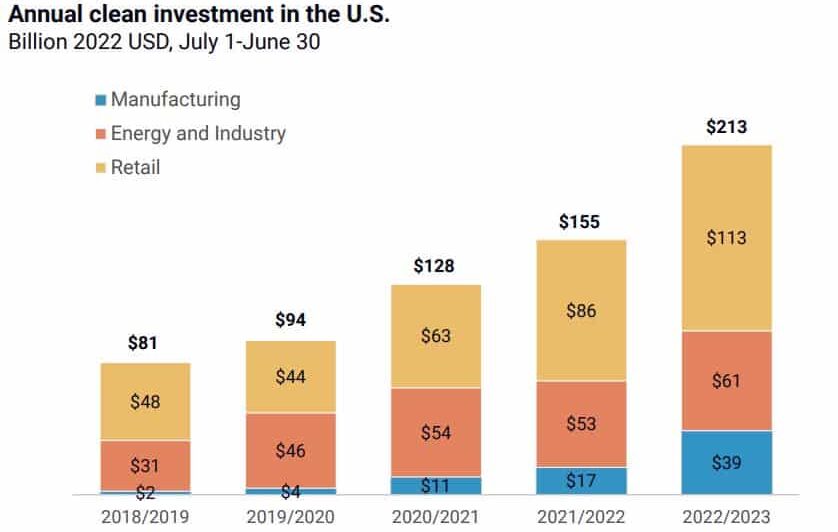
A new database tracking the progress of the U.S. toward its decarbonization journey showed that a total of $213 billion was invested in clean technologies and infrastructure that lower carbon emissions in the last year.ย 

Rhodium Group and MITโ€™s Center for Energy and Environmental Policy Research (CEEPR) developed the database called the Clean Investment Monitor. It tracks real-time all announced private and public investments in the manufacture and deployment of clean energy in the country.ย 

The developer has released an accompanying report โ€œThe Clean Investment Monitor: Tracking Decarbonization Technology in the United Statesโ€. Per Brian Deese who led the team and served as the director of the White House National Economic Council:ย 

โ€œThe Clean Investment Monitor is a tool designed to help us understand and assess this growth in a real-time, comprehensive way. Our hope is that the CIM will enhance research and improve public policies designed to accelerate the clean energy transition.โ€

Clean Investment Trends in the U.S.ย 

Clean energy is increasingly becoming one of the biggest industries in the U.S.ย 

clean energy investment in the US 2018-2023Data from the CIM reveals that from July 2022 to June 2023, clean investments amounted to $213 billion. To put that into perspective, the amount is higher than the annual GDPs of 18 states in the U.S.

The data goes back to 2018 to provide a baseline before the enactment of the legislation in 2021 and 2022.

The $213 billion represents a 37% increase from the $155 billion invested in the previous year and a 165% increase from 5 years ago.

The report included investment data from three categories: manufacturing, energy and industry, and retail.

Manufacturing saw the fastest growth where investment increased by 125% year-on-year since 2021, primarily in EV and solar manufacturing. It reached a total of $39 billion, most of which channeled into battery manufacturing.

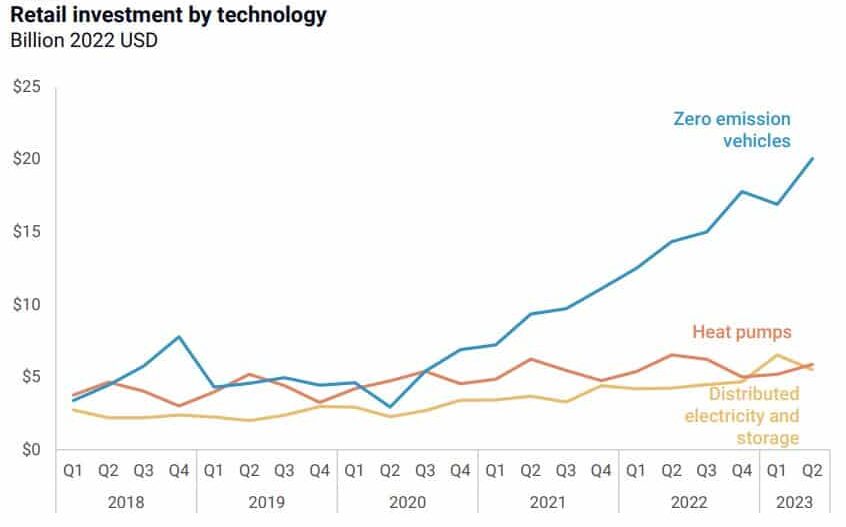
Retail got the most funding, with $113 billion and EVs also received the biggest share of the investments. Other retail segments reported include zero-emission vehicles (ZEVs) and heat pumps. Specifically, ZEVs has the fastest growth, with an estimated $70 billion investment over the past year.

retail investment by technologyThe CIM report also provided investment data in clean energy production, including solar, wind, and nuclear. Investments in clean hydrogen, carbon management, and sustainable aviation fuels increased to $80 billion over the past 2 years. Itโ€™s a 5x growth versus the preceding 2 years.ย 

Laws Advancing Investment in Clean Energy

In the previous two years, the federal government passed a series of new legislation seeking to advance national investment in clean energy. Three of them, as follows, offer subsidies and tax incentives to spur funding for clean technologies that reduce carbon emissions.ย 

It does make sense that ZEVs and batteries are getting the spotlight in these investments. The IRA tax incentives, in particular, promote the manufacture of EV batteries (48C) and clean energy storage (45X).ย 

For instance, in Q2 2023 alone, over $10 billion funded battery technology.ย 

The effectiveness of these climate-related policies in speeding up the transition to a clean economy will be crucial in assessing how the U.S. progresses toward its net zero emissions goals. In the short term, the country aims to reduce carbon emissions by 50% to 52% below 2005 levels in 2030.ย 

A previous analysis showed that the IRA will result in a 43% – 48% reduction in economy-wide emissions by 2035. Without the provisions, the reductions would only be between 27% – 35%.ย 

With that, experts believe that the legislation helps in ramping up the pace of clean investments in the country. Based on the reportโ€™s findings, the funding trend will continue to grow upward, with investments increasing in the coming years.ย 

Rhodium and MIT will update their CIM database quarterly with accompanying reports showing how investment trends are going. Their next report publication will provide insights on the breakdown of public and private investments. They will also provide an initial analysis of how the current pace of funding compares to forecasts when the laws were enforced.ย 

The U.S. has witnessed a substantial increase in clean energy investments, demonstrating its commitment to decarbonization. With substantial growth in manufacturing, energy, and retail sectors, and the influence of climate-related policies, the nation is on a promising path towards its net zero goal.

BASF’s New Plastic Additives Reduces CO2 Emissions by 60%

0

German chemical giant BASF announced the launch of the first biomass balanced plastic additives that can reduce a product’s carbon footprint by up to 60%.

Manufacturing the new plastic additives uses renewable feedstocks instead of fossil fuel-based feedstocks. As such, these novel product solutions can help companiesโ€™ achieve their sustainability targets such as reducing carbon emissions, BASF said.

BASF is the leading innovative global partner for plastic additives, focusing on aligning with customer sustainability goals through its biomass balance approach. As per ISCC Plus (International Sustainability and Carbon Certification), BASF new additives are certified by TรœV Nord for mass balance.

BASF Biomass Balance Approach

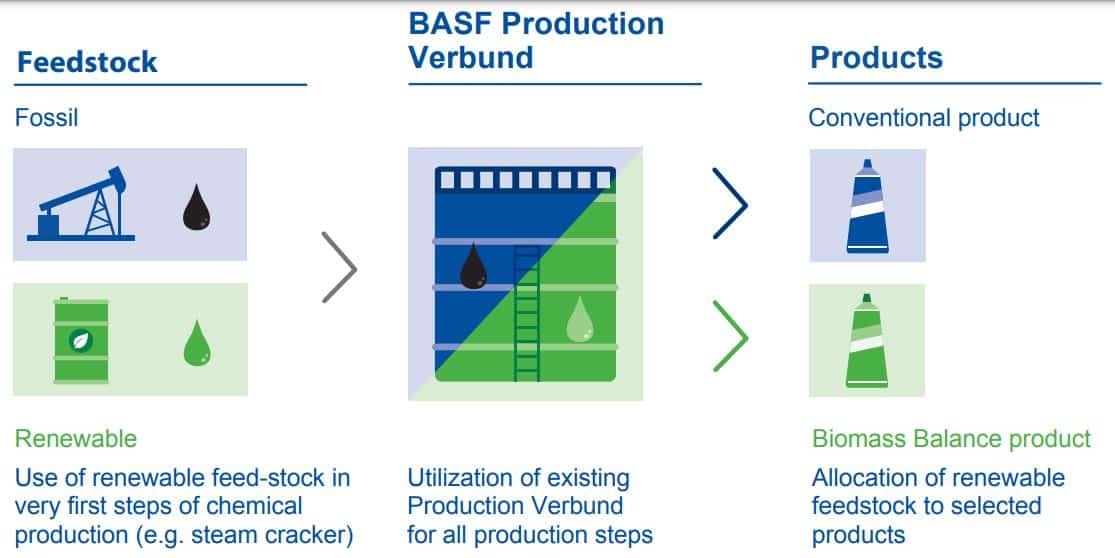
This manufacturing approach is a groundbreaking way of using renewable resources in the chemical industry. BASF uses this approach in its integrated production system and applies it to the majority of its products.ย 

BASF biomass balance approach
BASF Biomass Balance Approach

Under this method, renewable raw materials such as bio-naphtha or biomethane from organic wastes, crops, or vegetable oils are used as feedstock at the very beginning of the Production Verbund.ย 

The BASF Verbund system creates efficient value chains, extending from basic chemicals right through to high-value-added products such as coatings.

The ISCC PLUS certifies this production process. Itโ€™s an international certification program that ensures the chain of custody along the value chain from feedstocks to final product.

The renewable resources used are then allocated to the respective sales products using a 3rd-party verified certification method. The chemical expert markets its biomass balanced products under its BMBcertโ„ข portfolio.

BMBcertโ„ข additives are a part of BASFโ€™s VALERASโ„ข portfolio to create new value for plastics. The first certified biomass balanced plastic additives include the Irganox 1010 BMBcert and Irganox 1076 FD BMBcert.

This first offering will initially be produced at BASFโ€™s site in Kaisten, Switzerland, with further availability in McIntosh, USA in early 2024.ย 

These innovative product offerings are identical to the conventional grades in terms of performance, quality, and regulatory. Thus, customers donโ€™t have to reformulate their products or requalify the biomass balanced plastic additives.

Saving on Fossil Resources and Carbon Emissions

With their sustainably sourced renewable feedstocks, the productsโ€™ cradle-to-gate carbon emission is significantly lowered by up to 60% versus the global average product CO2 footprint of conventional grades.

The certified biomass balanced plastic additives offer customers unique product solutions, along with the following major benefits.

Saves fossil resources: rather than sourcing virgin fossil fuel feedstocks, the additives use renewable resources, thereby saving on fossil resources. The bio-based amount is then allocated to specific products sold by means of the certified method.

Saves carbon emissions: by replacing fossil fuel-based materials with bio-based resources, biomass balanced plastic additives save on carbon footprint. By applying a closed chain of custody, the carbon savings for each product is quantifiable.ย ย 

Independent certification: An independent certification validates that BASF plastic additives have replaced fossil feedstock following the REDcert2 requirements.

Identical product performance: the drop-in solution applies for other BASF products, such as dispersions and superabsorbent. These biomass balanced products have identical formulation and quality but can reduce carbon emissions significantly.ย 

Highlighting these characteristics and benefits of their sustainable plastic additives, Joerg Bentlage at BASF said:

โ€œBy leveraging BASFโ€™s highly integrated global production network of interconnected sites and plants, we are able to produce these industry-first, low carbon footprint, drop-in solutions with the same performance characteristics.โ€ย 

The certified additives thus contribute to global sustainable development by saving fossil resources, reducing carbon emissions, and promoting the use of renewable resources.ย 

BASF’s innovative product solution allows partner companies to meet their sustainability goals without trading off performance and quality, signifying a significant step toward sustainability in the chemical industry.ย 

Ontario Teachers’ Pension Plan Buys Majority Stake in KKR’s Australian Carbon Project Developer

A Canadian pension fund Ontario Teachersโ€™ Pension Plan (OTPP) has agreed to acquire KKR’s stake in a leading Australian carbon markets platform GreenCollar.

KKR acquired the 49% stake in GreenCollar three years ago for $100M. Greencollar is now worth close to $800 million so KKR pocketed a nice return on their investment with this sale to OTPP.ย  This investment marks Ontario Teachers’ deepening commitment to GreenCollar, building upon their initial investment in March 2022.ย 

The pension fund will now hold a significant majority stake in the company, though the financial terms werenโ€™t disclosed. GreenCollar CEO and Co-founder James Schultz will remain as the business leader and a substantial shareholder.

Delivering Positive Environmental Impacts

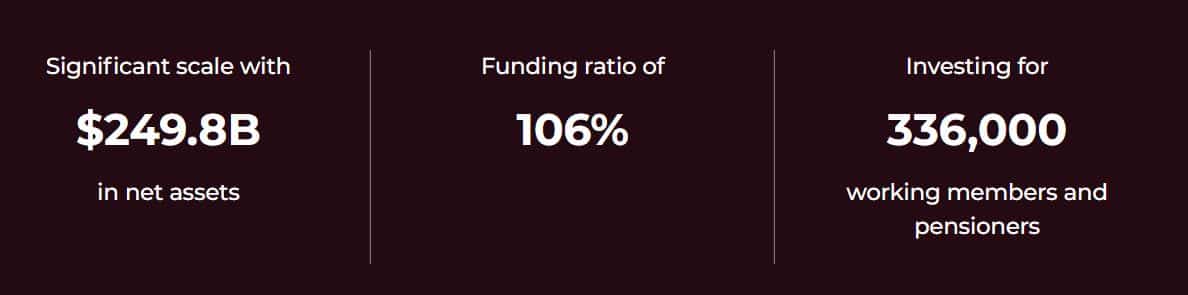
The OTPP continues to look for positive environmental impacts of their investments. As one of the worldโ€™s biggest pension funds, it boasts net assets of C$249.8 billion as at June 30, 2023.

Ontario Teachers Pension Fund latest dataSince their 2050 net zero announcement in 2021, Ontario Teachersโ€™ saw a significant drop in their carbon emissions by shifting to active exposure. Since then, the Canadian pension fund has been investing billions to reach net zero.ย 

OTPPโ€™s climate strategy reflects its commitment to lowering the environmental impact of its portfolio. Its strategies also capitalize on investment opportunities that support the transition to a net zero future. And acquiring KKR’s carbon project developer is one of those decarbonizing strategies.ย 

KKR initially invested in GreenCollar in 2020 as part of its Global Impact strategy, focusing on companies contributing to the United Nations Sustainable Development Goals (SDGs).ย 

GreenCollar, a certified B corporation, aligns with SDG 13 (Climate Action) and supports other sustainable goals like SDG 15 (Life on Land) and SDG 14 (Life Below Water) through its environmental initiatives.

A notable feature of this deal is that GreenCollar will become the first Global Impact Fund investment to implement a comprehensive employee ownership plan. Under the plan, all GreenCollar workers will join to bolster company strength, financial inclusion, and engagement.ย 

They also had about 10% of the private equity, meaning they will be dividing around $75 millionย in cash.

GreenCollar is a profit-for-purpose organization. Itโ€™s the leading environmental markets project developer and investor across the Australian climate, water quality, biodiversity, and plastics markets.ย 

The Australian carbon credit project developer and investor has expanded internationally. The expansion includes forest protection projects in SouthEast Asia, plastic recovery projects in Africa and the Pacific, and cook stove projects in Southern Africa.ย 

Being the largest project developer in the Australian carbon market, GreenCollar handles 220+ projects covering more than 10 million hectares and generating over 126 million Australian Carbon Credit Units (ACCUs). ACCUs are initiatives that avoid clearing vegetation in Australia.ย 

Investing in Carbon Credits as Market-Based Solution

In 2021, Ontario Teachersโ€™ has also supported carbon market developer GreenCollar with a $250M investment, apart from last year’s funding. This alongside KKR investment accounted for about 2/3 of the developer’s shares.

The generated carbon credits are sold by GreenCollar to first and secondary markets.

OTPP supports GreenCollar because they see the positive impact of its carbon credit projects which align with their return goals.

In this new transaction, the Ontario Teachersโ€™ Natural Resources group will manage the investment. Operating within the Infrastructure and Natural Resources department, the group boasts extensive experience investing in various environmental sectors, including agriculture, aquaculture, timberland, and natural climate solutions.

Remarking on their new deal, Senior Managing Director Christopher Metrakos said that:

โ€œWe are pleased to increase our investment in GreenCollarโ€ฆ a proven leader in delivering positive environmental outcomes with market-based solutions and we are excited to continue supporting the company in its next chapter of growth in Australia and beyond.โ€

In Australia, KKR has invested across sectors including financial services, healthcare, infrastructure, technology, real estate, consumer goods, etc. since 2007. The global investor has also impact investments in other regions such as in Asia Pacific.

Since 2011, KKR portfolio companies have awarded billions of dollars through broad-based equity programs to 60,000+ non-senior employees. In all these investment programs, a culture of employee ownership is reinforced.ย 

Ontario Teacherโ€™s transaction with KKR will close in the 4th quarter of 2023, pending customary regulatory approvals.

Interests and investment opportunities in environmental programs are growing, with global carbon markets expected to hit $22T by 2050.ย 

Ontario Teachersโ€™ Pension Plan’s expanded investment in GreenCollar demonstrates its commitment to environmentally responsible investments and carbon reduction strategies. If more large pension plans choose to have the same goals as OTPP, the planet will see significant carbon reductions.ย 

Biochar Makes the Grade: Unlocking The Potential of Engineered Carbon Removals

BeZero Carbon has given its first Biochar project the rare โ€œAโ€ rating, only 21 projects of the 350+ projects rated on their platform have an A or an AA rating. This rating is based on a comprehensive analysis of publicly available data and assesses the project against various risk factors, including additionality, carbon accounting, and non-permanence risks.

This pivotal move signifies the maturation of the Carbon Dioxide Removal (CDR) sector and particularly biochar which accounts for over 90% of all CDR deliveries.

The engineered carbon removal sector has been hindered by a lack of transparency and public information and that is set to change.

  • Puro.Earth expects the supply of CDR in the next 18 months to grow by an โ€œorder of magnitudeโ€.
  • The U.S. Department of Energy has plans to purchase up to $35M of CDR credits from a portfolio of CDR pathways consistent with the objectives of the Carbon Negative Shot.

What is Engineered Carbon Removal?

As the world grapples with the climate crisis, there is a growing consensus that large-scale engineered carbon removal is indispensable.

In fact, projections indicate that by 2030, the annual demand for durable engineered carbon removal could range from 40 to 200 million tCO2. Rating the quality of these carbon credits including biochar will help enhance transparency and integrity in the market.

Currently, here are the top 5 carbon dioxide removal technologies available:

Direct Air Capture (DAC)

  • Captures CO2 directly from ambient air using chemical processes.
  • Suitable for long-term storage or utilization in various industries.

Bioenergy with Carbon Capture and Storage (BECCS)

  • Combines biomass energy production with carbon capture technology.
  • Captured CO2 is stored underground.

Enhanced Weathering

  • Spreads crushed minerals on land or in the ocean to react with CO2.
  • Forms stable carbonates, storing CO2 in a solid form.

Ocean Alkalinity Enhancement

  • Increases the ocean’s capacity to absorb CO2 by adding alkaline substances.
  • Also helps to mitigate ocean acidification.

Biochar

  • Involves the pyrolysis of biomass to create a stable form of carbon.
  • Can be added to soil to improve its quality and store carbon long-term.

What is Biochar?

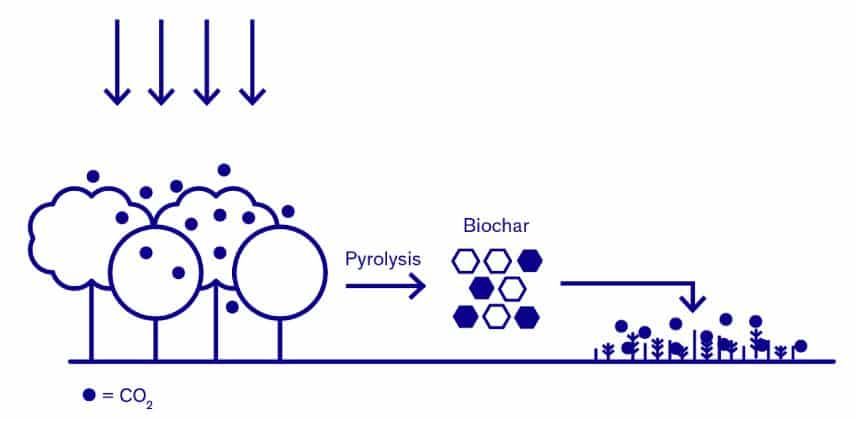
Biochar is a form of charcoal produced from the pyrolysis of organic matter, usually plant-based materials like wood, crop residues, or manure. Its molecular structure changes to a more stable form, thus storing carbon much longer than biomass feedstock.

what is biochar

Key Advantages

Stable Carbon Storage: Biochar is highly stable and can remain in the soil for hundreds to thousands of years, effectively sequestering carbon.

Soil Fertility: When added to soil, biochar can improve water retention, nutrient availability, and microbial activity, thereby enhancing agricultural productivity.

Waste Utilization: Biochar can be produced from agricultural and forestry waste, providing a way to utilize these materials while reducing methane emissions from decomposition.

Energy Co-Production: The pyrolysis process also generates heat and syngas, which can be an input for energy.

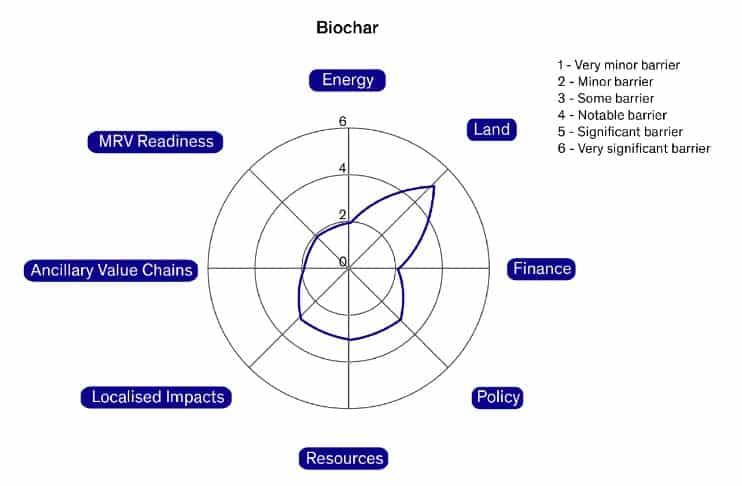
Earlier this year BeZero Carbon found that biochar encounters fewer obstacles to scaling compared to other methods under consideration.ย 

Notable advantages for biochar include third-party verified methodologies, cost-effectiveness, well-developed ancillary value chains, and the potential for energy production.ย 

biochar advantages

Biochar: The Market Leader

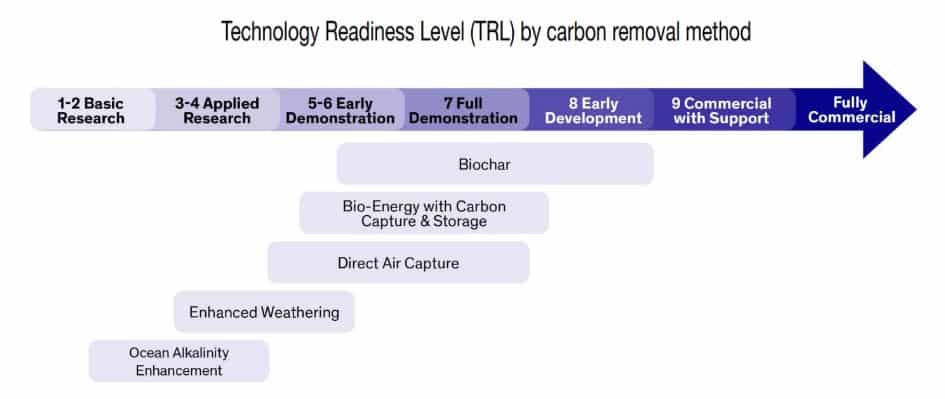
Biochar is at the forefront of the ex post technological carbon removal market; it is furthest along the Technology Readiness Level (TRL) of all carbon removal methods.

technology readiness level of CDR methodsAs a product of pyrolysis, a high-temperature, low-oxygen process, biochar has the ability to store carbon for extended periods, far surpassing its original biomass feedstocks.ย 

The process also generates waste gasses that can be useful as waste heat in district heating networks. Biochar’s versatility extends to its use as a soil amendment, a feed additive, and even as an input in concrete production.

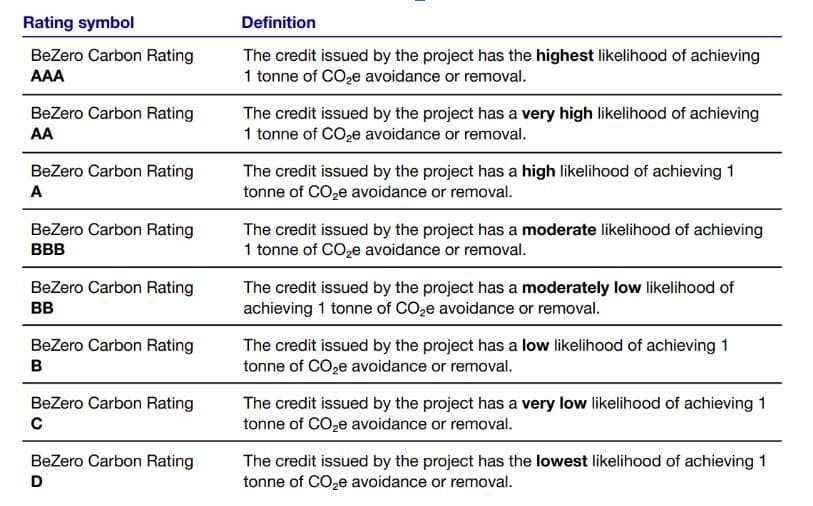
‘A’ Rating: A Benchmark for Excellence

BeZero Carbon rating frameworkBeZeroโ€™s โ€˜Aโ€™ carbon rating is based on the rating analysis of publicly available information. Carbon credits rated โ€˜Aโ€™ have a high likelihood of achieving 1 tonne of avoided or removed COโ‚‚e. This biochar rating assesses the project against BeZeroโ€™s risk factors.

Carbon Credit 3rd-Party Verification

In the Voluntary Carbon Market (VCM), third-party verification is a fundamental aspect of the carbon credit process. It serves as the initial step in confirming that a carbon removal activity has occurred.ย 

There are two ways to perform verification:

  1. Developing an internal methodology that is subsequently verified by an external auditing service
  2. Adopting methodologies established by third-party standards-issuing organizations.

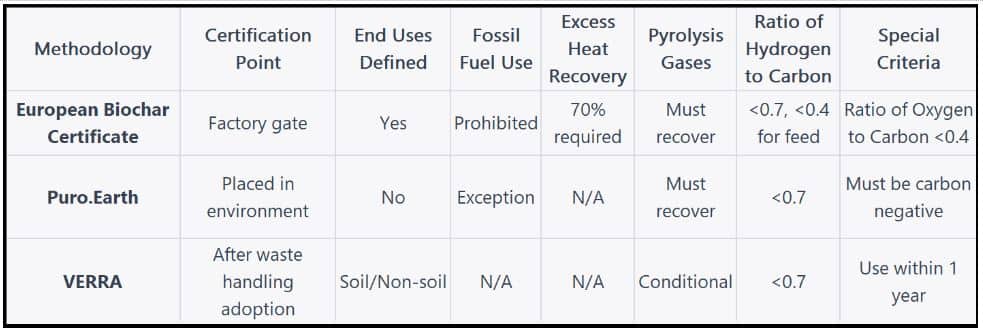
Currently, key third-party methodologies available for Biochar include the European Biochar Certificate, Puro.Earth, and the Verified Carbon Standard.

third-party methodologies verification for biocharA lower hydrogen to carbon and lower oxygen to carbon ratio generally means the Biochar is more stable and less likely to break down, making it better for long-term carbon storage.ย 

As the CDR sector gains momentum, biochar stands out as a key solution for long-term carbon sequestration and soil improvement. BeZero Carbon’s ‘A’ rating for a biochar project underscores the growing importance and effectiveness of engineered carbon removal in addressing climate change.

Stalled but Profitable: How Fortune 500 Companies Miss Climate Targets Yet Earn Billions More

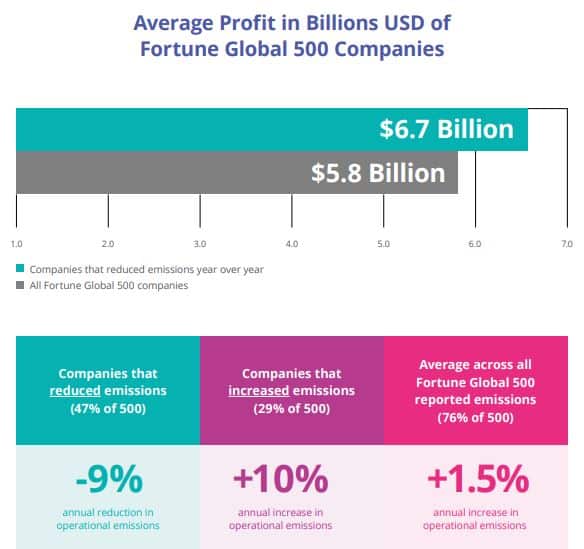
A study by a leading global carbon finance organization, Climate Impact Partners, revealed that the climate commitments of Fortune Global 500 companies are stalling. The report also showed that businesses that reduced emissions earned about $1 billion more in profit than those that didnโ€™t.ย 

Amid the rising global warming, urgent action from the world’s largest companies is crucial in meeting global climate goals.ย But thereโ€™s no increase in the number of companies with 2030 targets and thereโ€™s only a 3% increase in those that have 2050 commitments, the study found.ย 

Climate Impact Partners develops and delivers high-quality and high-impact carbon-financed projects for climate action. The company committed to delivering 1 billion tonnes of emissions reductions, supporting 600+ carbon removal and reduction projects worldwide.ย 

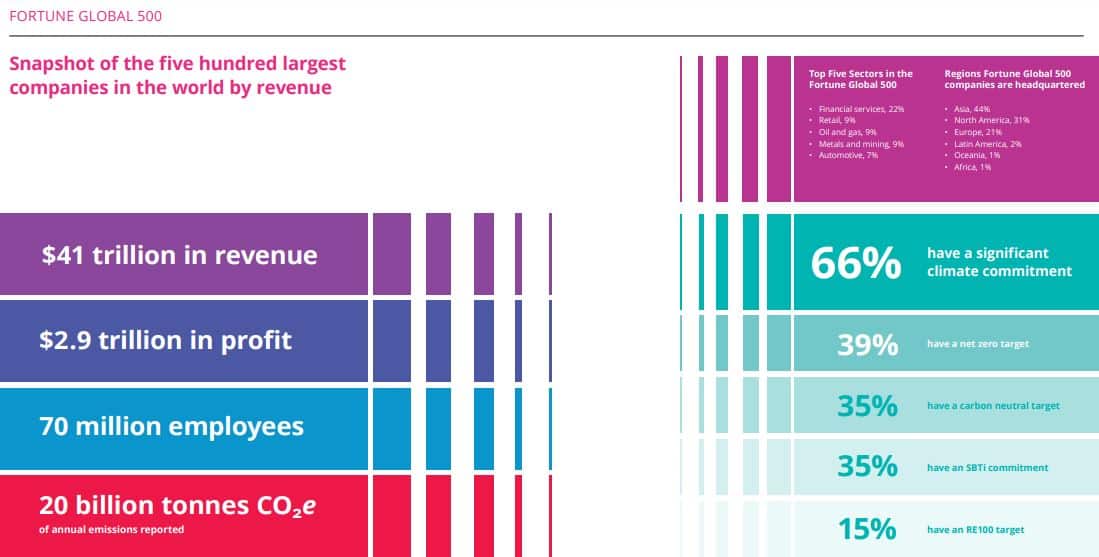
Fortune 500 companies covered in the study are defined as follows:

Fortune Global 500 companies

More Companies Report Emissions and Targets Lead to Reductions

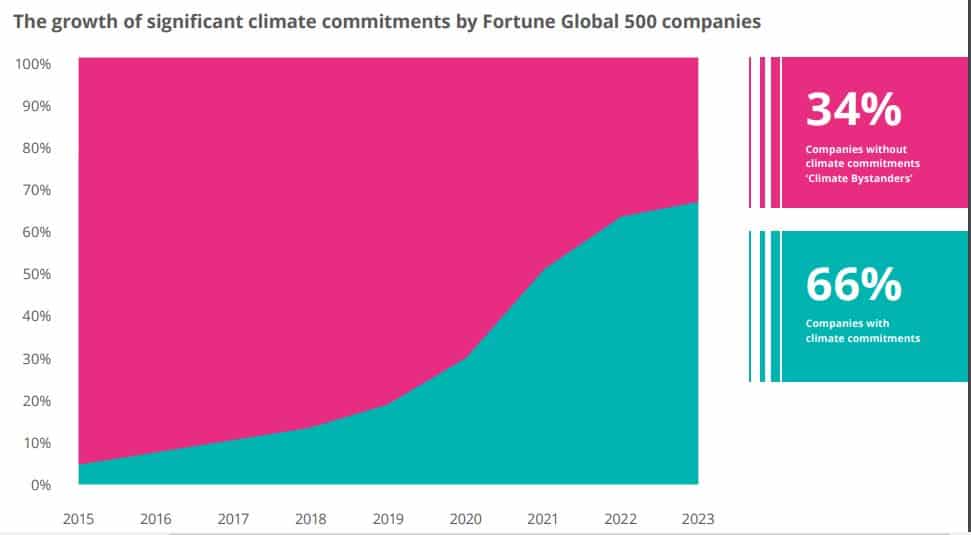
There has been a steady rise in corporate climate commitments but the number of Fortune Global 500 businesses with a significant climate commitment has stagnated at around 66%.ย 

Fortune 500 companies with climate commitmentsThough commitments are sluggish, carbon emissions continue to rise. But lowering emissions isnโ€™t just good for the environment, but it also pays off financially for the companies. Those who reported annual emissions reductions also profited about $1 billion more than their peers (climate bystanders).ย 

Fortune 500 with reported emissions earn $1B moreRemarking on the reportโ€™s findings, Climate Impact Partners CEO Sheri Hickok noted that the lack of climate commitments is concerning. But she also said that

โ€œAt this critical juncture, we need companies to lean in, not pull away. The good news is that we have found clear markers for the companies making the most positive impact on emissions today, serving as an example for others to follow.”

One major marker is that more top-earning companies are now reporting their carbon emissions.ย 

  • 76% of the companies are reporting annual emissions year over year, with 55% reporting some form of Scope 3 and 23% completing Scope 3 reporting.

Scope 3 emissions account for 90% of the companiesโ€™ total reported footprint.ย 

Fewer than 5 in 10 Climate Bystanders report any emissions data while over 9 in 10 companies with commitments do. Most of the Fortune 500 companies that report complete Scope 3 emissions also have significant climate commitments.

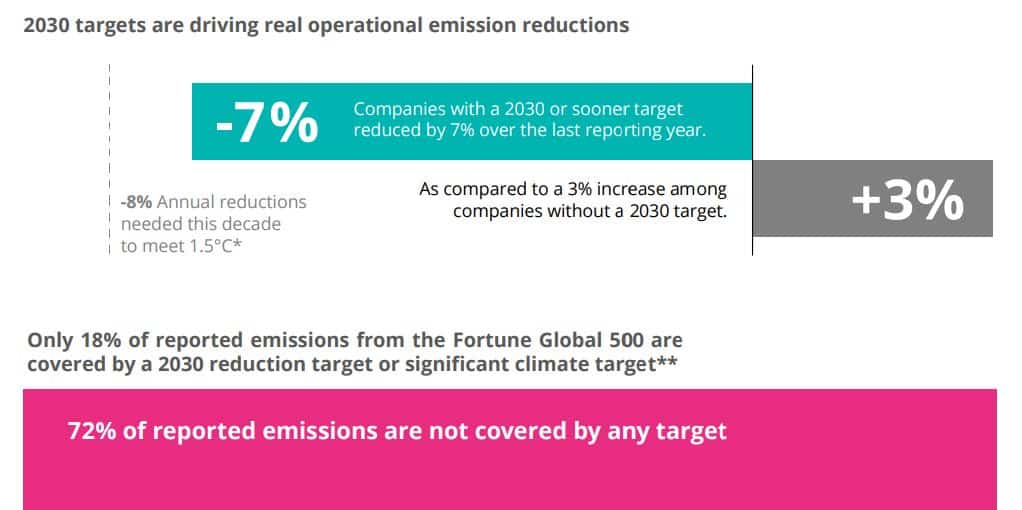
Another notable marker is that setting 2030 climate targets leads to significant emissions reductions. Businesses with a 2030 or sooner target managed to lower operational emissions by 7% year over year.ย 

2030 targets lead to emission reductionsOverall, 42% of companies have a 2030 climate target, but those targets only cover 18% of total reported emissions. This leaves 72% of reported emissions not covered by a significant climate target as only 38% of Fortune 500 have commitments involving their Scope 3 emissions.ย 

CSOs Drive Earlier Climate Targets

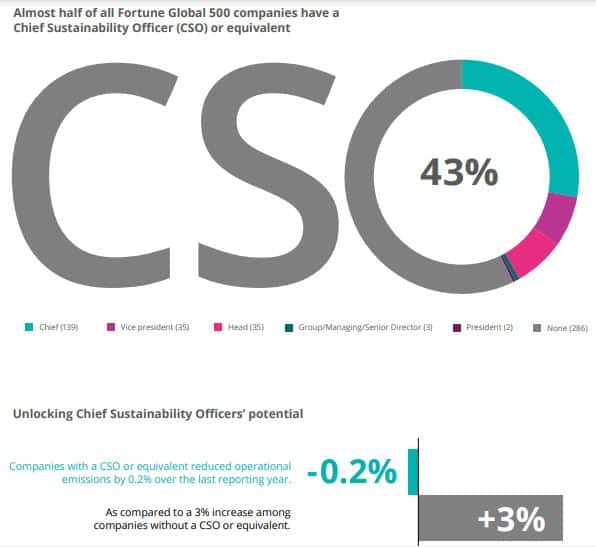
The report also discovered that 43% of top companies have a Chief Sustainability Officer (CSO) or equivalent. With these officers in place, businesses set net zero, carbon neutral, and other climate commitments sooner, 7, and 3 years respectively.

Fortune 500 CSO

Climate bystanders, those without set targets, and without a CSO reported an increase in emissions by 3%. Thus, this new sustainability role โ€œis expected to increasingly deliver greater impactโ€, the report said.ย 

Thatโ€™s mainly because CSOs aid companies in developing more ambitious climate targets and action plans than those without.ย 

Lastly, the study concluded that Europe leads the way with 108 out of 112 Fortune 500 list with climate pledges.ย 

The U.S. and China have the most businesses in the surveyed companies. 74% of top companies in the U.S. have voluntary climate goals while only 15% of those in China have.ย 

Between net zero and carbon neutral pledges, net zero goals are more popular among new commitments across Europe and North America; carbon neutral targets are preferred in Asia.ย 

While corporate climate commitments remain stagnant, this study emphasizes the financial benefits of emissions reductions for businesses. With urgent action needed to address global warming, this report serves as a call for companies to lean into climate action and explore the financial gains of reducing emissions.

Carbon Credit Investments Surpass $36B, But $90B Gap Looms for 2030 Climate Targets

A report by Trove Research revealed that thereโ€™s a total of $36 billion invested in carbon credit projects from 2012 to 2022, accelerating with more than $18 billion raised in the last 2.5 years. But global efforts are still short of $90 billion to meet the 2030 carbon reduction targets.

Investments in developing carbon credit projects are an important market signal indicating levels of corporate climate action.ย 

However excessive criticism of quality may deter companies from engaging in their voluntary commitment to support carbon credits. This, in turn, may undermine critical voluntary climate actions from large companies.ย 

The new commitment will deliver over a thousand new carbon projects, ranging from forest protection to carbon capture and storage solutions. It will also provide a growing supply of carbon credits that companies can use for their net zero strategies.ย 

Trove Research is a leader in delivering data and intelligence on voluntary carbon market (VCM) and corporate climate pledges.

Carbon Credit Investments Reach $36 Billion

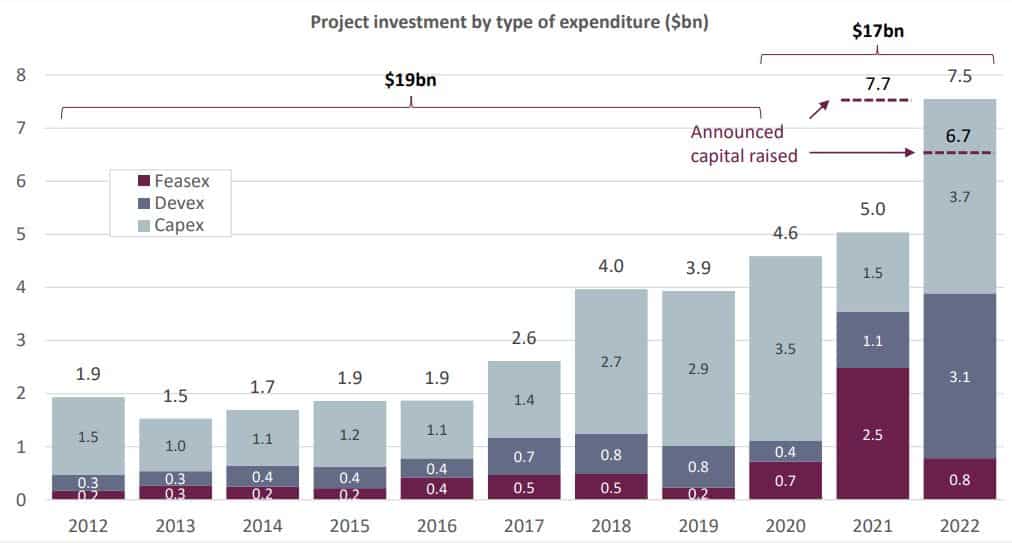
The report also analyzed capital invested in 7,000+ carbon credit projects from 2012 to 2022. Around $36 billion has been invested over this period, with $17 billion in 2021-2023 and $7.5 billion of this investment in 2022 alone.

carbon credit investment by expenditure type
Capex refers to investment in building carbon credit projects; Feasex refers to feasibility-related expenditure; and Devex represents development-related expenditure.

The increase in investment is especially notable in the years from 2020 to 2022 as seen above. This has been fueled by the ballooning interest in using carbon credits by corporations to reach their climate targets. These corporations include the worldโ€™s largest companies.

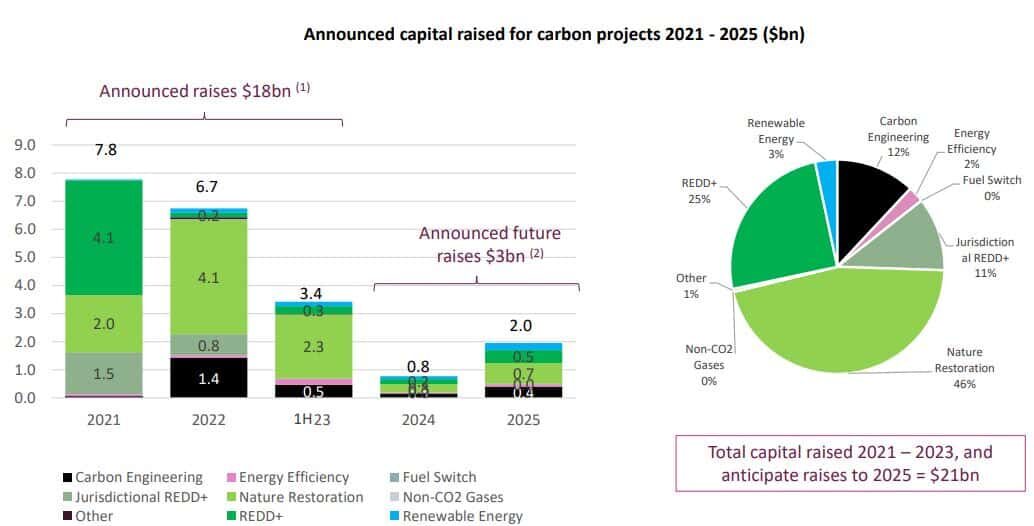
The researchers also examined announced capital raises associated with the VCM since 2021. Results show that a total of $18 billion has been secured for carbon credit funds just for the last two and a half years.ย 

The largest raise was in 2021 with $7.8 billion. And around $3 billion has been committed up to 2025.ย 

announced capital raised for carbon projects 2021-2025Among those raised funding and committed investment, over 80% or $15 billion are for nature-based projects. These include REDD+, nature restoration, and improved forest management. A total of 246 nature-based initiatives cover a total area of 30 million hectares, almost the same size as Italy.ย 

But notably, thereโ€™s a growing share of capital for carbon engineering projects which include Direct Air Capture (DAC) and Bio-energy with CSS (BECCs).ย 

DAC, in particular, has been getting attention both from the private sector and federal government. Billions of dollars have been invested and promised by the U.S. Department of Energy into DAC and other carbon capture innovations.ย 

Bridging the $90B Funding Gapย 

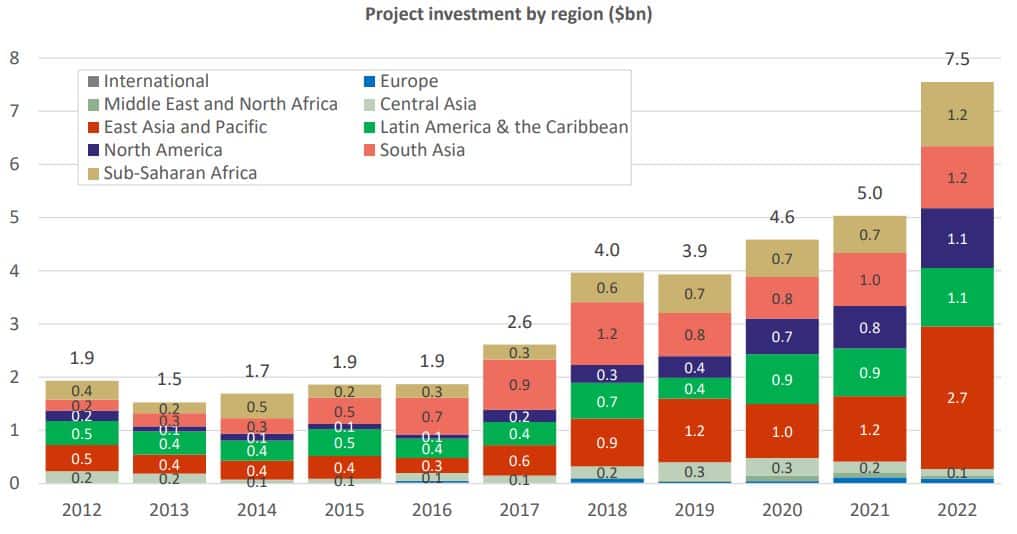
By region, since 2020 North America maintained the top spot as the largest destination for carbon credit investment, accounting for up to 16%. In comparison, only 1% of global carbon credits funding went to Europe.ย 

carbon credit investment by regionIn terms of share, the East Asia and Pacific region got the biggest investment, representing โ…“ or $2.7 billion in 2022. However, the Sub-Saharan African region is keeping pace with its 70% increase in global investment share.ย 

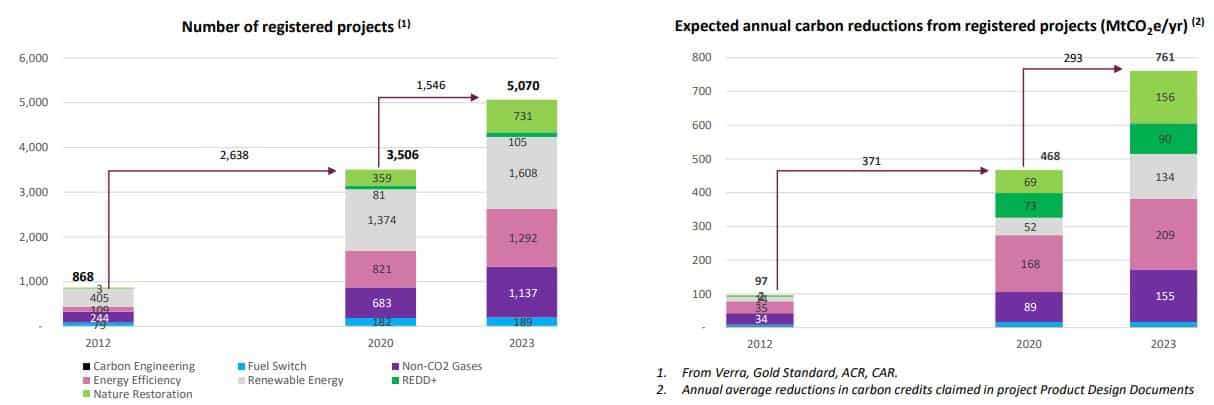
The analysis also showed that since 2020, over 1,500 new carbon credit projects have been developed and registered with the 5 leading carbon registries. It represents a 160% increase in registration rate compared to the 2012-2020 period.

Together, these new projects claim to reduce an additional 300 million tonnes of CO2 annually, or about the same as the UKโ€™s annual emissions.ย 

number of registered projects and expected annual reductionsAmid the growth in the number of registered projects, more than 3,000 additional projects are awaiting registration. Once implemented, together they could reduce another 530 million tonnes of CO2 emissions.ย 

Developments in carbon credit investment are bullish. However, the current commitment is still not enough to satisfy the global 2030 emission reduction targets. In fact, it represents just a third of the total funding needed to realize enough carbon credits by the decadeโ€™s end.ย 

The report said that another $90 billion in capital is necessary by 2030 to meet net zero goals. By 2050, that capital expenditure must grow to a whopping $1,600 billion, or $1.6 trillion, in carbon credit funding to reach the 1.5C scenario. That means a $60 billion annual investment in carbon credit projects.ย 

Investments in carbon credit projects have surged but a significant gap remains to achieve 2030 climate targets. Urgent funding is required to bridge the $90 billion deficit and accelerate the transition to a net zero future.