At DECARBON 2026, leading companies come together to turn ambition into action — demonstrating the innovations and finding collaborations to drive the transition to a low-carbon future.
The oil and gas industry operates through highly complex systems in which upstream, midstream and downstream segments often follow distinct strategies and priorities. Upstream focuses on exploration and production efficiency, midstream prioritises secure and reliable supply routes, while downstream aims to enhance refining performance and reduce environmental impact. Aligning these three sectors towards a single goal — decarbonisation — remains one of the greatest challenges. Reducing emissions across exploration, transportation and refining requires technological innovation as well as cross-sector collaboration and consistent strategic alignment.
For these goals, the Oil & Gas Decarbonisation Congress (DECARBON) 2026 unites global industry leaders from the whole value chain to exchange practical insights and proven approaches that deliver measurable results. Throughout the Congress, companies across upstream, midstream and downstream share their experiences and innovations from P2X technologies and green hydrogen to AI-powered autonomous plants.
In the upstream-focused session, Kuwait Oil Company offers valuable perspectives on integrating energy transition strategies into exploration and production planning. Fayez Al-Mezel, Business Planning Specialist, delivers the presentation about the integration of energy transition into upstream strategies. He addresses key challenges such as capital-cost dispersion, technology readiness and infrastructure constraints. The speaker outlines mitigation measures, including modular pilot projects, standardised designs and verified data management. This approach demonstrates how strategic planning and transparent performance tracking translate decarbonisation ambitions into efficient, cost-competitive outcomes.
In the midstream discussion, LiveEO (Session Sponsor) highlights digital tools that enhance pipeline safety and sustainability. Nick Ferguson, Chief Evangelist, explains that satellite technology elevates pipeline safety. Drawing on a case study, he demonstrates that combining high-resolution satellite imagery with artificial intelligence enables the detection of 73% of previously unidentified threats and improves prediction accuracy by 80%, supporting proactive risk management and streamlined operations.
Kent participates in the dialogue dedicated to downstream decarbonisation, specifically low-carbon fuels and feedstock. Luigi Crolla, Head of Energy Transition Technologies, explores how integrating electrolytic hydrogen and Reverse Water Gas Shift (RWGS) technologies into waste-to-fuel processes enhances Sustainable Aviation Fuel (SAF) yield and reduces carbon intensity. While Kent operates across multiple energy transition domains, its contribution highlights the importance of technological integration in scaling sustainable fuel production.
By bringing together diverse organisations working across and beyond traditional sector boundaries, DECARBON 2026 creates a unified platform for forward-looking conversation. The Congress underscores that decarbonisation is not the responsibility of one stream alone but a coordinated transformation across the entire oil and gas value chain — from production to refining. Explore the full programme and speaker line-up at: https://sh.bgs.group/3hn
ReNew Energy Global Plc, an Indian renewable energy company, announced it will invest about US$9.33 billion (around ₹82,000 crore) in green energy projects in the southern state of Andhra Pradesh. This is one of the largest private investments in renewable energy in the region. The plan aims to expand India’s clean energy capacity while supporting local industries and jobs.
The investment will focus on key areas of renewable energy. This includes solar, wind, energy storage, and green fuel production. India is shifting from just power generation to a full renewable energy value chain. This multi-pronged approach highlights that change.
The Projects Included in the $9.33B Power Play
ReNew Energy’s projects in Andhra Pradesh are diverse. The company will set up a 6 GW solar ingot and wafer manufacturing plant. This facility will produce essential materials for solar panels. By making them locally, India can reduce its reliance on imports and strengthen its domestic solar industry.
In addition, the company will build a 2 GW pumped-hydro storage system. This storage will allow renewable energy to be saved when the sun isn’t shining or the wind isn’t blowing, making the electricity supply more reliable.
A green ammonia facility will also be built, producing around 300,000 tonnes per year. Green ammonia can be used as a cleaner fuel and for industrial purposes, helping reduce greenhouse gas emissions.
ReNew plans to develop 5 GW of hybrid renewable projects combining wind, solar, and battery storage. These projects aim to maximize energy output and efficiency. Together, all these efforts cover manufacturing, generation, storage, and newer forms of clean energy.
Benefits and Local Wins for Andhra Pradesh
Andhra Pradesh has set ambitious renewable energy targets. The state aims to achieve 78.5 GW of solar, 35 GW of wind, and 25 GWh of battery storage. ReNew Energy’s investment will help move the state closer to these goals.
The projects are expected to create over 10,000 jobs, both directly and indirectly. Jobs will vary from factory work at the solar plant to construction, operations, and maintenance of storage and hybrid projects. The investment will strengthen local supply chains. This gives businesses chances to provide materials, transport, and other services.
By producing solar wafers and ingots locally, the state can also reduce dependency on imported materials. This supports both energy security and the development of local industries.
Sumant Sinha, Founder, Chairman, and CEO, ReNew remarked during the announcement:
“ReNew has a long-standing presence in Andhra Pradesh and with this expansion we are bringing a fully integrated clean energy value chain to the state of Andhra Pradesh, from wafer to large-scale renewable projects and storage deployment…We appreciate the leadership and clear policy direction of the Government of Andhra Pradesh, which makes the state a natural partner in accelerating India’s energy transition and sustainable economic growth.”
The world’s third-largest CO2 emitter has the following progress in its renewable power targets.
Source: DowntoEarth.org
Investments like ReNew Energy’s are essential to achieving this goal. They provide not just electricity but also infrastructure that supports the country’s shift away from coal and oil.
The company’s plans show that India is moving beyond simply building solar and wind farms. Making solar parts, building storage systems, and producing green fuels are key steps in creating a complete renewable energy ecosystem. This approach also strengthens India’s position in global renewable energy markets.
ReNew Energy already operates wind and solar plants in Andhra Pradesh, including 717 MW of wind capacity and 60 MW of solar capacity. The new projects build on earlier investments of about ₹22,000 crore (US$2.5 billion) made in May.
The scale of the projects means careful planning is essential. Building factories and large storage systems requires land, permits, skilled workers, and strong infrastructure. Financing will also need to be managed carefully. It is not yet clear how much funding will come from company funds, loans, or government incentives.
Although the announcement is positive, implementing these projects will take years. The company, state authorities, and other stakeholders will need to work closely to ensure timely completion.
Cleaner Energy, Stronger Economy
The investment could bring both environmental and economic benefits for India. Cleaner electricity means lower greenhouse gas emissions. Local manufacturing reduces the need to import materials, which also lowers carbon footprints from transportation.
Economic benefits include job creation, skill development, and opportunities for local businesses. The green ammonia project could support industries that require cleaner fuels. Battery storage and hybrid projects can boost energy reliability. This benefits both households and industries.
ReNew Energy’s Emission Reduction Moves
ReNew Energy has strengthened its sustainability plans as it works toward becoming a net-zero company by 2040. The company aims to cut almost 90% of its total emissions from its 2022 levels, covering all scopes, including its supply chain.
The company is boosting energy efficiency at its sites. It’s also increasing clean power use and swapping out fossil-fuel equipment for electric options. It is also working with suppliers to adopt science-based climate targets and cleaner transport systems.
ReNew has made progress in recent years. In its latest reporting cycle, it reduced 18.2% of its Scope 1 and 2 emissions and helped avoid 18.6 million tonnes of CO₂ through its renewable projects.
Source: ReNew Energy
The company now gets 76% of its electricity from renewable sources. It has also saved over 540 million liters of water by focusing on conservation. ReNew’s targets are validated by the Science Based Targets initiative, reflecting stronger accountability and transparency.
Beyond emissions, ReNew also has broader environmental goals:
It aims to be water-positive by 2030 — meaning it gives back more clean water than it uses.
It targets zero waste to landfill in its operations.
It also aims to make a positive social impact, including having 30% women in its workforce and improving ESG
A Benchmark and Bold Step Toward a Low-Carbon India
If successful, ReNew Energy’s investment could serve as a model for other states in India. Private companies can invest in many areas of renewable energy. This includes manufacturing, generation, and storage. The size of the investment shows trust in India’s clean energy policies. It also highlights the country’s long-term renewable energy market.
ReNew Energy $9.33 billion investment in Andhra Pradesh is a big step for India’s renewable energy efforts. It includes solar manufacturing, storage systems, hybrid renewable projects, and green fuel production.
For the state, the projects offer job creation, energy security, and industrial growth. For India, they support national renewable energy targets and demonstrate the country’s commitment to cleaner energy.
The success of these projects will depend on execution, planning, and coordination among the company, governments, local communities, and supply chains. If done well, it could set a benchmark for future investments and contribute significantly to India’s transition toward a low-carbon economy.
Google has taken another major step toward its clean energy goals by signing a 15-year Power Purchase Agreement (PPA) with French energy company TotalEnergies. Under the agreement, Google will purchase 1.5 terawatt hours (TWh) of renewable electricity from TotalEnergies’ Montpelier solar farm in Ohio.
The 50-megawatt (MW) solar facility, which is nearing completion, will be connected to the PJM grid system, the largest electricity market in the United States. Once operational, the project will supply clean electricity directly to Google’s data centers in Ohio, helping the company reduce its carbon footprint and support local grid decarbonization.
Will Conkling, Director of Clean Energy and Power, Google, said:
“Strengthening the grid by deploying more reliable and clean energy is crucial for supporting the digital infrastructure that businesses and individuals depend on. Our collaboration with TotalEnergies will help power our data centers and the broader economic growth of Ohio.”
Ohio Powers the Next Wave of Data Center Growth
According to S&P Global, data center electricity demand in the U.S. is set to rise sharply — from 75.8 GW in 2026 to 134.4 GW by 2030. This surge is driven largely by the growing adoption of artificial intelligence (AI), cloud computing, and high-performance computing workloads.
In Ohio alone, Central Ohio leads the state with over 100 data centers, including those operated by Google, AWS, and Meta. New projects from companies like Cologix, QTS Data Centers, and Vantage Data Centers continue to expand the region’s energy demand.
This booming digital infrastructure is reshaping the U.S. electricity landscape. Many utilities are now planning for massive grid expansions to support this load growth. Yet, questions remain about how quickly clean energy projects can keep up with the rising power needs of hyperscale data centers.
Source: S&P Global
A Shared Commitment to Building a Carbon-Free Digital Economy
The press release highlights that both companies share a strong commitment to sustainability. The partnership aligns with Google’s 2030 goal for 24×7 carbon-free operations and with TotalEnergies’ strategy to expand its clean power portfolio for digital infrastructure.
Together, they showcase how strategic corporate partnerships can accelerate decarbonization and fuel the clean energy transition.
Stéphane Michel, President Gas, Renewables & Power at TotalEnergies, commented,
“We are delighted to strengthen our partnership with Google with this agreement to supply renewable electricity to their data centers in Ohio. This agreement illustrates TotalEnergies’s ability to meet the growing energy demands of major tech companies by leveraging its integrated portfolio of renewable and flexible assets. It also contributes to achieving our target of 12% profitability in the power sector.”
Corporate PPAs: Driving the Energy Transition
Corporate PPAs are becoming key to cutting global emissions. These long-term contracts let companies buy clean electricity directly from renewable energy developers. By doing this, they skip middlemen and make sure new renewable projects get built.
For companies, PPAs provide steady energy prices and clear proof of their green energy use. For developers, they offer financial security to invest in new projects.
In Google’s case, the deal with TotalEnergies supports its goal to power every data center and office with carbon-free energy from the same grid. This approach goes beyond buying renewable energy certificates or offsets. Instead, it adds real clean energy to local grids and helps reduce emissions where it matters most.
TotalEnergies’ Expanding Renewable Footprint
TotalEnergies is one of the world’s leading integrated energy companies, and its renewable power ambitions are accelerating. By October 2025, the company had reached 32 GW of installed renewable capacity and aims to hit 35 GW by year-end. By 2030, TotalEnergies targets over 100 TWh of net electricity production from renewables.
In the U.S., the company is developing a 10 GW clean energy portfolio, including solar, onshore wind, and battery storage projects. Of this, 1 GW is located within the PJM market and 4 GW in Texas under ERCOT.
The new PPA with Google joins a list of corporate deals TotalEnergies has signed with major firms such as Amazon, Microsoft, Air Liquide, LyondellBasell, Saint-Gobain, STMicroelectronics, and Merck. These partnerships significantly help stabilize project revenues while accelerating the clean energy transition for large industrial and technology customers.
Source: TotalEnergies
Google’s Journey to 24/7 Carbon-Free Data Centers by 2030
Google’s data centers run its global operations but also create most of its emissions. In 2024, Scope 2 emissions hit 3.1 million metric tons of CO₂, mostly from electricity use.
To address this, Google improved efficiency, reaching an average PUE of 1.09—much better than the industry average of 1.56. This means its data centers use 84% less extra energy.
At the same time, Google signed over 8 GW of new clean energy contracts. These solar, wind, and other carbon-free projects help the company move toward running 24/7 on carbon-free energy by 2030.
Source: Google
Solar Energy: The Core of Clean Power Strategy
Solar energy is a cornerstone of Google’s sustainability roadmap. Since 2017, the company has maintained a 100% renewable energy match globally and has now signed more than 170 clean energy agreements totaling over 22 GW of capacity.
Recent highlights include:
A 1 GW solar pipeline in Taiwan, developed in partnership with BlackRock’s Climate Infrastructure business.
A 1.5 GW portfolio of new solar projects across the PJM grid in the U.S., aligned with Google’s data center locations.
Investments that help semiconductor suppliers and manufacturers in Asia decarbonize their operations.
Through initiatives like Project Sunroof and the Solar API, Google is also using AI and satellite imagery to make rooftop solar more accessible to homeowners and developers. In 2024, solar panels installed through partners using Google’s API were estimated to enable 6 million metric tons of lifetime GHG reductions. It’s roughly 6,000 times greater than the emissions produced by the model’s computing energy that same year.
A Blueprint for Energy and Technology Synergy
The Google–TotalEnergies partnership goes beyond energy supply—it shows how tech and clean energy can work together. However, energy equity remains important. Policymakers and utilities must ensure local communities also benefit from clean energy, not just large data centers.
As AI and digital demand grow, scaling renewables will be key. Partnerships like this help lay the foundation for a sustainable, carbon-free digital future.
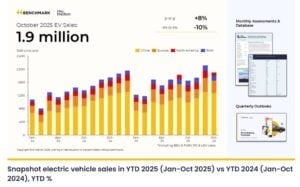
Electric vehicle (EV) sales surged worldwide in October 2025, rising 23% and brushing aside claims of a market slowdown. New data from Rho Motion shows global sales reached 1.9 million units in a single month. This rapid rise highlights a major shift in the automotive world as consumer interest leans toward cleaner transport.
While some headlines suggest fading momentum, the latest numbers show the opposite. EV adoption continues to expand across regions, backed by technology gains, government incentives, and rising environmental awareness.
Source: Rho Motion
Global EV Boom Hits New Highs: What’s Behind It?
China remains the global leader by a wide margin. In October alone, the country sold roughly 1.3 million EVs, accounting for more than half of global sales. The main driver is affordability. The price gap between EVs and gasoline cars keeps shrinking, making electric options attractive to everyday buyers.
China’s Pricing Advantage
Rho Motion data manager Lester noted that China’s pricing advantage makes EVs accessible to millions. Local manufacturing strength, broad incentives, and practical urban mobility policies give China a decisive edge.
Europe’s Clean Transport Policies
Europe showed remarkable growth too. Sales jumped 36% in October, reaching 372,786 units. Countries like Germany, France, and the UK saw major boosts from subsidies and growing concern over emissions. Policies aimed at cleaner transport and climate goals are reshaping buying behavior across the continent. Cultural acceptance of green mobility is rising, and EVs increasingly feel like the new normal for European drivers.
North America delivered a mixed picture. Sales dropped 41% compared to the prior two months after the federal 7,500-dollar EV tax credit expired. Without that incentive, buyers faced higher price tags, which slowed momentum. One analyst noted that the slowdown underscores the importance of incentives for adoption. Yet long-term investments in charging networks and improvements in battery performance continue to support future growth across the region.
Technology and Policy Are Accelerating EV Demand
The EV market’s strength comes from steady technological improvements and ongoing policy action. As of Q3 2025, the International Energy Agency reported that EVs reached 14% of new U.S. vehicle sales in September, the highest rate so far.
Battery ranges now average 293 miles, a 4% improvement over last year. Fast-charging speeds increased 7%, making EV ownership more convenient and reducing range anxiety.
Public charging networks also saw major upgrades in 2025. About 17,000 new charging ports came online this year, a 33% jump. Tesla opened its Supercharger network to most brands, marking a turning point for fast-charging access. With more stations and faster speeds, drivers feel more confident switching from gasoline to electric.
Additionally, education programs, stronger warranties, and better resale options are helping build buyer confidence. For many drivers, switching to electric is becoming a practical choice rather than a risky one.
How EV Growth Is Influencing Carbon Markets
The rise in EV adoption is reshaping carbon markets around the world. Transportation produces about one-fifth of global emissions, so electrification has a direct impact on climate strategies. In Europe and parts of Asia, automakers must buy carbon credits if their fleets exceed emissions limits. Growing EV sales reduce that need, which lowers compliance costs and influences credit prices.
China and the European Union are leading in linking EV adoption to carbon trading. In China, pilot programs reward companies for meeting EV quotas by giving them easier access to carbon allowances. Some automakers are now trading these credits for revenue. One major Chinese EV producer exchanged 10,000 metric tons of carbon credits for 160,000 yuan, showing how electrification creates new economic opportunities.
As EV adoption rises, demand for voluntary carbon credits is also changing. Companies with net-zero goals see new chances in battery recycling, renewable energy projects, and other clean technologies. Because of this, carbon markets are evolving alongside the global shift to electric transportation.
Regional Standouts: Where Growth Is Most Impressive
China’s dominance is clear, but Europe’s rapid climb stands out. Germany delivered record EV sales in October, helping offset declines in gasoline car demand. Analysts at PwC Strategy& noted that steady EV performance has softened the impact of the broader auto slowdown. France and the UK also benefited from fresh incentives and growing consumer interest.
Rho Motion Data revealed the following figures:
Snapshot electric vehicle sales in YTD 2025 (Jan-Oct 2025) vs YTD 2024 (Jan-Oct 2024), YTD %
Global: 16.5 million, +23%
China: 10.3 million, +22%
Europe: 3.4 million, +32%
North America: 1.6 million, +4%
Rest of World: 1.3 million, +48%
Emerging markets surprised analysts as well. EV sales in smaller, developing countries rose 48% year over year. India saw more than 100,000 EV sales in October, worth about 11 billion rupees. These buyers represent a broader shift toward cleaner air and lower ownership costs as local manufacturers release more affordable models.
Key Players Shaping the EV Industry
Automakers like BYD, Tesla, and Volkswagen continue to lead global electrification. Tesla sold more than 22,100 Cybertrucks in 2025, reinforcing its reputation for shaping consumer trends. Fleet operators, public transit agencies, and ride-share companies also increased their EV purchases to meet environmental goals and offset fuel costs.
Consumers themselves are the final force behind EV momentum. Families, professionals, and commuters see clear benefits in lower running costs, cleaner air, and better performance. With better battery ranges and faster charging, many concerns that once slowed adoption are fading.
Experts at the International Energy Agency say EVs could account for more than 60% of new car sales in major economies by 2030.
BloombergNEF also estimated that one in four new cars sold in 2025 will be electric. By 2030, that number could reach more than 40 million units a year. At this pace, EVs may permanently shift global industry economics and shape the future of carbon markets.
China Targets 80% EV Sales by 2030
IEA further reestablished the fact that China will dominate the EV market in the future as well. It’s on track for electric cars and vans to make up about 80% of total sales by 2030.
To keep momentum, China has extended trade-in grants through 2025 and continued the NEV purchase-tax exemption until the end of 2027. The government also plans major charging-infrastructure expansion through 2030, focusing on residential areas, workplaces, industrial parks, and government buildings to match rising EV demand
In conclusion, by 2035, EVs may become the standard choice, supported by stronger carbon markets and broader industry collaboration.
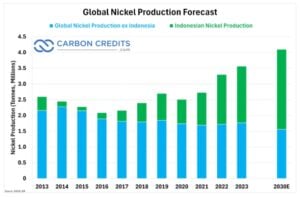
Indonesia has slashed its national nickel mining quota by 120 million tons for 2025. The country’s permitted production will drop from 272 million tons in 2024 to just 150 million tons. As the world’s top nickel producer, responsible for over 56% of global mined nickel, Indonesia’s move immediately shakes global supply chains. The policy also affects carbon markets tied to battery and industrial metals.
The Ministry of Energy and Mineral Resources says the reduction aims to preserve long-term resources and promote environmentally sustainable processing. But the decision carries wider consequences for downstream industries, international buyers, and global nickel pricing.
Why Indonesia Cut the Nickel Quota
Officials cited multiple reasons. First, the government wants to prevent over-extraction and protect strategic reserves. Second, it aims to shift from raw ore exports to higher-value products like nickel matte and Mixed Hydroxide Precipitate (MHP). These processed materials bring more revenue and support the booming electric vehicle (EV) battery sector.
Environmental concerns also played a role. Authorities want stricter compliance with ecological rules to limit habitat loss, water contamination, and other mining impacts. Miners must now meet tighter standards, or their quotas may be reduced further. Mining plan approvals, previously multi-year, are now reviewed annually, increasing regulatory oversight.
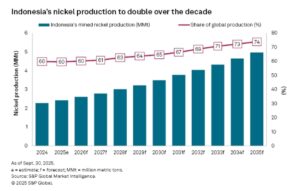
Historically, Indonesia’s quota ranged from 200 to 272 million tons. The 44% reduction in 2025 is unprecedented. However, S&P Global noted that, “Indonesia is still projected to more than double its production over the next decade to an estimated 4.97 MMt by 2035.“
Analysts expect it will address oversupply issues that kept nickel prices in the $14,000–$16,000 per metric ton range this year.
Indonesia’s decision reverberates worldwide. As the “swing producer,” any production change rapidly affects global inventories and prices. Early 2025 saw a temporary price slump from oversupply, but the quota cut is likely to tighten markets and trigger a price rebound.
Macquarie Group Indonesia’s reduction could cut global supply by 35%. This translates to over a third of global supply lost in a single year. Market analyst Adrian Gardner warns that temporary mine closures may occur if prices stay near or below production costs.
Disruption to EV Supply Chains
Nickel is vital for stainless steel and EV batteries. Indonesia supplies over a third of global EV nickel demand, so the quota cut could tighten raw material supply and push prices up. However, growing use of nickel-free alternatives like lithium-iron-phosphate (LFP) batteries—especially in China—may ease pressure. Battery makers and stainless steel producers are now evaluating risks from constrained supply amid strong demand.
Winners and Losers of Indonesia’s Policy
Indonesia anticipates benefits at home. The shift toward processed nickel will attract investment and create domestic jobs. BloombergNEF estimates that local nickel processing and battery plant investments could exceed $15 billion over the next three years.
Export-focused miners face challenges. Smaller operators may see revenue drops, layoffs, and operational hurdles, especially in Sulawesi and Halmahera. Environmental groups have welcomed the move cautiously, urging strict enforcement to ensure promised ecological gains.
International buyers, particularly in China and the West, face tighter competition. China is expected to consume over 63% of primary nickel in 2025. EV and stainless steel manufacturers must secure supply while navigating price volatility.
Implications for Carbon Markets
Nickel’s supply changes have knock-on effects for carbon markets. Green nickel—produced under higher environmental standards—is becoming a key differentiator. Indonesia’s policy encourages cleaner processing methods, which could generate higher-quality carbon credits.
Western companies sourcing “clean nickel” for low-carbon steel and EV batteries may see costs rise. At the same time, the move may attract investment into green mining technology, supporting carbon offset programs.
Supply bottlenecks could increase the price of both nickel and associated carbon credits. Traders and intermediaries may find opportunities in a market that links commodity supply and decarbonization goals.
Nickel Price Volatility and Market Adaptation
The nickel market is already sensitive. Over 20% of global producers operate at a loss at prevailing prices near $15,000 per ton. Cutting a third of global supply may push prices higher and incentivize new investments.
Fundamentals remain complex. Stainless steel production in China rose 12% in early 2025, while battery nickel consumption grew 10–15%. However, total battery demand is still below earlier expectations. Analysts like Mark Selby at Canada Nickel Corp note that Western projects for sustainable nickel are accelerating, especially in Canada, Australia, and Brazil.
This quota cut serves as a wake-up call. Some industrial parks in Indonesia have already reduced external nickel ore forecasts by nearly 30% to adjust to supply constraints.
Will the Market Adapt?
Nickel prices fluctuated through 2025 but stabilized around $15,000 per ton by Q3. The International Nickel Study Group predicts global supply of 27.2 million metric tons versus demand of 27.3 million metric tons—a near balance after years of surplus.
Several factors heighten market risk. About a quarter of global supply operates at or below cash costs, risking mine closures. Chinese stockpiling surged 30% year-over-year, tightening markets further. Meanwhile, demand for EV batteries and stainless steel continues to grow, intensifying competition.
Western governments are investing in alternative sources. North America and Australia are seeing new mines and financing models. Battery makers increasingly prioritize sustainable nickel, adding complexity but promoting lower-carbon supply chains.
Analysts predict global battery-grade nickel demand could double by 2030. If Indonesia’s reduced output persists, competition for raw materials and carbon credits will intensify. Geopolitical and supply chain risks are likely to rise.
Indonesia’s Strategic Pivot and Global Ripple Effects
Indonesia’s decision is more than a domestic policy—it reflects the challenges of critical minerals in the energy transition era. By limiting raw ore output and emphasizing processed nickel, the country is reshaping markets, investments, and carbon credit dynamics.
The reduction affects boardrooms, factories, and carbon markets worldwide. Companies must adapt, governments must secure alternative sources, and investors must anticipate volatility. In a market increasingly linked to decarbonization, Indonesia’s nickel policy highlights the global stakes of sustainable mining and energy transition strategies.
Nestlé, the Swiss food and drink giant, has committed to two major restoration projects in Brazil to generate carbon credits. The company is working with re.green, a Brazilian restoration company, and chocolatier Barry Callebaut on these projects.
They aim to cut down Nestlé’s carbon footprint. At the same time, they aim to restore degraded lands, plant native trees, and support more sustainable supply chains for cocoa and coffee.
Planting Millions: Nestlé’s Brazil Projects
Nestlé’s deal with re.green focuses on restoring roughly 2,000 hectares in Bahia’s Atlantic Forest. Over a 30-year period, the project plans to plant around 3.3 million native trees.
Re.green estimates this will create around 880,000 tonnes of CO₂-equivalent in carbon credits. This is based on a strong ARR (Afforestation, Reforestation, and Revegetation) method.
In a second initiative, Nestlé and Barry Callebaut will work on 6,000 hectares across Bahia and Pará. This project will turn degraded land into a mixed agroforestry system—mainly cocoa trees plus native species.
The plan calls for planting 7.7 million seedlings over many years. This agroforestry system is expected to generate around 600,000 tonnes of carbon credits.
Altogether, Nestlé’s efforts in Brazil cover about 8,000 hectares and aim to plant roughly 11 million trees.
Why This Deal Matters for Climate and Business
This deal is strategically important for Nestlé on several fronts. First, it supports its climate goals. These project credits reduce carbon in the atmosphere. This helps Nestlé aim for net-zero emissions in the long run.
Second, the projects improve Nestlé’s supply chain resilience. Restoring landscapes where the company sources cocoa and coffee helps to keep these regions healthy.
Third, these are not just tree-planting projects. Restoration boosts biodiversity, enhances soil quality, safeguards water resources, and helps local communities. Using native species in the Atlantic Forest helps preserve one of Brazil’s most threatened biomes.
Finally, the deal is a signal of long-term commitment. Nestlé is more than just buying credits. It’s creating nature-based solutions that match its business and environmental goals.
Nestlé’s Roadmap to Net-Zero
Nestlé has set bold climate targets. The company aims to plant 200 million trees by 2030 and achieve net-zero greenhouse gas emissions by 2050.
Source: Nestlé
In its 2024 Non-Financial Statement, Nestlé clarifies that it will not use carbon credits outside its value chain to achieve its main net-zero goals. Instead, it invests in nature-based solutions tied directly to its sourcing regions.
Nestlé uses rigorous approaches to estimate greenhouse gas removals. It accounts for tree growth, species types, soil differences, and uses field data and science-based models. It also meets global standards, like those from the Intergovernmental Panel on Climate Change (IPCC) and the GHG Protocol. This helps ensure transparency and accuracy.
In addition to reforestation, Nestlé partners on regenerative agriculture. For instance, it has a global agroforestry initiative with OFI (Olam Food Ingredients). This program will help 25,000 farmers in Brazil, Côte d’Ivoire, and Nigeria change their farms.
The plan includes planting 2.8 million trees and transforming more than 72,000 hectares into agroforestry systems over time.
These combined efforts show how Nestlé links carbon removal, biodiversity restoration, and sustainable farming to its broader climate strategy.
Nestlé’s Nescafé hit its 2025 target early by sourcing 32% of its coffee through regenerative agriculture in 2024. This gives it a strong lead toward the 2030 goal of 50%.
Source: Nescafé Plan 2030 Report
The company has invested over $1 billion. This supports more than 200,000 farmers on 400,000 hectares. They train these farmers in methods like shade trees, natural composting, and cover crops.
These practices help restore soil health and lower the need for chemicals. They have also cut greenhouse gas emissions by 20-40% per kilogram of green coffee. They also help Nestlé reach its goal of halving production-related emissions by 2030 and achieving net-zero by 2050.
These reforestation deals come amid strong momentum in Brazil’s nature-based carbon sector. The Brazilian Development Bank (BNDES) approved an $85 million loan for ARR projects. These projects should create about 2.47 million carbon credits.
Meanwhile,re.green itself has won fresh financing. It secured 80 million reais (approx. US$14 million) from BNDES, with Bradesco as a financial partner. The deal helpsre.green scale up restoration in key biomes.
Credits from ARR projects in Brazil, especially those using high-quality methods, should trade for around $55 per tonne of CO₂ equivalent. This carbon price can vary based on deal structures.
This shows that both public and private resources are flowing into nature-based carbon solutions. For Nestlé, joining this trend offers both environmental benefits and strategic value.
Impact for Business and Nature
These contracted projects by Nestlé have a significant impact on business and nature:
Credible Carbon Removal: Nestlé is funding long-term restoration projects linked to its supply chain. This helps create high-integrity carbon credits instead of just buying generic ones.
Sustainable Sourcing: Restoring tree cover in cocoa and coffee regions strengthens the ecological base of Nestlé’s ingredient supply.
Corporate Climate Leadership: This move positions Nestlé as a leader in tying net-zero goals to meaningful, nature-based actions.
Market Signal: Big corporate deals like this could drive more investment in restoration. This would boost Brazil’s carbon credit market and increase the supply of high-quality nature credits.
What Could Go Wrong? Nestlé’s Bold Step in Carbon Leadership
While this initiative is ambitious, its success depends on several factors. Tree survival over decades is crucial: saplings must grow, persist, and avoid being lost to fires or land-use changes. Long-term monitoring is needed to make sure the credits represent real removal.
Also, the permanence and additionality of the credits matter. Observers will watch howre.green, Nestlé, and their auditors ensure that the forest does not revert and that the project would not have happened without this financing.
Finally, the social dimension is important. Local communities must benefit, and land rights and governance issues should be handled transparently. Without community support, restoration projects often struggle.
Nestlé’s carbon credit deal withre.green and Barry Callebaut marks a significant and strategic step in its climate journey. Its net-zero strategy focuses on nature-based solutions, backed by careful accounting and long-term commitments. Public and private investors in Brazil’s carbon market are also backing this shift.
If the projects succeed, they could show big companies how to scale regenerative landscapes. This approach can help not only to offset emissions but also to build stronger business foundations.
Indonesia is making one of the biggest moves at COP30 in Belém, Brazil. The government aims to reach about US$1 billion (Rp 16 trillion) in carbon credit deals during the summit. The plan includes around 90 million tonnes of carbon credits from forestry, energy, and industry projects.
This goal is part of a wider plan to grow Indonesia’s carbon trading system. It follows new rules under Presidential Regulation No. 110 of 2025 on carbon economic value. It also comes after the country allowed international carbon trading again, following a four-year pause. These steps show that Indonesia wants to become a major player in climate finance and green investment in Asia.
At COP30, other countries are also stepping up their climate plans and carbon market initiatives. Nations like Brazil, Iraq, Singapore, Kenya, and the United Kingdom unveiled new projects, partnerships, and rules to boost verified carbon trading and ensure benefits reach local communities.
Building Stronger Rules and Partnerships
Indonesia used COP30 to prove it can build a fair and trusted carbon market system. The Ministry of Environment and Forestry introduced four new rules to improve how projects are managed and approved. The changes aim to make sure that money from carbon sales reaches local people, including indigenous groups.
To raise global trust, Indonesia signed new partnerships with leading organizations. It formed a Mutual Recognition Agreement with Verra, one of the world’s biggest carbon credit certifiers. This deal allows up to 50 million tonnes of CO₂ credits to enter global markets.
Indonesia also signed a memorandum of understanding with the Integrity Council for the Voluntary Carbon Market (ICVCM). This will help the country follow global standards for transparency and quality.
Indonesia is presenting 40 carbon projects at COP30. These include forest recovery work, renewable energy plants, and waste reduction programs. Together, they could generate more than 90 million credits once fully certified.
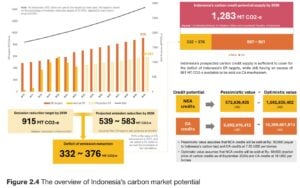
Officials see this as part of a long-term plan. The Forestry Ministry estimates that Indonesia’s carbon credit potential could reach 13.4 billion tonnes of CO₂ by 2050. That could bring yearly income of $2.8 billion to $8.6 billion, depending on carbon prices.
Government estimates show that Indonesia can cut emissions by 31.8% on its own and by 43.2% with global support. Carbon trading could help meet these goals by linking domestic projects with international buyers.
Indonesia’s projects range from mangrove restoration to geothermal power and the low-carbon industry. This diversity makes the country one of Asia’s most promising suppliers of carbon credits. However, success will depend on good governance, fair profit-sharing, and public trust.
If Indonesia reaches its US$1 billion target, it would be one of the largest carbon trade achievements for a developing nation. It could also inspire other countries in Southeast Asia, such as Vietnam, Malaysia, and the Philippines, to follow similar paths.
Global Carbon Moves at COP30: What Other Countries Are Doing
Indonesia is not alone in expanding carbon markets. At COP30, several other countries also announced new plans to link climate action with trade and investment.
Brazil, the host nation, launched an Open Coalition on Compliance Carbon Markets. The group now includes 11 countries, such as China, Canada, Mexico, the United Kingdom, and members of the European Union.
The coalition wants to connect national markets and create shared standards for tracking and reporting emissions. It also aims to stop “double-counting” of credits and make global trading more transparent.
Source: COP30 website
Brazil is working on its own national cap-and-trade system that will cover energy, transport, and industry. Officials say the plan will help the country use its vast forests to generate high-quality credits. They also promise that indigenous and local communities will share in the profits from these projects.
In the Middle East, Iraq announced its first national carbon market during COP30. This is a big shift for a country still dependent on oil and gas. Iraq plans to use carbon market funds to support renewable energy, modernize infrastructure, and cut emissions from heavy industry. It hopes to attract international investors to help build new low-carbon projects.
Meanwhile, the United Kingdom, Kenya, and Singapore launched a joint campaign to grow corporate demand for trustworthy carbon credits. Their goal is to set clear rules for how companies buy carbon offsets and ensure that every credit represents a real emissions cut.
Singapore is already one of Asia’s key carbon market hubs. It runs the Climate Impact X exchange and has signed several carbon trade deals under Article 6 of the Paris Agreement. The country acts as a bridge between credit producers in Southeast Asia and buyers in major financial markets.
Kenya is focusing on fairness and inclusion. It wants to make sure that African countries and local communities get a fair share of income from carbon projects. The country is building its own carbon credit export system based on lessons from other African nations.
Together, these efforts show that countries are now moving from promises to action. Each one is shaping its carbon market plan based on its strengths—Brazil’s forests, Singapore’s financial networks, Iraq’s energy sector, and Indonesia’s vast natural resources.
A Growing Global Network, Despite Challenges
Even as interest grows, carbon markets face challenges. Some projects have been criticized for exaggerating their climate impact or failing to help local communities. These issues have raised doubts about the real value of some credits.
“High-integrity” carbon credits were a major topic at COP30. Many delegates agreed that only verified, transparent credits would attract global investors. But developing nations also want flexible rules so smaller projects can join the market more easily. Finding a balance between strong oversight and easy access will be crucial.
The nations’ various moves reflect a shift toward teamwork. Countries and companies are learning that trading carbon credits can support both climate goals and economic growth.
Source: Data from MSCI Carbon Markets estimates
The chart above shows the projected global carbon credit market size from 2025 to 2050. The range shows lower and upper bounds for 2030 and 2050 only, reaching up to $250 billion by 2050 (in 2024 prices).
Growth depends on demand: high demand with loose supply drives the market upward, while low demand with loose supply results in the lower bound. The range widens significantly by 2050, reflecting uncertainty in future policy, technology, and corporate demand.
Indonesia’s $1 billion carbon-trade goal at COP30 shows how fast the global carbon market landscape is changing. The country’s mix of policy reforms, new partnerships, and project pipelines demonstrates leadership among developing nations.
At the same time, efforts by Brazil, Iraq, Singapore, Kenya, and the United Kingdom reveal a broader global trend. Carbon markets are no longer experimental—they are becoming a major part of climate finance.
If these systems stay transparent and fair, COP30 could mark the start of a new phase for global carbon trading, one where countries and companies work together to cut emissions and invest in carbon markets.
Tencent, one of China’s largest technology firms, plans to form a carbon credit buyers’ alliance to help expand the supply of credits in the market. The company aims to launch this initiative by the end of 2025.
Carbon credits allow companies to offset greenhouse gas emissions by supporting projects that reduce or remove carbon. As firms face growing climate targets, the supply of high-quality carbon credits is becoming a key issue. Tencent’s initiative may help meet demand while improving market trust.
Tencent’s Scale and Market Muscle
Tencent is well placed to lead such an initiative. In 2024, the company reported revenue of RMB 660.3 billion (almost US$92 billion), up 8% year-on-year. Its gross profit rose by 19%.
With such scale and financial strength, Tencent has the capacity to invest in market mechanisms and alliances. Its size gives it market power. This can attract other corporations, project developers, and tech partners to join the alliance.
Tencent’s share price has shown a notable rise year‑to‑date, with a gain of around 50 % over the past 12 months.On a more recent weekly basis, the stock recorded a smaller uptick of approximately 2 % over the past five trading days.
What Tencent Aims to Achieve
The news was revealed by Ella Wang, a senior program director at Tencent’s Climate Innovation Hub, in an interview at the United Nations’ COP30 climate summit in Brazil.
The alliance will bring together corporations, investors, and carbon project developers. Tencent’s main aim is to make more carbon credits available for companies that want to reduce their net emissions. Many businesses now have a hard time finding certified credits. They especially seek high-quality ones from verified projects.
Tencent also plans to introduce digital tools to track carbon credit projects. These tools will make it easier for buyers to verify that credits are genuine and that projects deliver real environmental benefits.
The company envisions a market where credits are easier to trade and pricing is more predictable. The alliance can standardize processes and verification methods. This will help prevent disputes and reduce market confusion.
Moreover, the use of credible carbon credits is part of Tencent’s strategy to reach its carbon neutrality goal.
Source: Tencent
How the Alliance Will Work
Tencent expects its carbon credit alliance to bring together firms from the technology, manufacturing, and consumer sectors across Asia. The aim is to boost supply from Global South countries and to create a collective demand signal.
The company signed a memorandum of understanding (MoU) with GenZero. GenZero is a decarbonization investment platform owned by Temasek. Under this MoU, Tencent can offtake at least one million verified carbon credits over 15 years. This means at least one million tonnes of greenhouse gases will be avoided or removed.
Digital tools will play a key role. Monitoring, reporting, and verification (MRV) technologies, possibly leveraging blockchain or advanced data, will help ensure that credits are real, measurable, and traceable. That helps raise trust in credits and the market. The alliance will also likely help:
Support project developers to fund, certify, and issue credits.
Ensure credits meet common quality standards.
Create easier market access for buyers and sellers, reducing transaction costs and risks.
The Carbon Credit Market: China and Global Context
China’s carbon market is already big and growing. In 2021, the government started a national carbon trading system. This system includes key industries like power generation, cement, and steel. It allows companies to trade emission allowances and provides financial incentives to reduce pollution.
China’s national emissions trading system (ETS) includes over 5 billion metric tons of CO₂. This accounts for more than 40 percent of the country’s emissions.
Experts say that the use of digital tools and alliances like Tencent’s could help scale the market faster. Improved tracking and verification can make carbon trading more credible. Companies that were previously cautious may feel more confident in participating.
A recent study shows that China’s market contributes more than half of the global total among trading markets. The global voluntary carbon credit market is set to grow fast.
One estimate puts its value at $2.1 billion in 2025. It could reach $19.8 billion by 2035. Another forecast says the global carbon market could reach up to $250 billion by 2050 under the most favorable conditions.
Where Credits Fall Short and Prices Swing
The demand for verified, high-quality carbon credits currently appears to exceed supply in many markets. For example, when China reopened its voluntary carbon credit market in 2024, the price of the new China Certified Emission Reduction (CCER) credits briefly rose to 107.36 yuan (≈USD 14.82) per ton and then fell to 72.81 yuan (≈USD 10).
These swings reflect a mismatch of demand and supply, as well as price uncertainty. On the compliance side, China’s ETS currently covers over 2,200 power plants and industrial firms. Analysts say that as the market grows in steel, cement, and aluminum, it could cover about 8 billion metric tons. This is over 60% of China’s emissions.
Given this, companies that need credits to meet their emissions targets may face a tight supply of trusted credits. Tencent’s buyers’ alliance could close the gap. It would pool demand, aid verification, and boost supply.
Why Corporations Are Joining
Companies are under increasing pressure to meet net-zero or carbon reduction goals. High-integrity carbon credits give them a way to offset unavoidable emissions. By joining Tencent’s alliance, firms can:
get access to a larger pool of credits,
reduce the risk of buying low-quality or unverifiable credits,
shape market standards together with peers, and
benefit from the credibility boost of a coordinated group.
For smaller companies, the alliance can help them get credits at a lower cost. It can also allow for shared purchasing. In turn, stronger credit supply and verification can boost companies’ confidence in meeting climate goals. This may also help attract investors, regulators, and customers.
What This Means Beyond China
If the alliance succeeds, it may influence carbon credit markets beyond China. A reliable mechanism in China for verified credits can:
attract international buyers seeking high-quality credits,
set an example for digital verification and collaboration in Asia and other emerging markets,
encourage more supply from Global South countries by signalling demand, and
potentially increase cross-border trade in credits as integrity improves.
Given that the global voluntary credit market is expected to grow strongly, improvements in supply, standards, and transparency matter. This initiative may help bridge the gap between compliance systems and voluntary offset markets.
Tencent’s Bold Step Forward
Tencent’s plan to form a carbon credit buyers’ alliance comes at a time when corporate demand for verified credits is rising, and the supply side still faces challenges. With remarkable revenue and financial results, Tencent has the capacity to lead such an initiative.
By pooling demand, supporting verification, and using digital tools, the alliance may help improve supply and market trust. For corporations, this offers a path to more reliable offsets and could serve as a model for boosting high-integrity credits.
How well the alliance deals with the challenges will shape its impact. But as an effort, this marks a meaningful step toward more organized, transparent, and scalable carbon credit markets in China and beyond.
A recently published report from CarbonBrief explained that China’s carbon dioxide (CO2) emissions have shown signs of stabilization for the past 18 months, from March 2024 through the third quarter of 2025. This marks a major shift for the world’s largest emitter, as strong renewable energy growth and electric vehicle (EV) adoption begin to offset emissions from heavy industry.
China’s Renewable Boom Drives a Historic Emissions Slowdown
The global renewable boom adds further momentum. International Energy Agency’s (IEA) Renewables 2025 report shows that the world added over 510 GW of renewable capacity in 2024 — the fastest pace in history. Another 520 GW is expected in 2025, with solar making up nearly 75% of new installations.
China alone contributes nearly 60% of the world’s renewable capacity — around 1,400 GW in total. Renewables now supply over 35% of China’s electricity, up from 27% in 2020.
Notably, China’s emissions have remained flat or slightly fallen for six consecutive quarters — a remarkable change after decades of growth. The key driver behind this trend is the country’s unprecedented expansion of renewable energy capacity.
According to the IEA, in 2025 China added about 240 gigawatts (GW) of solar and 61 GW of wind capacity in the first nine months alone, setting a new global record.
Solar power generation rose 46% year-on-year, while wind increased by 11%. These clean energy gains allowed China to meet rising electricity demand — which grew by 6.1% in Q3 2025 — without increasing fossil fuel use.
Source: IEA
Furthermore, power-sector CO2 emissions held steady in the third quarter, supported by renewable growth and small boosts from nuclear and hydropower. As renewables continue to expand, they are covering nearly all of the new electricity demand in China.
The rapid growth of electric vehicles has been another key factor in flattening China’s emissions curve. The CarbonBrief report highlighted that in the third quarter of 2025, transport fuel emissions dropped by 5% year-on-year, as more drivers switched from gasoline and diesel cars to EVs.
This trend also highlights China’s policy success in electrifying its vehicle fleet. The country leads the world in EV production and adoption, supported by strong government incentives and expanding charging networks.
However, emissions from other oil-consuming sectors rose by 10%, driven mainly by a surge in chemical and plastics production. This increase in industrial demand offset the transport sector’s emission gains and kept total oil-related emissions slightly higher.
Industrial Emissions Paint a Mixed Picture
While China’s renewable and EV progress is impressive, heavy industries continue to weigh on its emission profile. In the third quarter of 2025:
Cement and building materials emissions fell 7%, reflecting a prolonged real estate slowdown.
Steel sector emissions declined 1%, even as output dropped 3%.
Interestingly, lower demand in steelmaking was absorbed mostly by electric-arc furnace (EAF) producers, who are less carbon-intensive. Yet, China’s transition toward cleaner steelmaking remains slow due to entrenched coal-based production and limited policy enforcement.
Meanwhile, chemical industry emissions surged, with both coal and oil consumption rising sharply in 2025. This sector has become a major emissions hotspot, offsetting gains in construction and power generation.
Gas demand also grew modestly — 3% overall — with power sector consumption up 9%. While natural gas emits less CO2 than coal, its rising use still adds to total emissions.
As of late 2025, China’s total CO2 emissions stood around 15.1–15.2 gigatonnes, making up roughly 30–35% of global emissions.
That’s about the same level as last year, showing a fine balance between sectors reducing emissions and others increasing them.
September 2025 provided a positive signal: emissions fell about 3% year-on-year, raising the likelihood that the full-year total will show a slight decline. Since electricity demand — and thus emissions — usually peak during hot summer months due to air conditioning, the fourth quarter will determine whether 2025 records an actual drop.
CarbonBrief also analysed that even a 1% decrease or increase would hold major symbolic value. China’s policymakers have repeatedly said that emissions can still grow before 2030, leaving the exact “peak year” undefined. A small drop in 2025 could signal that the country’s emissions have already plateaued ahead of schedule.
Despite its renewable energy boom, China is set to miss its 2025 carbon intensity target, which aimed to reduce CO2 emissions per unit of GDP by 18% compared with 2020 levels. Current data suggests that only about a 12% reduction has been achieved.
China’s Long-Term Climate Strategy: The Path to 2030
To meet its 2030 goal — a 65% reduction in carbon intensity from 2005 levels — China will now need a much steeper 22–24% cut over the next five years. This will require stronger emission control measures, industrial efficiency improvements, and faster deployment of low-carbon technologies.
The shortfall also raises the stakes for China’s 15th Five-Year Plan (2026–2030), which will likely set a more ambitious emissions reduction framework.
President Xi Jinping’s announcement in September 2025 introduced a new 2035 greenhouse gas target — to cut total emissions by 7–10% below peak levels. However, since the peak year remains undefined, the level of that peak will directly determine how steep future reductions must be.
If China’s emissions peak closer to 2030, achieving the 2035 target would require more drastic cuts. But if the peak already occurred around 2024–2025, the path toward carbon neutrality becomes smoother.
In conclusion, China’s next few years will define its climate legacy. The nation’s renewable leadership has already reshaped global clean energy markets. The next challenge lies in translating that power into sustained, absolute emission reductions — a crucial step toward a genuine net-zero future.
Meta has announced one of the biggest technology investments in history — over $600 billion by 2028 to build new artificial intelligence (AI)-ready data centers across the United States. The plan aims to boost computing power, support local economies, and promote sustainability.
This huge spending marks a turning point for both Meta and the wider tech industry. As demand for AI grows, so does the need for energy, data processing, and new infrastructure. Meta’s goal is to meet this demand while keeping its projects efficient and climate-friendly.
Building the Next Generation of AI Infrastructure
AI systems require enormous amounts of computing power. A 2024 study reported that U.S. data centers consumed over 4% of the nation’s electricity in 2023. They also emitted about 105 million tonnes of CO₂ equivalent, making up more than 2% of total U.S. emissions. With AI workloads growing rapidly, these figures will rise further.
Meta plans to bring over 1 gigawatt of AI computing power online by 2026, supported by its purchase of more than 1.3 million GPUs this year.
These centers will have high-performance chips and strong cooling systems. These facilities will manage AI training and storage for products like Facebook, Instagram, and WhatsApp. They will also support future apps using generative AI.
The company said the new centers will be designed for both speed and sustainability. Each site will include advanced energy-saving technologies, improved water-cooling systems, and high-efficiency servers.
Meta also plans to team up with energy companies. They want the electricity for their data centers to come from renewable sources, like solar and wind. In one notable example, it is partnering with Blue Owl Capital on a $27 billion AI data center project in Louisiana. It shows both the scale of financing and the strength of public-private partnerships.
This expansion is expected to create thousands of construction and tech jobs across several states. Local communities near Meta’s campuses, such as in Iowa, Texas, and Utah, have gained from previous investments. New data centers should provide similar benefits. This includes better infrastructure and training programs for the workforce.
Greener Tech, Bigger Goals
Meta says sustainability is central to its $600 billion plan. The company adds 15 gigawatts of new clean energy capacity across the country. This helps modernize the grid and expand clean energy.
The company aims to reach net-zero emissions across its entire value chain by 2030. It already claims to run its global operations with 100% renewable energy, but future growth will test that commitment.
Meta is expanding its renewable energy partnerships. It is also signing long-term power purchase agreements to meet its climate goals. It also aims to use new tools that will help measure and cut emissions from construction materials, transportation, and hardware manufacturing.
Source: Meta
Water management is another focus. Many data centers require large volumes of water for cooling. Meta aims to be water-positive by 2030. This means it will restore more water to local ecosystems than it uses. Projects to restore wetlands and protect river basins are already underway near its U.S. facilities.
Meta’s move reflects a major trend across the tech industry: the race to build AI-capable infrastructure. AI models are getting bigger and more complex. They need more computing power and energy than ever.
According to industry surveys, 85% of current data centers are not yet AI-ready, underscoring the importance of this next-generation buildout.
In the past year, top tech firms have announced new spending on AI infrastructure. The total adds up to hundreds of billions of dollars. Meta’s $600 billion push sets a new benchmark and signals how serious this competition has become.
However, this rapid expansion also raises new challenges. Data center growth is putting pressure on electricity grids, land use, and local resources. Analysts warn that without strong planning, this surge could lead to higher energy costs or strain local water supplies.
Source: IEA
At the same time, the sector is innovating fast. Engineers are testing several solutions. They’re looking at liquid-cooling systems, heat-recycling technologies, and AI-based monitoring tools. These aim to cut down on waste. Many experts believe the next generation of data centers will be far more energy efficient than the ones built just a few years ago.
Big Tech Moves: Microsoft, Google, and Amazon
Meta is not alone in investing heavily in AI-ready data centers. Other big tech companies are building up their infrastructure. They need to handle the rising demand for cloud computing and AI workloads.
Microsoftplans to invest about $80 billion in AI and data centers.
The tech giant has over 400 facilities around the globe. The company continues to grow its Azure regions, creating thousands of construction and tech jobs. Microsoft teams up with local governments and utilities. This helps its projects boost renewable energy and support community growth.
Amazon/AWS runs about 135 hyperscale data centers.
The ompany invests billions each year to grow their cloud infrastructure. Its projects in states like Pennsylvania and Virginia create many jobs. This includes both construction and ongoing operations. Amazon often engages local suppliers and workforce programs to maximize regional economic benefits.
It is also investing billions in AI-focused facilities, with projects in Germany and India. These centers help create local jobs, including technical and construction roles. They also support community development efforts. Google emphasizes energy efficiency and clean power, aligning its growth with environmental and sustainability goals.
Data source: Company announcements and industry news
These moves reveal a clear trend: major tech firms are racing to create next-gen infrastructure. They aim to boost economic growth, create jobs, and provide regional benefits.
At the same time, they face shared challenges, including land use, energy supply, and community impact. These companies work with local authorities and invest in renewable energy. This helps them grow while also being responsible.
What Lies Ahead for Meta and the Data Center Market
In the next 5 years, analysts expect a big increase in global demand for data center capacity. This is especially true for facilities built for AI workloads. If Meta’s $600 billion plan proceeds on schedule, the company could add several gigawatts of new computing capacity by the end of the decade.
This growth will also influence renewable energy markets. To power so many facilities sustainably, Meta and other tech firms will need to secure long-term renewable energy deals, invest in energy storage, and help modernize aging power grids.
Industry observers say this could create a positive cycle: as more companies demand clean power, utilities will have a greater incentive to expand renewable generation. The challenge will be ensuring that this transition happens fast enough to match the pace of AI adoption.
If Meta keeps its promises, this project might show how big AI systems can grow while being eco-friendly. The next few years will show whether the company’s vision — of technology that empowers both people and the planet — can truly become a reality.
To provide the best experiences, we use technologies like cookies to store and/or access device information. Consenting to these technologies will allow us to process data such as browsing behavior or unique IDs on this site. Not consenting or withdrawing consent, may adversely affect certain features and functions.
Functional
Always active
The technical storage or access is strictly necessary for the legitimate purpose of enabling the use of a specific service explicitly requested by the subscriber or user, or for the sole purpose of carrying out the transmission of a communication over an electronic communications network.
Preferences
The technical storage or access is necessary for the legitimate purpose of storing preferences that are not requested by the subscriber or user.
Statistics
The technical storage or access that is used exclusively for statistical purposes.The technical storage or access that is used exclusively for anonymous statistical purposes. Without a subpoena, voluntary compliance on the part of your Internet Service Provider, or additional records from a third party, information stored or retrieved for this purpose alone cannot usually be used to identify you.
Marketing
The technical storage or access is required to create user profiles to send advertising, or to track the user on a website or across several websites for similar marketing purposes.