

The aviation industry, responsible for over 2% of global CO₂ emissions, faces mounting pressure to decarbonize. Against this backdrop, the UK has embraced the United Nations’ Carbon Offsetting and Reduction Scheme for International Aviation (CORSIA), a global initiative aimed at limiting carbon emissions from international flights. This step aligns with the UK’s broader climate commitments, including its net-zero by 2050 target.
Here’s a closer look at what’s unfolding and why it matters.
CORSIA: The Global Aviation Emission Standard Taking Flight
CORSIA seeks to cap net emissions from international aviation, one of the fastest-growing emitters, at 2019 levels. It was established by the International Civil Aviation Organization (ICAO) in 2016.
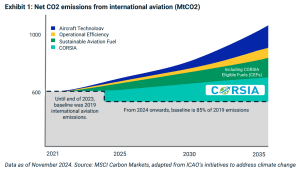
The framework requires airlines to offset emissions that exceed the baseline by funding projects that reduce or remove greenhouse gas emissions such as reforestation or renewable energy initiatives. It has three phases:
- Pilot (2021-2023),
- First (2024-2026), and
- Second (2027-2035).
The scheme already has 126 participating countries, covering 75% of global aviation activity.
For compliance, airlines must purchase and cancel eligible carbon credits or use CORSIA-eligible sustainable aviation fuels (SAFs). These fuels, derived from renewable sources, significantly lower lifecycle emissions compared to conventional jet fuels.
- SEE MORE: Boosting Aviation Carbon Credits: ICAO Greenlights Verra’s VCS Program for CORSIA Carbon Market
UK’s Dual Approach: CORSIA Meets the UK ETS
The UK was instrumental in shaping CORSIA and remains a strong proponent of its implementation. Having participated since the pilot phase, the country is now integrating CORSIA alongside its domestic Emissions Trading Scheme (UK ETS).
Britain’s approach balances international commitments with its domestic climate goals, ensuring minimal economic disruption.
The UK ETS, launched in 2021, applies to domestic flights and certain international routes. Operating on a cap-and-trade principle, it limits total emissions by requiring companies to purchase allowances (or credits) for their emissions.
Flights from the country to the European Economic Area (EEA) and Switzerland currently fall under both the UK ETS and CORSIA. Thus, this creates potential overlaps. To address this, the UK Department for Transport (DfT) is consulting on two policy options:
- UK ETS Only: This option would remove CORSIA obligations for flights already covered by the UK ETS, avoiding double regulation and maintaining the integrity of the domestic scheme.
- Price-Based Hybrid: Under this model, flights would comply with both systems, but airlines would receive compensation for CORSIA compliance costs to prevent financial double charging.
Challenges in Implementation
Despite its ambitious goals, implementing CORSIA is not without hurdles. There are three challenges in implementing the scheme:
- Carbon Credit Uncertainty: The availability and quality of eligible carbon credits remain contentious. Ensuring credits meet rigorous environmental and social standards is essential to maintaining credibility.
- Administrative Complexity: Aligning CORSIA’s 3-year compliance cycle with the UK ETS’s annual requirements adds a layer of operational complexity.
- Double Regulation: Balancing compliance under both schemes for flights to the EEA and Switzerland requires careful policy design to prevent inefficiencies.
Financial Implications and Industry Perspectives
To encourage compliance, the UK’s draft legislation proposes fines of £100 ($127) per tonne of CO₂ for non-compliance, indexed for inflation. However, the DfT emphasizes the importance of avoiding excessive cost burdens that could lead to higher ticket prices.
Policymakers aim to achieve decarbonization without compromising the affordability of air travel.
The International Air Transport Association (IATA) and UK-based airlines broadly support integrating CORSIA. They recognize its role in reducing aviation’s climate impact.
However, they stress the need for clear rules and effective implementation to avoid market distortions. The Climate Change Committee (CCC) has also advised ensuring strict eligibility criteria for carbon credits and avoiding double compliance burdens.
SAF and The UK’s Roadmap to Achieving Net-Zero Aviation
A critical enabler of aviation decarbonization is the adoption of SAFs. These fuels are eligible under both CORSIA and the UK ETS, offering airlines a way to reduce emissions directly.
The UK government’s Jet Zero strategy emphasizes increasing SAF production, aligning with international goals under ICAO’s Global Framework for Aviation Cleaner Energies.
The Jet Zero strategy outlines the country’s plan to achieve net-zero aviation by 2050. It emphasizes rapid technology development to preserve the benefits of air travel while leveraging decarbonization opportunities for the UK.
The UK Jet Zero Roadmap
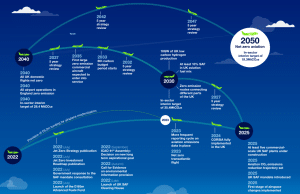
The strategy includes a 5-year delivery plan detailing the actions necessary to meet net-zero targets and will be reviewed and updated every five years. Informed by over 1,500 responses from consultations, the strategy also includes the Jet Zero investment flightpath, which is part of the Prime Minister’s Ten-Point Plan for a Green Industrial Revolution.
The roadmap highlights the UK’s leadership in advancing low- and zero-emission aviation technologies. It has a focus on investment opportunities in systems efficiency, sustainable aviation fuels, and zero-emission aircraft.
The UK’s adoption of CORSIA complements its domestic initiatives to decarbonize aviation. The Jet Zero Taskforce and strategies such as phasing out free ETS allowances for aviation by 2026 underscore a strong commitment to reducing emissions. Combined with advancing SAF technology, these measures are key to achieving net-zero aviation.
As consultations continue, Britain faces crucial decisions on integrating CORSIA with the UK ETS. The chosen approach will shape how airlines balance compliance costs with sustainability goals.
By taking proactive steps, the UK aims to lead global efforts in aviation decarbonization. As the 2025 compliance deadline approaches, the aviation industry stands at a crossroads—with the potential to drive meaningful climate action through innovation and international cooperation.