

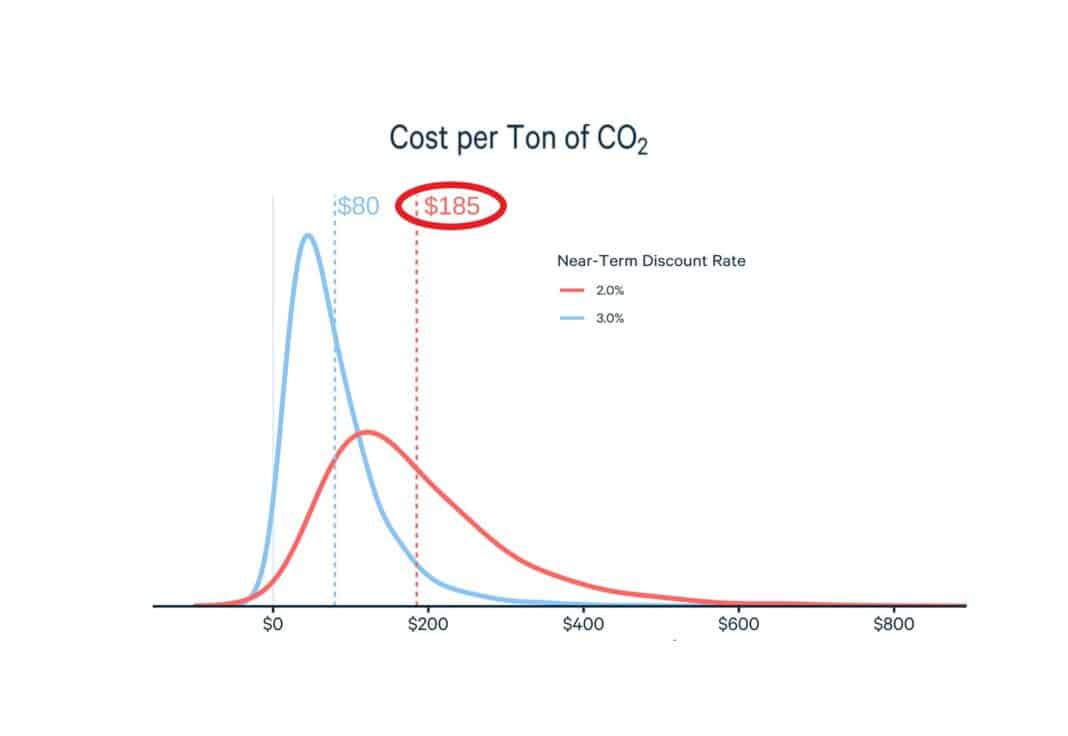
A recent study argued that the social cost of carbon in the US is 3.6x more than the current price which does not take into account the actual damages of carbon emissions.
As climate change bakes the earth, countries and local governments are putting a price tag on carbon emissions that intensify wildfire flooding, and droughts.
All those catastrophic events are causing big losses to communities, homes, and even lives across the globe.
But what’s the real cost in dollar terms of the emissions that drive drastic changes to climate?
A team of researchers tried to provide an answer by determining the social cost of carbon (SCC). It’s a price representing the total climate change caused to society by carbon emissions.
The Social Cost of Carbon
This carbon price is a less direct approach by President Biden to calculate the future climate damages to justify tougher limits on polluting industries.
The current social cost of carbon in the US is $51. This means each ton of CO2 emitted today will contribute to $51 in damages in coming years.
The state of New York has its own SCC. That’s $125 as updated in 2020 to account for economic trends.
By contrast, emissions were most recently valued at $13.50 per tonne at auction under the Regional Greenhouse Gas Initiative (RGGI).
Canada has a more aggressive carbon pricing approach. It imposes fuel charges on individuals ($40/tonne) and makes big polluters pay for emissions. It’s one of dozens of nations with some kind of carbon tax.
- The US has a social cost of carbon used in regulatory decisions but not a carbon price that is faced by the market.
The difference between these two approaches to carbon emissions is this: the social cost of carbon guides policy, while carbon pricing represents policy in practice.
Economists say that the two figures ($51) would line up in an efficient world. But the researchers in the journal Nature believe that the current price is 3.6x lower than the true SCC.
They argue that it should be $185 per tonne.
They developed a tool to estimate the true cost of carbon pollution using the latest research on socioeconomic projections, climate modeling, climate impact assessments, and economic discounting.
Their model shows how much the value of future climate damages are discounted due to projected growth.
According to Kevin Rennert, the study author:
“Our results suggest that we are vastly underestimating the harm from each additional ton of carbon dioxide in the atmosphere… And the implication is that the benefits of government policies and other actions that reduce global warming pollution are greater than has been estimated.”
But not all in the industry think that the results of the new study are workable for the government right now.
A senior research economist thought that it’s ($185/tonne) a long way from what the current administration needs.
Underestimated cost
Federal officials in the US have been using the social cost of carbon to new policies over a decade ago. It started when environmentalists sued the government for discounting GHG emissions when setting vehicle mileage standards.
But some legislators were against using the SCC to steer policy. President Biden’s estimation ($51) gets blocked a couple of times. And the White House is still reviewing the best way to come up with the final figure.
- In fact, officials already have determined that the interim price of $51 per tonne is too low.
In an analysis of the new climate law published by the White House, officials wrote that:
“…the interim social cost of carbon estimates are currently significantly underestimated because they do not account for many important climate damage categories, such as ocean acidification.”
Even the authors of the new study noted that their estimate is conservative. Their model doesn’t account for several costs associated with rising temperatures including:
- biodiversity loss,
- reduced labor productivity,
- increased conflict and violence, and
- climate-related migration.
Indeed, as potential future climate damages become more costly, the benefits from preventing them with stricter rules will also grow.
But federal officials said that though the SCC has been taken into account in various climate solutions, it hasn’t been a deciding factor so far.
Yet, the present administration will continue to assess how best to account for those social costs of carbon in its regulatory and budgetary contexts.