

The World Economic Forum (WEF) and Indonesia have signed a partnership to ramp up the nation’s blue carbon efforts as well as address the growing demand for blue carbon credits.
The deal, signed in Davos, Switzerland, will help support Indonesia’s national road map on blue carbon. This, in turn, will drive blue carbon credits financing to promote ocean restoration and conservation efforts.
Indonesia will be the first national government to have this partnership with the WEF, leveraging its blue carbon resources to meet climate goals. Kristian Teleki, Director, Ocean Action Agenda, WEF remarked:
“As a global leader in blue carbon, having Indonesia as the first national partner with the Forum will set an example of how coordinated action can enhance the contributions of blue carbon for climate, biodiversity and societal benefits.”
Meeting the Rising Demand of Blue Carbon Credits
The partnership is the first of a series under the WEF’s initiative “Ocean Action Agenda”. It seeks to connect global blue carbon actors from different sectors.
It will also unlock knowledge, engage champions, build collaborations, and create innovation in these impact areas:
- Ocean innovation
- Blue food
- Climate and resilience
- Business and policy transformation
With those initiatives, the end goal is to help meet the rapidly increasing demand for high-quality blue carbon credits and projects worldwide.
What is Blue Carbon?
Teleki from WEF also noted about blue carbon:
“Blue carbon holds immense potential for marine ecosystem restoration and coastal community resilience, while contributing to climate mitigation and helping raise critical funds to advance the urgent needs for ocean protection and conservation.”
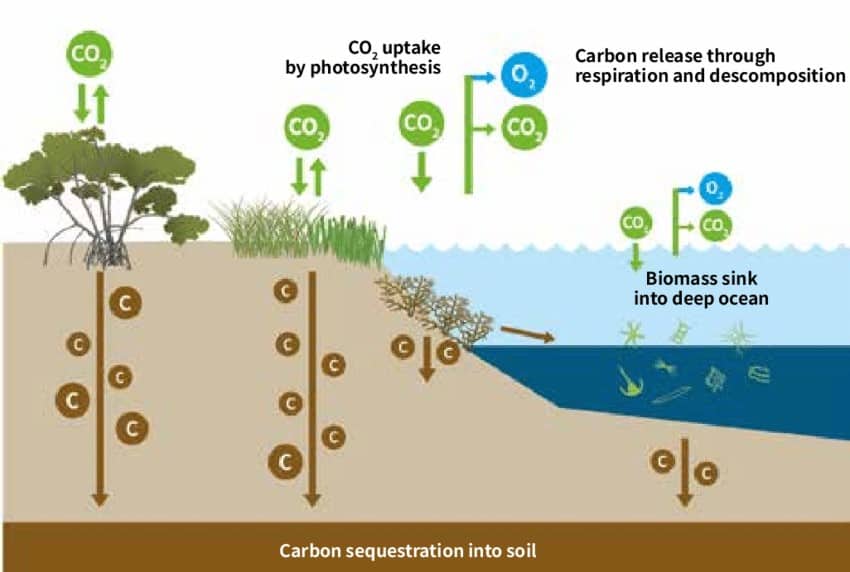
Blue carbon refers to the carbon captured and sequestered by ocean ecosystems. It stores up to 5x more carbon per acre than tropical rainforests.
Common examples of marine ecosystems are mangrove forests, seagrasses and salt marshes. These ecosystems are among the most intensive carbon sinks in the world.
Here’s how a typical blue carbon ecosystem works in absorbing carbon.
These marine habitats are also critical in protecting coastlines from storms and other natural disasters. Let alone serving as nurseries for fish stocks while providing food sources and jobs for coastal communities.
Growing and conserving those carbon-absorbing ecosystems produce blue carbon credits. These carbon credits usually trade at a premium. That is because of the large positive second-order effects of blue carbon projects such as the positive effects on corals, algae, and marine biodiversity.
Market analysis also shows that global demand for carbon credits is growing as businesses are working hard to offset their emissions. Countries are also striving to achieve their carbon reduction goals.
- The island nation of The Bahamas is among the first nations to sell blue carbon credits.
Blue carbon credits help raise critical funds to advance ocean protection and conservation.
WEF and Indonesia Blue Carbon Partnership
Indonesia, the world’s biggest archipelago nation, is a leader in blue carbon and the sustainable ocean economy. It is home to the largest blue carbon resources in the world – about 20% of the world’s remaining mangroves).
It was the president of the G20 last year tasked to fast-track sustainable blue economies in the region.
Prior to this blue carbon deal, the WEF had launched the Ocean 20 (O20) with the Indonesian government last November 2022.
Luhut B. Pandjaitan, Indonesia’s Minister for Maritime Affairs and Investment said the country plans to rehabilitate 600,000 hectares of mangroves by 2024. The minister further added that:
“We have the largest and most diverse mangrove forests in the world… Creating this partnership between Indonesia and the Forum to work on blue carbon will really help accelerate our efforts for climate action.”
The blue carbon pact between the WEF and Indonesia will bring together stakeholders across sectors and initiatives in blue carbon. This, in turn, will help drive blue carbon projects financing.
The WEF will continue to promote blue carbon efforts and support countries in achieving their national climate ambitions and initiatives.
The organization further leads the implementation of the High-Quality Blue Carbon Principles and Guidance that was launched at the United Nations Conference COP27. It’s a product of a collaboration between the WEF and world leaders working on blue carbon.
It outlines a set of clear principles and guidance that describe what “high-quality” means for blue carbon projects and credits, with the goal of preserving and restoring blue carbon ecosystems.