

A new report by Dryad Networks unveiled the hidden costs and impacts of wildfires, its carbon emissions, and how early detection can prevent huge economic losses and save lives.
Wildfires endanger people’s health and nature, affecting 6.2 million people and causing decades’ worth of damage to biodiversity. They also cost the global economy hundreds of billions of dollars each year.
More remarkably, the report estimates that wildfires can be a major source of global carbon emissions (30%) by the end of the century.
Carsten Brinkschulte, CEO of Dryad Networks commented:
“It is clear from the report findings that the world needs to wake up to the full impact of wildfires and it is time for governments to shift the focus of investment onto detection and prevention – not just suppression.
The Underestimated Impacts of Wildfires
Within just one decade, 8 of the worst wildfires on record have happened. And they’ve become even more widespread, burning about 2x more tree cover today as they did two decades ago.
Still, the full impact of wildfires is largely underestimated.
The new report by ultra-early detection IoT firm Dryad, “What lies beneath – the hidden truth about wildfire” – looks closely at the unseen impacts of wildfires. It focuses on these key areas:
- full environmental impact
- human health hazards
- financial costs to governments and
- what could be avoided with early wildfire detection.
Hidden Costs: Emissions & Biodiversity
Wildfires account for about 6 to 8 billion tons of carbon emissions, according to estimates. That means it contributes 20% to the total global GHG emissions. It equates to how much the transport sector also emits.
But more alarmingly, wildfires’ impact on climate change can get worse. They can be the source of 30% of emissions by 2100, the report says.
Wildfires also damage biodiversity significantly.
In fact, the fires killed or displaced around 3 billion animals in Australia in 2020 alone. While in Europe, wildfires destroyed ⅔ of the Plaine des Maures Nature Reserve during the Gonfaron Fire in France last 2021.
Unfortunately, it takes decades for fauna and flora to recover from the damages of wildfire.
At the UN COP15 biodiversity conference last year, nations agreed to protect nature and biodiversity hotspots 30% of land by 2030.
Impacts on Health and Economy
According to the World Health Organization (WHO), “wildfires and volcanic activities affected 6.2 million people between 1998-2017”. This resulted in 2,400 attributable deaths worldwide from suffocation, injuries and burns.
WHO also says that, since that period, the “size and frequency of wildfires are growing due to climate change”. That means hotter and drier conditions are further increasing the risk of spreading wildfires.
-
On top of environmental and health damages, the financial impact of wildfires is also very high, worth billions of dollars.
For instance, a study by University College London stated in the report showed that California’s 2018 wildfires alone cost the U.S. a whopping $148.5 billion. Capital losses and health costs within the state amounted to $59.9 billion.
The report noted that employing traditional wildfire detection methods fail to reduce the risks of the disaster. Detecting fires through human sight may take up to 6 hours or more.
Within those hours, a wildfire may have already spread and cost the state or country billions in firefighting. In the U.S., for example, the cost of fighting wildfires is around $3.7 billion in 2022.
Companies that use carbon credits from forests created a buffer pool in case of wildfires. But the buffer pool is far from being enough to cover the losses. 10-20% of the total credits from forests fill the buffer pool.
California, in particular, has a huge forest carbon offset program that credits carbon stored in forests. These carbon credits are sold for those who seek to offset their emissions. As well, a study suggested that California’s buffer pool also severely lacks capital to keep up with the increasing wildfire events.
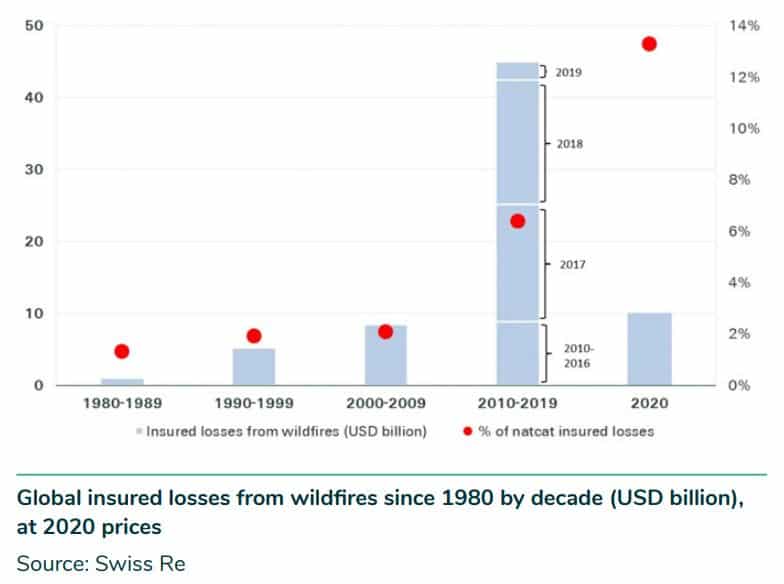
Interestingly, insurance giant Swiss Re pointed out how the cost of global insured claims due to wildfires has risen to around $10 billion per year. The insurance giant also projected that figure to go up, from 6% in 2020 to over 13% by 2030 as seen in the chart.
Dryad Early Wildfire Detection Tech
For Dryad’s CEO Carsten:
“There should be no hidden costs for wildfires. All countries must work together to share data communicating the full impacts of wildfires to ensure the extent of damage caused is fully understood. This will unlock the critical level of investment and attention needed on detection and prevention to address the issue of wildfire once and for all.”
In this regard, the Iot company created an effective technology that can detect a wildfire very early – within the first 60 minutes. That’s before the open fire has even developed.
Dryad’s early fire detection system “Silvanet” is pending patent. It uses low-cost solar-powered sensors and IoT mesh gateways. It also offers cloud-based big data platform for analytics, monitoring and alerting.
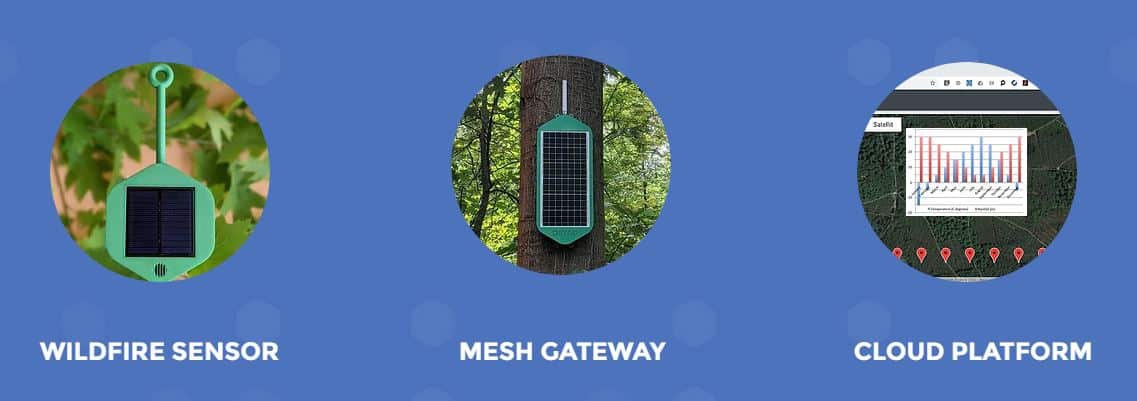
The tech can be placed even in the most remote locations but still transmit the first signs of fire to firefighters. It can detect the exact location of the fire, which substantially enhances response times.
In terms of cost, Dryad’s detection tech can be less than $50. It can help get rid of almost all the impacts of wildfire if deployed on a commercial scale.
Take for example the case of Camp Fire in California in 2018. The company estimates that if early detection happens, their technology could have saved 5.5 million hectares of land, 2,500 homes and 26 lives from harm. Not to mention the expensive firefighting cost of $150 million or more.
Only with an early detection system in place, billions of tonnes of emissions, billions of dollars of financial losses, millions of hectares burnt, millions of animals, and thousands of lives could have been spared from wildfires. Billions of carbon credits could also be created.