

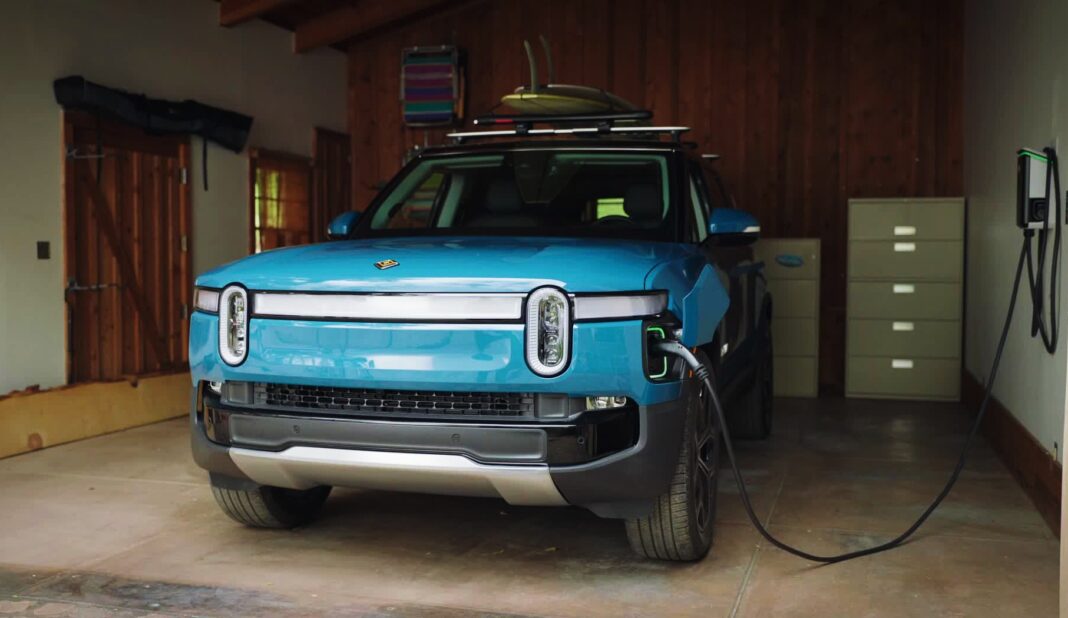
California-based EV startup Rivian hoped to earn carbon credits for the chargers powering its electric trucks and SUVs, including those found in the homes of its customers, which raised questions about who should own the credits.
The popular EV maker claiming carbon credits for home chargers received big disagreements from market experts, MIT reports. It particularly raises concerns on who has the right to claim the climate impact of using clean technologies like EVs. Should it be the manufacturing company or the buyer?
Speeding Up the Move to Carbon-Free Transport
Rivian has received outstanding reviews both from customers and automotive critics for its high-end electric pickups (R1T) and SUVs (R1S). They’re praising the EV’s power, design, and luxury features.
Last year, Rivian applied to Verra to earn carbon credits for the carbon emission reductions through the use of its chargers. The EV startup stated that it “retains all environmental attributes” (or carbon credits) from the use of its EV chargers. These credits are tradable in carbon markets and bought by entities looking to offset their own carbon footprint.
Rivian’s project proposal with Verra specifically includes these items:
- Adventure Networks
- Waypoint chargers (bought by 3rd-party site hosts)
- Residential or home chargers located in the U.S.
The EV carmaker clearly said in the documents that they have the “sole and exclusive” rights to the carbon credits generated by their charging network. That means they have absolute discretion to transfer, sell, or hold those credits as they see fit.
Rivian’s electric cars come with portable wall chargers that are compatible with standard outlets. By displacing fossil fueled vehicles, the company’s charging network can cut carbon emissions.
- They said that their charging infrastructure can cut CO2 emissions by 200,000 tonnes yearly all throughout the project’s 7-year period. Each tonne of reduced emission produces one carbon credit.
Andrew Peterman, Rivian’s director of renewable energy, noted that this program is crucial in transitioning to clean transportation, saying that:
“Alternative revenue sources from programs like this not only make the scaled transition to clean electric transportation possible (and at the necessary speed) but enable companies like Rivian to do so while generating a greater positive impact for communities, conservation, and the climate.”
In a separate study, researchers found that charging 1 million EVs at an optimized time delivers carbon emissions savings equal to taking up to 80,000 fossil fuel-powered vehicles off the road.
However, Rivian’s claim was met with critics – especially on “additionality” concerns.
Meeting the Criteria for Reliable Carbon Credits
Not all carbon credits are made equal. The best and credible carbon credits must meet a set of criteria and one of them is additionality.
A carbon credit becomes additional if it delivers climate impact that wouldn’t happen without the revenue from selling the credit. But if the carbon reductions are going to happen anyway, even without the revenue from the credits, then they’re not additional.
Now, applying that additionality to Rivian’s EV charging network, do they deserve to earn carbon credits for it?
Some say they don’t because of the factors that are driving the growth of EVs and their charging infrastructure. In particular, these include more policy support and the current rising trends for EVs.
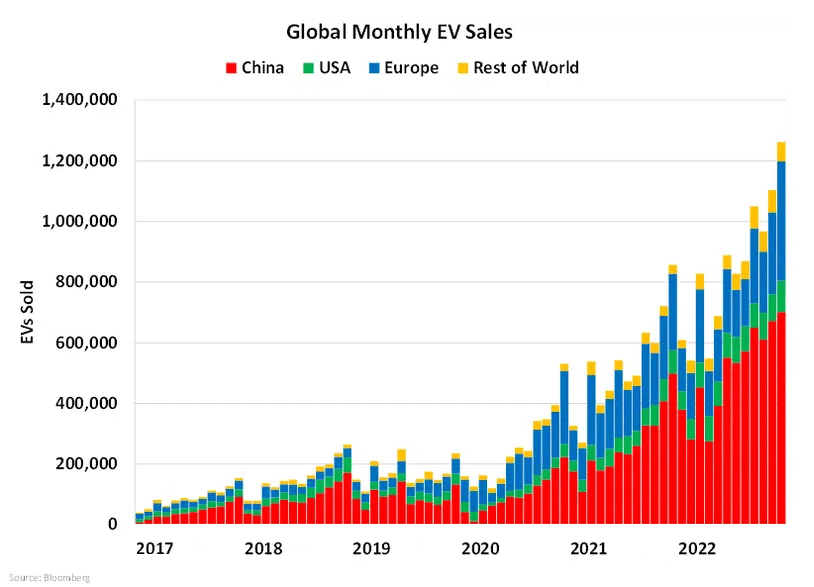
As per market estimates, EVs will make up over 50% of new passenger car sales in the US by 2030. And it’s not just in the US because historic EV sales are also soaring globally as shown in the chart below.
Others are also skeptical of Rivian’s claim to cover residential chargers in their Verra carbon credit proposal.
In that case, the company is assuming that the EV chargers won’t be installed without the funds from carbon credits. Not to mention the fact that it’s the customers who pay for the chargers themselves and they can decide to either charge at their homes or not, regardless of the credit revenue.
So for critics, it seems not right that Rivian takes ownership of the credits that customers can independently produce. As one skeptic puts it, customers buy the EV, pay for the charger, and pay for the power to charge it. But then others take the credits?
Commenting on these questions, Peterman said that the additional revenues from selling carbon credits will help speed up the deployment of clean renewable EV charging solutions. He further added that the extra funds also help promote more access to and more affordable home charging solutions. And that’s even more important in states or locations where there are limited utility incentives.
Peterman also stressed that Rivian is not using carbon offset credits to meet its own climate goals.
According to 3Degrees, the climate firm that made Rivian’s proposal to Verra, the additional revenue will enable the carmaker to pass on cost reductions to EV owners through lower costs of EV chargers. The climate solution provider also said that “successful project validation and verification is not guaranteed” so the critics come too early.
Rivian’s Carbon Credits from EV Chargers Under Review
Verra, the world’s largest carbon credits certifier and issuer, is still in the process of reviewing Rivian’s project proposal. So there are no carbon credits issued or sold yet.
In 2018, Verra published a methodology on how entities become eligible to generate carbon credits for reducing emissions through EV charging systems. Since then, the nonprofit organization has approved projects and issued the corresponding credits. But some proposals remain under review, including Rivian’s.
Verra emphasized that for a project to be approved, it has to meet safeguards to be additional, including:
- Below 5% of the maximum adoption potential for EV charging system’s penetration level
- Expansion of EV chargers is not mandated by government regulations
With that, Rivian’s proposal does not cover EV chargers in states where existing government crediting programs are in place. So the EV maker didn’t include Oregon and California, for instance.
From the point of view of a Rivian SUV owner, the issuance of carbon credits seems to be questionable if it doesn’t incentivize people (to use EVs and install home chargers). He said that he will charge his car at home, whether or not he buys a charger from Rivian.
But he also stressed that EVs are a good alternative to gas-powered cars. They emit less pollution and cost much less to drive – $30 for electric power vs. $100 for gas. So, he is for carbon credits that make the shift to electric cars more possible.