

Gold mining is not only energy-intensive but also challenging. Miners weigh various factors like geology, ore grades, depth, and transport distances, which could potentially turn into challenges as well.
However, as the world is transitioning to sustainability, gold fields are significantly considering a reliable energy supply and management, not just for power operations but also for reducing emissions.
The gold mining industry as a whole has a clear path to decarbonization that aligns with the Paris Agreement. They aim to cut absolute emissions by 50% and net emissions by 30% on their journey to net zero by 2050.
Top 3 Low-Emitter Gold Mines
Lundin Gold’s Fruta del Norte
Lundin Gold Inc., based in Vancouver, British Columbia, is a Canadian mining company with a strong focus on sustainability and efficiency. The company 100% owns the Fruta del Norte gold mine in southeast Ecuador, which has been producing gold since late 2019.
Known for its low carbon emissions, high-grade output, and cost efficiency, Fruta del Norte is among the most environmentally responsible and productive gold mines globally. In 2023, it achieved an impressive production of 481,274 ounces of gold, making it one of South America’s largest gold producers.
The company holds 28 metallic mineral concessions and three construction material concessions in Ecuador’s Zamora Chinchipe province. As per its sustainability report,
- Lundin Gold maintains an industry-leading greenhouse gas (GHG) emissions intensity of just 0.08 tCO2e per ounce of gold produced. This makes the miner a top low-carbon gold producer.
The mine is powered by Ecuador’s national grid, which sources 81% of its energy from renewables. This is how it achieves significantly lower Scope 2 emissions.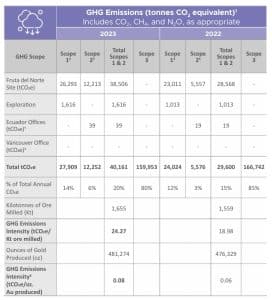 Source: Lundin Gold
Centerra Gold Inc.
In 2023, Centerra Gold Inc. achieved a 77% drop in emissions intensity at its Öksüt mine, despite production suspension in 2022 due to mercury detection. They resumed operations in 2023 and sold higher gold ounces after resuming operations in June 2023. A mercury abatement system was installed to restart the mine. This led to the production of 195,926 ounces of gold—the highest since 2020- and consequently, it cut down emissions.
As per their sustainability report,
- Global Scope 1 emissions totaled 107,384 metric tons of CO₂e in 2023. The company’s two main operating mines, Mount Milligan and Öksüt, accounted for 90,655 metric tons.
Mount Milligan reduced emissions by 7% due to shorter haulage distances and optimized pit sequencing, while Öksüt achieved a 21% decrease from temporary mining interruptions and improved haulage cycles.
- Global Scope 2 emissions totaled 33,790 metric tons of CO₂e in 2023, with 13,185 metric tons from Mount Milligan and Öksüt.
Despite a 7% rise in electricity use, emissions remained stable through efficient energy use. Notably, Scope 3 emissions, with purchased goods and services contributed to more than 50%.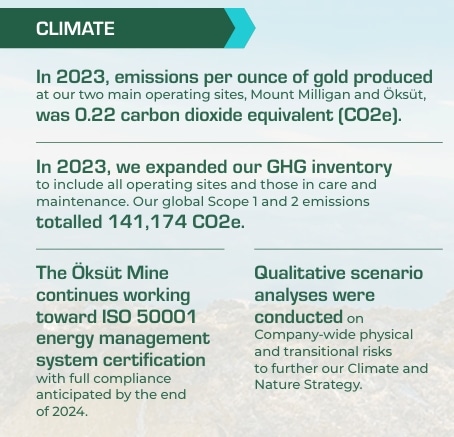
Source: Centerra-Gold
The company uses the Greenhouse Gas Protocol for emissions reporting and is exploring cost-effective decarbonization pathways to cut Scope 1 and Scope 2 emissions in the coming years. Additionally, it is evaluating opportunities to reduce scope 3 emissions.
Agnico Eagle Mines Ltd.
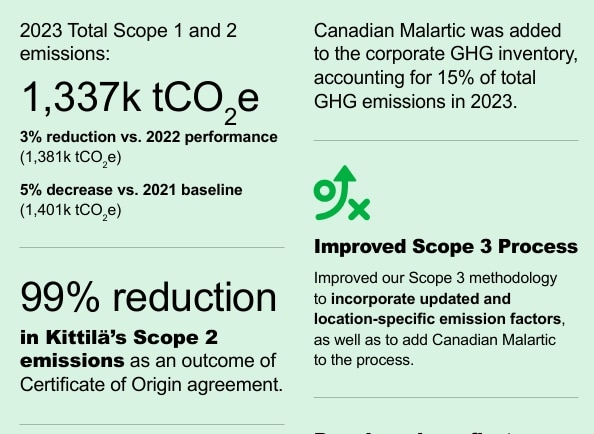
The Canada-based gold mining company, is the world’s third-largest gold producer, with operations in Canada, Australia, Finland, and Mexico. In 2023, the company achieved significant progress in reducing its emissions, particularly with its Kittila mine, which halved its Scope 2 emissions intensity. They achieved this by sourcing all of its grid electricity from zero-emission sources.
 Source: Agnico Eagle
In total, Agnico Eagle produced 3.44 million ounces of gold in 2023, and all 11 of its active operations outperformed the industry average for emissions per ounce of gold produced.
The company’s total Scope 1 and 2 emissions in 2023 were 1,337,000 tCO₂e, a 3% reduction from 2022 and a 5% decrease from the 2021 baseline.
The mining giant has robust plans to upgrade its technological innovation, decarbonization efforts, and its Energy and Greenhouse Gas Management Strategy. Its dedication to sustainability and emissions reduction underscores its leadership in responsible gold production.
Other Players
For 2023, PJSC Polyus has fully offset its Scope 2 emissions since 2021 by sourcing renewable energy and acquiring carbon-free electric energy certificates from H2 Clean Energy LLC to cover 72,000 metric tons of CO₂e in 2023.
Additionally, Kinross Gold Corp. reduced its Scope 2 emissions intensity by 31% and Barrick Gold’s Nevada operations significantly cut 197,000 metric tons in 2023 with the 2020 baseline.
These reductions primarily came from renewable energy sources like hydroelectric and power purchase agreements to buy energy credits from solar power plants.
On the flip side, Sibanye Stillwater had the highest emission footprint…
Sibanye Stillwater’s Cooke operation topped the list of record-high emissions. It recorded a massive amount of 9,980 kg CO₂e per ounce of gold in 2023. The mine relies heavily on electricity from South Africa’s coal-based grid and processes low-grade historic tailings through two plants, Cooke and Ezulwini.
Outside South Africa, Pueblo Viejo in the Dominican Republic ranked second, with 3,236 kg CO₂e per ounce of gold in 2023, indicating a 25% rise from 2022. Emissions intensity increased due to a 22% drop in production, lower head grades, and reliance on diesel-powered plants.
Gold’s Role in a Sustainable Future
Gold plays a key role in modern technologies and the shift to a low-carbon economy. Its inclusion in investment portfolios also boosts resilience against climate risks, solidifying its status as a sustainable asset in global finance.
The gold mining industry is aligning with sustainability goals by cutting its carbon footprint while increasing production. This balance highlights better energy efficiency, cleaner technologies, and improved operational strategies.