


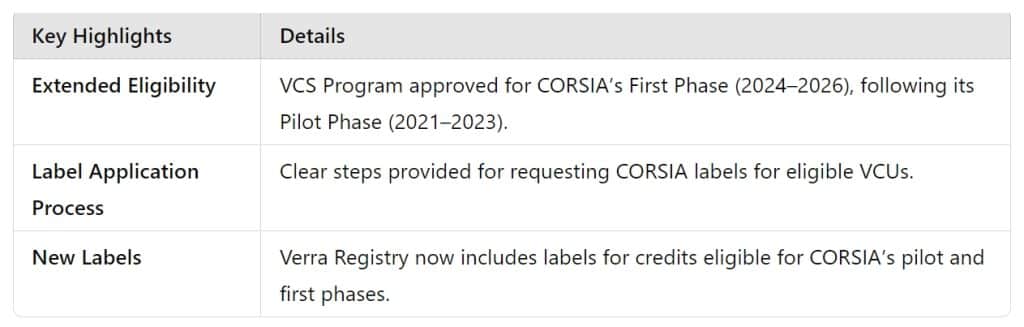
Last year in December, Verra achieved a significant milestone when the United Nations International Civil Aviation Organization (ICAO) approved its Verified Carbon Standard (VCS) Program for the Carbon Offsetting and Reduction Scheme for International Aviation (CORSIA). This approval extended the program’s eligibility from CORSIA’s Pilot Phase (2021–2023) to its First Phase (2024–2026), marking a major advancement for Verra and the voluntary carbon market.
Following this achievement, Verra released its CORSIA Label Guidance document on January 20, 2025. This document provides clear instructions for project proponents on how to request CORSIA labels for eligible Verified Carbon Units (VCUs), ensuring a smoother and more transparent process.
Ensuring Compliance with ICAO Guidance
CORSIA operates as a global market-based mechanism to cap international aviation emissions at 2020 levels. Countries and airlines participate voluntarily in the Pilot Phase (2021–2023) and First Phase (2024–2026), with mandatory participation beginning in 2027.
Under CORSIA, aircraft operators must monitor, report, and offset emissions exceeding their allowable share. These offset requirements are reconciled over three-year compliance periods. ICAO defines the scope of eligibility for credits, considering factors such as:
- Credit type
- Activity type
- Vintage year
- Sustainable development reporting
- Assurance of no double-claiming
This scope is published twice a year in the CORSIA Eligible Emissions Units document.
- RELATED: Boosting Aviation Carbon Credits: ICAO Greenlights Verra’s VCS Program for CORSIA Carbon Market
Simplifying Verra’s CORSIA Label Guidance for Carbon Offsetting
Verra’s milestone with the UN’s ICAO approval of its VCS Program marks a significant step forward for sustainable aviation and the voluntary carbon market. In the following content, we have simplified the process for easy understanding.
Key Requirements for Eligible VCUs
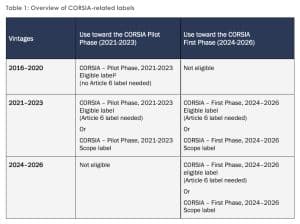
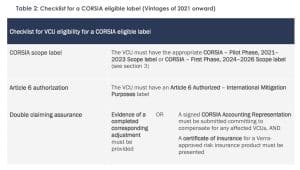
To meet CORSIA’s standards, VCUs with vintages of 2021 onward must carry specific labels. Here’s what’s required:
- Article 6 Authorized Label: VCUs must include an Article 6 Authorized – International Mitigation Purposes label to qualify for CORSIA obligations.
- CORSIA Eligible Label: This label indicates that the VCU meets all criteria for retirement within CORSIA’s pilot or first phase.
- Assurance of No Double Claiming: Verra prevents double claiming by requiring proof of a corresponding adjustment or a signed CORSIA Accounting Representation. This must come from an entity ensuring double-claimed VCUs are addressed and include insurance backed by a Verra-approved product.
How to Obtain CORSIA Labels
Project proponents can request CORSIA labels when submitting a VCU issuance request or at any time after that through the Verra Registry. They need to navigate the “Additional Certifications” section on the project’s Verification Summary page.
Verra will approve or reject CORSIA label requests based on the guidance provided. Once approved, CORSIA labels are publicly displayed on the Verra Registry under the “Additional Certifications” section in the “VCUs” tab.
Purpose of Labels
Verra offers multiple labels to streamline compliance with CORSIA requirements. Each label serves a specific purpose:
- CORSIA Eligible Label: Confirms that the VCU can be retired for CORSIA compliance within a specified phase.
- Article 6 Authorized Label: Indicates the host country’s authorization for using the mitigation outcomes under CORSIA obligations.
- CORSIA Scope Label: Identifies that the mitigation falls within CORSIA’s eligibility scope for a particular phase. However, this label alone does not make a VCU eligible for retirement.
For VCUs with vintages of 2021 onward, the CORSIA scope label must be replaced with a CORSIA-eligible label to qualify for retirement under CORSIA.
Automatic Updates for Existing VCUs
VCUs labeled during CORSIA’s pilot phase will automatically update to show the new label designations. This keeps existing credits aligned with the latest CORSIA requirements. As a result, project proponents won’t face any extra administrative work.
Avoiding Double Counting: Verra’s Core Principle
The guidance also emphasizes Verra’s commitment to transparency. It ensures mitigation outcomes from 2021 onward are not double-claimed. This means VCUs cannot be counted by both aircraft operators and the countries where the reductions occur.
To achieve this, Verra verifies that VCUs retired under CORSIA do not count toward a host country’s climate goals or Nationally Determined Contributions (NDCs). This process is supported by Article 6 authorization, which allows the host country to approve the international use of these VCUs. Verra also enforces corresponding adjustments to ensure the country’s emissions records accurately reflect this approval.
In cases where corresponding adjustments aren’t applied, Verra requires compensation assurances for VCUs used toward CORSIA obligations. This safeguard guarantees compliance even if the host country withdraws or alters its authorization.
This approach shows Verra’s commitment to trust and credibility in carbon markets. These measures also boost transparency and help the aviation sector meet its climate goals while sticking to international commitments.
A Step Toward Sustainable Aviation
Verra’s CORSIA Label Guidance is updated periodically to align with ICAO’s evolving standards on credit eligibility and other criteria. Users must always refer to the latest version to ensure they meet current requirements.
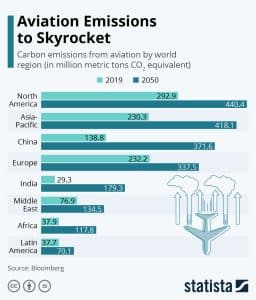
With this update, Verra is streamlining compliance for project proponents and supporting global efforts to reduce aviation emissions. By ensuring transparency and preventing double claiming, Verra upholds carbon market integrity. This supports aviation’s climate goals and paves the way for a more sustainable future in international aviation.