


Climeworks, a Swiss company known for its carbon removal technology, announced a major partnership with Mitsui O.S.K. Lines (MOL), one of the world’s largest shipping companies. This is Climeworks’ first collaboration with a shipping company and its first agreement with a Japanese partner.
As part of the deal, Climeworks will remove 13,400 tons of carbon dioxide (CO₂) from the air on behalf of MOL by 2030.
This agreement supports MOL’s goal of reaching net-zero greenhouse gas emissions by 2050. MOL is already using clean energy, improving energy efficiency, and testing new technologies. But because shipping is one of the hardest industries to decarbonize, carbon removal is seen as a necessary tool to meet climate goals.
Christoph Gebald, co-founder and Co-CEO of Climeworks, said,
“Shipping is a hard-to-abate sector where residual emissions are likely to remain even with ambitious mitigation measures. Carbon removal solutions will be necessary to address those emissions and reach full climate targets.”
How Climeworks’ Direct Air Capture Technology Works
Climeworks uses a method called Direct Air Capture (DAC) to remove CO₂ directly from the atmosphere. Special machines with large fans pull in air, which passes through filters that trap CO₂.
When the filters are full, they are heated to release the CO₂ gas. This gas is then either stored underground, where it turns into rock over time, or reused in other processes. This approach removes CO₂ permanently and allows it to be measured, verified, and tracked.
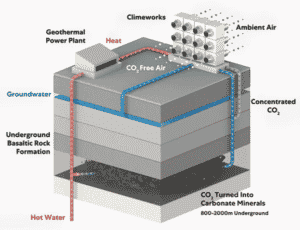
Climeworks opened its largest DAC facility, called Mammoth, in Iceland in 2024. This plant can capture up to 36,000 tons of CO₂ per year. It builds on Climeworks’ Orca project. This is part of their plan to remove multi-megaton CO₂ by the 2030s and reach gigaton levels by 2050.
Hard-to-Abate Emissions and the Role of Carbon Removal
Shipping contributes about 3% of global greenhouse gas emissions. The chart below shows the industry’s emissions since 2012 by vessel type. Unlike cars or buildings, which can switch to electric or renewable energy solutions more easily, cargo ships are harder to decarbonize.

Even with low-carbon fuels and better designs, some emissions will remain. That’s why companies like MOL are turning to carbon removal.
Through this agreement, MOL is taking early action to address the challenge. It plans to remove 2.2 million tons of CO₂ by 2030. The partnership with Climeworks marks an important first step in reaching this goal.
MOL’s Commitment to Net-Zero Emissions
MOL has set a clear goal to achieve net-zero GHG emissions by 2050, as outlined in its “MOL Group Environmental Vision 2.2.” This roadmap outlines clear goals and milestones. They will help the company reduce emissions in its operations.

To reach this goal, MOL is implementing various strategies, including:
-
Adopting Clean Energy. MOL is investing in alternative fuels, such as e-methane and bio-methanol, to power its vessels. These cleaner energy sources are part of the company’s plan to reduce reliance on traditional fossil fuels.
-
Energy-Saving Technologies. The company is enhancing ship designs and operations to improve energy efficiency. This includes utilizing wind power for vessel propulsion and other innovative technologies to lower fuel consumption.
-
Carbon Removal Initiatives. MOL has partnered with Climeworks to remove CO₂ from the atmosphere using DAC technology. This collaboration aims to offset emissions that are difficult to eliminate through other means.
Hisashi Umemura, Senior Executive Officer of MOL, explained,
“At Mitsui O.S.K. Lines, we’re committed to navigating toward a net-zero future. Contributing the expansion of high-integrity carbon removal credits, driven by Climeworks’ state-of-the-art Direct Air Capture technology, empowers us to address emissions that are hard to eliminate through conventional methods. This is not just an investment in carbon removal but an investment in the future of sustainable shipping.”
Japan’s Role in the Carbon Removal Market
Japan is playing a bigger role in the carbon removal industry. In 2024, it became the first country to allow international, durable carbon removal credits in its national emissions trading system. This made it easier for companies like MOL to invest in projects like Climeworks’.
MOL is not only Climeworks’ first shipping client but also its first customer from Japan. This shows how both are working together to push the boundaries of climate solutions.
The Growing Market for Direct Air Capture

A Bigger Vision for Global Impact
Alongside the offtake agreement to remove 13,400 tons of CO₂, MOL and Climeworks also signed a Memorandum of Understanding. This means MOL might invest in future Climeworks projects. These investments would help Climeworks build more DAC plants worldwide, increasing their ability to remove CO₂ on a large scale.
This partnership goes beyond reducing emissions in shipping. It shows how companies can take the lead in fighting climate change. By working with Climeworks, MOL is also helping to create demand for high-quality carbon removal solutions. These early actions could make it easier and more affordable for other industries to follow.
More initiatives like this can help carbon removal technologies grow to become a key part in decarbonizing the shipping industry and be a global strategy to fight climate change.