

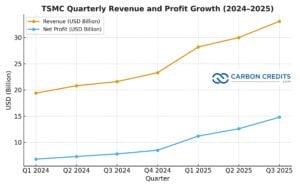
Taiwan Semiconductor Manufacturing Company (TSMC), the world’s largest contract chipmaker, reported record results in the third quarter of 2025. Driven by soaring demand for artificial intelligence (AI) chips, the company’s profit jumped 39% year-on-year to NT$452.3 billion ($14.77 billion).
Revenue rose 30.3% to NT$989.9 billion ($33.1 billion), beating analyst forecasts and setting a new quarterly record. TSMC’s strong performance shows that it is the backbone of global AI and high-performance computing.
Chief Executive C.C. Wei said AI demand is growing faster than expected, noting:
“AI demand continues to be very strong — stronger than we thought three months ago.”
TSMC raised its 2025 revenue growth forecast to the mid-30% range. This shows confidence that the AI boom will stay strong in the coming years. How about the company’s sustainability and net zero aims? Let’s find out.
AI and HPC Fuel Record-Breaking Quarter
The main growth driver came from high-performance computing (HPC), which includes AI, 5G, and data center chips. This segment made up 57% of TSMC’s total quarterly sales. It shows how AI infrastructure spending is changing the semiconductor market.
Most of TSMC’s production now focuses on its most advanced technologies:
- 3-nanometer chips: 23% of total wafer revenue
- 5-nanometer chips: 37%
- 7-nanometer chips: 14%
Together, these advanced nodes made up 74% of total wafer sales. Smaller and more efficient chips are key for training AI models. They also power cloud computing and support next-gen mobile devices.
TSMC supplies chips to many of the world’s biggest tech firms, including NVIDIA, Apple, and AMD. Each company is growing its data center capacity. They need this to support AI systems that use thousands of processors. These processors must run all day and night.
Industry analysts estimate that global AI infrastructure spending will exceed $1 trillion within the next few years. McKinsey estimates companies will cumulatively invest $5.2 trillion into AI-related data center capacity by 2030. As the leading manufacturer of advanced AI chips, TSMC is positioned to capture a major share of that investment.

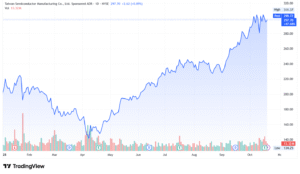
TSMC’s share price has surged nearly 48% year-to-date, reaching around $298 per share in late October 2025. The stock briefly hit a high of $311, marking its strongest performance in over two years.
Investor optimism is rising. This is due to record profits, strong demand for AI chips, and growing global manufacturing capacity. The chart shows steady growth since April. That’s when AI infrastructure spending picked up among major clients like Nvidia and Apple.
Record Expansion Amid Global Competition
TSMC is investing heavily to keep up with soaring demand. The company increased its 2025 capital expenditure to $40–42 billion, slightly higher than previous guidance. Much of this spending supports expansion in both Taiwan and the United States.
The chipmaker is already building two major factories in Arizona, part of a long-term plan to invest over $100 billion in U.S. manufacturing. These sites will produce advanced 3- and 4-nanometer chips for American customers such as Apple and NVIDIA.
This expansion also helps TSMC reduce geopolitical risks amid U.S.–China trade tensions. The company is confident in its Chinese business. However, it is diversifying production. This helps protect against possible export restrictions or tariff changes.
TSMC’s strong performance has boosted its stock price significantly. Shares have gained about 38% year-to-date, reaching record highs as investors bet on sustained growth from AI and high-performance computing.
Managing Challenges in a Shifting Global Landscape
Despite its success, TSMC faces several headwinds. The global semiconductor supply chain remains fragile, with persistent material shortages and high equipment costs. Rising labor expenses in the United States could also affect profit margins for new facilities.
In addition, competition is intensifying. Samsung Electronics and Intel are making advanced 2-nanometer chips. They want to compete directly with TSMC. Each is seeking partnerships with major tech companies to secure long-term contracts.
Still, TSMC maintains a strong technological lead. Its 3-nanometer process is already in mass production, while its 2-nanometer chips are expected to enter commercial use in 2026. These chips provide better performance and use less power. This is crucial for AI workloads that run non-stop in data centers.
TSMC’s Net-Zero Push Strengthens Its Global Reputation
Beyond financial results, TSMC is also expanding its efforts to reduce environmental impact. Making computer chips uses a lot of energy. Between 2015 and 2023, the industry’s power use more than doubled — from about 58,000 GWh to 131,000 GWh.
Some chip factories use as much electricity as a small town. In 2024, chip production emitted about 185 million metric tons of CO₂ equivalent from making integrated circuits. The entire semiconductor sector’s emissions were close to 500 million metric tons CO₂e. This accounts for about 0.5% to 1.3% of global carbon emissions. This shows a mix of growing industry output and continuing efficiency gains.
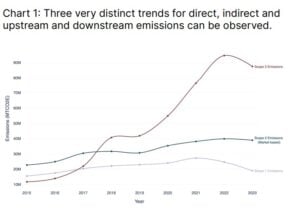
Because of this, many chipmakers plan to reach net-zero emissions by 2040 to 2050. They are also switching to renewable energy and improving efficiency to lower their environmental impact.
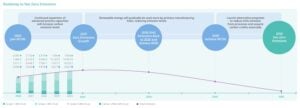
TSMC is switching to cleaner and more efficient methods. Key sustainability goals and actions include:
- Net-zero emissions by 2050: TSMC has pledged to reach full carbon neutrality across its operations.
- Renewable energy target: The company aims to use 100% renewable electricity by 2040.
- Energy efficiency improvements: Over the past five years, TSMC has cut energy intensity by about 15%, according to its latest ESG report.
- Water recycling: Its plants now recycle more than 85% of water used in production, a vital step in water-scarce regions like southern Taiwan.
- Supplier collaboration: TSMC works with its global partners to develop low-carbon manufacturing materials and reduce waste.
The company is on the Dow Jones Sustainability Indices and the CDP Climate Change A List. This shows its leadership in corporate climate action.
TSMC’s environmental strategy also aligns with customer expectations. Many of its clients, like Apple, NVIDIA, and AMD, aim for net-zero. They prefer suppliers who can show clear carbon reductions. This alignment helps the company secure long-term contracts while supporting the broader clean energy transition in tech manufacturing.
The Future: AI Chips and Green Tech Shape the Next Decade
The global semiconductor industry continues to expand rapidly, fueled by AI, electric vehicles, and digital infrastructure. According to the World Semiconductor Trade Statistics (WSTS) organization, worldwide chip sales could grow 15.4% in 2025, reaching nearly US $728 billion.
For TSMC, most of that growth will come from:
- AI and data-center chips used in training large language models.
- Automotive semiconductors for self-driving and electric vehicles.
- 5G and IoT technologies, which connect billions of smart devices.
As more countries invest in digital and AI ecosystems, the need for efficient, low-carbon chip production will rise. TSMC’s focus on sustainability gives it a competitive edge as a responsible manufacturer adapting to global climate goals.
By 2030, analysts expect AI chips to make up more than 25% of TSMC’s total revenue, compared with less than 10% in 2020. The combination of strong AI demand, ongoing capacity expansion, and environmental innovation positions TSMC to remain the world’s leading semiconductor foundry well into the next decade.
TSMC’s record-breaking third-quarter profit confirms its role at the center of the global AI revolution. With AI and high-performance computing driving over half its sales, the company is expanding aggressively while balancing sustainability goals.