Carbon CreditsClimate Impact Partners Unveils High-Quality Carbon Credits from Sabah Rainforest in Malaysia

Climate Impact Partners Unveils High-Quality Carbon Credits from Sabah Rainforest in Malaysia

The voluntary carbon market is changing. Buyers are no longer focused only on large volumes of cheap credits. Instead, they want projects with strong science, long-term monitoring, and clear proof that carbon has truly been removed from the atmosphere. That shift is drawing more attention to high-integrity, nature-based projects.

One project now gaining that spotlight is the Sabah INFAPRO rainforest rehabilitation project in Malaysia. Climate Impact Partners announced that the project is now issuing verified carbon removal credits, opening access to one of the highest-quality nature-based removals currently available in the global market.

Restoring One of the Worldโ€™s Richest Rainforest Ecosystems

The project is located in Sabah, Malaysia, on the island of Borneo. This region is home to tropical dipterocarp rainforest, one of the richest forest ecosystems on Earth. These forests store huge amounts of carbon and support extraordinary biodiversity. Some dipterocarp trees can grow up to 70 meters tall, creating habitat for orangutans, pygmy elephants, gibbons, sun bears, and the critically endangered Sumatran rhino.

However, the forest within the INFAPRO project area was not intact. In the 1980s, selective logging removed many of the most valuable tree species, especially large dipterocarps. That caused serious ecological damage. Once the key mother trees were gone, natural regeneration became much harder. Young seedlings also had to compete with dense vines and shrubs, which slowed the forestโ€™s recovery.

To repair that damage, the INFAPRO project was launched in the Ulu-Segama forestry management unit in eastern Sabah.

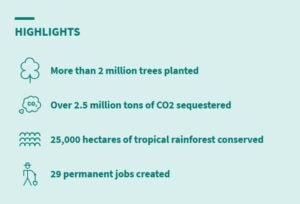
  • The project has restored more than 25,000 hectares of logged-over rainforest.
  • It was developed by Face the Future in cooperation with Yayasan Sabah, while Climate Impact Partners has supported the project and helped bring its credits to market.

Why Sabahโ€™s Carbon Removals are Attracting Attention

What makes Sabah INFAPRO different is not only the size of the restoration effort. It is also the way the project measured carbon gains.
SABAH MALAYSIA RAINFOREST
Source: face the future

Many forest carbon projects issue credits in annual vintages based on year-by-year growth estimates. Sabah INFAPRO followed a different path. It used a landscape-scale monitoring system and waited until the forest moved through its strongest natural growth period before issuing removal credits.

  • This approach gives the credits more weight. Rather than relying mainly on short-term annual estimates, the project measured carbon sequestration over a longer period. That helps show that the forest delivered real, sustained, and measurable carbon removal.

The scientific backing is also unusually strong. Since 2007, the project has maintained nearly 400 permanent monitoring plots. These plots have allowed researchers, independent auditors, and technical specialists to observe the full growth cycle of dipterocarp forest recovery. The result is a large body of field data that supports carbon calculations and strengthens confidence in the credits.

In simple terms, buyers are not just being asked to trust a model. They are being shown years of direct forest monitoring across the project landscape.

Strong Ratings Support Market Confidence

Independent assessment has also lifted the projectโ€™s profile. BeZero awarded Sabah INFAPRO an A.pre overall rating and an AA score for permanence. That places the project among the highest-rated Improved Forest Management, or IFM, projects in the world.

The rating reflects several important strengths. First, the project has very low exposure to reversal risk. Second, it has a long and stable operating history. Third, its measured carbon gains align well with peer-reviewed ecological research and independent analysis.

These points matter in todayโ€™s market. Buyers have become more cautious after years of debate over the quality of some forest carbon credits. As a result, they now look more closely at durability, transparency, and third-party validation. Sabah INFAPROโ€™s rating helps answer those concerns and makes the project more attractive to companies looking for credible carbon removal.

The project is also registered with Verraโ€™s Verified Carbon Standard under the name INFAPRO Rehabilitation of Logged-over Dipterocarp Forest in Sabah, Malaysia. That adds another level of market recognition and verification.

A Wider Model for Rainforest Recovery

Sabah INFAPRO also shows why high-quality nature-based projects are about more than carbon alone. The restoration effort supports broader ecological recovery in one of the worldโ€™s most important rainforest regions.

Climate Impact Partners said it has worked with project partners to restore degraded areas, run local training programs, carry out monthly forest patrols, and distribute seedlings to support rainforest recovery beyond the project boundary. These efforts help strengthen the wider landscape and expand the projectโ€™s environmental impact.

That broader value is becoming more important for buyers. Companies increasingly want projects that support biodiversity, ecosystem health, and local engagement, along with carbon removal. Sabah INFAPRO offers that mix, making it a stronger fit for the marketโ€™s shift toward higher-integrity credits.
Why IFM is Getting More Attention in the Carbon Market

The projectโ€™s launch also fits a wider shift in the voluntary carbon market. Improved Forest Management refers to practices that help existing forests store more carbon or avoid emissions through better stewardship. Unlike afforestation or reforestation, which involve creating or replanting forests, IFM focuses on improving the way current forests are managed.

These practices can help forests grow older, become more diverse, and stay healthier under climate stress. They can also support timber production in some cases by improving harvest cycles rather than stopping forest use altogether.

Because IFM projects often operate over very long periods, sometimes 100 years or more, they can generate lasting climate benefits. Still, buyers must be careful. Quality varies widely across projects, and strong due diligence remains essential.

IFM CARBON CREDITS

That is why Sabah INFAPRO is drawing attention. Although IFM supply has grown in recent years, truly high-quality carbon removal credits within the category remain limited.

Nature-Based Carbon Removal Still Leads the Market

Nature-based carbon removal continues to dominate the spot market, as reported by Carbon Direct. In 2025, about 95% of all carbon dioxide removal credits issued in the voluntary carbon market came from nature-based pathways. Only 5% came from higher-durability pathways such as biochar or BECCS.

This shows two things at once. First, nature-based carbon removal still plays the leading role in todayโ€™s market. Second, high-durability removal technologies are still at an early stage of deployment.

Demand Side:ย 

Within nature-based credits, supply conditions differ sharply by project type.

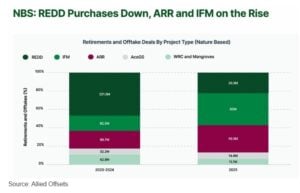
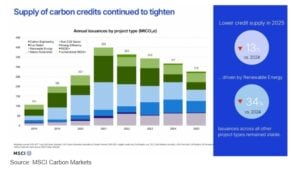
  • Afforestation, reforestation, and revegetation, known as ARR, have remained tight. Over the past four years, ARR issuances and retirements have stayed close to a 1:1 ratio, while annual issuance has held nearly flat at around 7 million to 8 million metric tons. That has left limited ARR inventory available for spot buyers.
  • IFM has followed a different path. Issuances have grown about 2.5 times since 2023, making it one of the biggest growth areas in nature-based carbon credits. Even so, the supply of top-tier IFM carbon removal credits remains much smaller than headline volumes suggest.

Supply Side:ย 

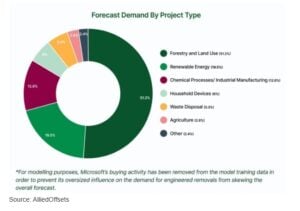
At the same time, buyer behavior is shifting. Demand has moved away from many older REDD+ projects and toward IFM, ARR, agriculture-based projects, and other credit types viewed as more credible or better aligned with corporate climate goals.

Retirements have dipped slightly, but that does not necessarily mean interest is fading. Buyer participation has remained steady. What changed is the purchasing strategy. Companies are becoming more selective about what they buy, when they buy, and how much they are willing to pay for quality.

Meanwhile, long-term nature-based offtakes and purchase commitments have risen above 90 million tons of future delivery. Most of those commitments are concentrated in ARR projects. That trend shows both how tight ARR supply is today and how seriously buyers are trying to secure future volume.

FOREST carbon credits

Against that backdrop, Sabah INFAPRO enters the market at the right time. It offers a rare mix of long-term monitoring, strong scientific backing, high biodiversity value, and verified removals. For buyers looking for high-quality nature-based carbon removal, this Malaysian rainforest project may become an important benchmark.


Most Popular


Ultimate Guide


Loading...


LATEST CARBON NEWS

Formula 1โ€™s (F1) Race to Net Zero Gains Speed as Emissions Fall 35%: Can It Really Reach the Finish Line?

Formula 1 has reported a 35% reduction in its carbon footprint since 2018, putting the sport on track to achieve its Net Zero 2030...

AI’s Next Frontier Is Space, but Orbital Data Centers Cost 3x More Than Earth, Says Wood Mackenzie

Artificial intelligence is causing a huge rise in computing demand. Today's AI models already use a lot of electricity. The next generation of AI...

Carbon Accounting Explained: The Complete Guide to Measuring, Reporting, and Reducing Corporate Emissions

Climate action starts with measurement. Before companies can reduce greenhouse gas emissions, achieve net-zero goals, or show sustainability progress to investors, they first need...

Under Trumpโ€™s Energy Agenda, Invenergy Drops $765M Offshore Wind Projects for Natural Gas and Geothermal

The U.S. energy landscape is shifting again. Invenergy, one of America's largest private energy developers, has agreed to end four offshore wind lease projects...
CARBON INVESTOR EDUCATION

What Does “Net Zero Emissions” Really Mean?

The recent report from climate scientists is crystal clear: the world must act now. That means limiting global warming to 2 or 1.5 degrees...

Planting Trees for Carbon Credits: Everything You Need to Know

As climate change intensifies, nations and industries are seeking innovative ways to cut carbon footprints. Carbon credits have emerged as a key tool in...

What is SMR? The Ultimate Guide to Small Modular Reactors

Energy is the cornerstone of modern life. We need electricity for healthcare, transportation, communication, and more. Many countries are choosing nuclear power because it...

What Is Carbon Dioxide Removal? Top Buyers and Sellers of CDR Credits in 2024

The world must remove 5โ€“16 billion metric tons of COโ‚‚ annually by 2050 to limit global warming to 1.5ยฐC. But with emissions still rising,...