

The voluntary carbon market (VCM) has struggled for years with one major problem: trust. Concerns about credit quality, transparency, and climate impact have made many companies cautious about buying carbon credits. Now, Amazon is trying to address this challenge.
The company has expanded its carbon credit service to qualified businesses in the United Kingdom. The move marks the first international expansion of the program since it launched in the United States in 2025.
Eligible companies can use Amazon’s Sustainability Exchange platform that offers a selection of vetted carbon credits. These credits are meant to support their efforts in reducing emissions.
The expansion comes as demand for trusted carbon credits continues to grow. More companies now want credits backed by strong science and measurable climate benefits.
Why Amazon Is Expanding Its Carbon Credit Service
For Amazon, the initiative supports its Climate Pledge commitment to reach net-zero carbon emissions by 2040. For the broader market, it could help channel more private capital toward forest protection, carbon removal, methane reduction, and other climate solutions.
Kara Hurst, Amazon’s chief sustainability officer, said:
“The voluntary carbon market has struggled with transparency and quality, making it hard for companies to invest with confidence. But the science is clear: we need to protect forests, restore ecosystems, and remove carbon at scale. We’re using our size and technical expertise to make high-quality credits available to ambitious UK companies already doing the hard work of cutting their own emissions and wanting to go further.”
Amazon says the service is only for companies that are already reducing emissions. Many businesses have cut emissions by purchasing renewable electricity, improving efficiency, electrifying fleets, and redesigning supply chains.
Yet, some emissions remain difficult to eliminate. These are often called residual emissions. That is where carbon credits can help. Amazon’s carbon credit portfolio includes several climate solutions:
- Forest protection and avoided deforestation.
- Ecosystem restoration and reforestation.
- Direct air capture carbon removal.
- Methane reduction and refrigerant destruction.
- Lower-carbon fuel insets linked to supply chains.
To qualify for the program, companies must:
- Have a net-zero target no later than 2050.
- Cover Scope 1, Scope 2, and Scope 3 emissions.
- Measure and publicly report greenhouse gas emissions regularly.
Amazon says these requirements help ensure carbon credits support emissions reductions rather than replace them. This approach shows increasing advice from climate groups and standard-setting organizations. They stress that companies must focus on reducing emissions and should only use carbon credits for any emissions that remain.
Beyond Offsets: The Rise of Carbon Insets
One notable feature of Amazon’s platform is its inclusion of carbon insets. Traditional carbon offsets support projects outside a company’s operations. Insets focus on reducing emissions within a company’s own value chain.
Examples include lower-carbon fuels (SAF) used in transportation or projects that reduce emissions from agricultural suppliers. Many experts view insetting as a key climate tool. It directly targets emissions tied to products and services.

Amazon’s Sustainability Exchange offers both neutralization credits and inset credits. The company says this gives businesses more options to address emissions both inside and outside their operations.
This reflects a broader shift in climate strategy. Companies increasingly want to reduce emissions across their entire value chain, not simply offset them elsewhere.
Inside Amazon’s Push Toward Net Zero
The expansion also highlights Amazon’s broader climate strategy. The company co-founded The Climate Pledge in 2019 and committed to reaching net-zero carbon emissions by 2040, ten years ahead of the Paris Agreement timeline. More than 550 organizations have since joined the initiative.
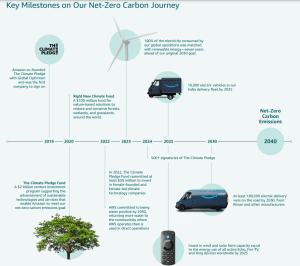
Amazon says it has made progress toward those goals. According to its latest sustainability report:
- Carbon intensity has fallen by more than 40% since 2019.
- Amazon remained the world’s largest corporate purchaser of renewable energy for the fifth straight year in 2024.
- The company has supported more than 600 solar and wind projects worldwide.
- Amazon deployed more than 31,000 electric delivery vans globally by the end of 2024.
Even so, Amazon reported about 68 million metric tons of CO₂e emissions in 2024. The figure shows how difficult it can be to reduce emissions while expanding a global business. In 2024, Amazon also launched the Sustainability Exchange platform to share climate tools, guidance, and best practices with suppliers and other companies.
- RELATED: Amazon Expands Its Carbon Credit Strategy with Lower-Carbon Fuel and Superpollutant Solutions
Carbon Markets Could Become a Major Climate Finance Tool
Many analysts believe voluntary carbon markets are still in the early stages of development.
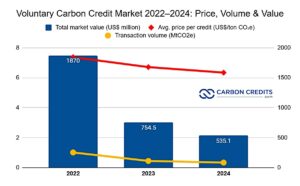
According to Ecosystem Marketplace, the market generated an estimated $535 million in transaction value in 2024. Activity is shifting towards higher-quality projects and carbon removal solutions. This is happening even though it’s below the peak of the carbon credit boom in 2021.
Long-term forecasts remain significant.
The Taskforce on Scaling Voluntary Carbon Markets estimated that the market could hit $50 billion by 2030 if conditions are right. McKinsey & Company predicts that the demand for carbon credits might grow over 15 times by 2030. By 2050, it could rise up to 100 times compared to today’s levels.
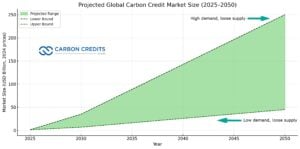
BloombergNEF estimates that global investment in carbon dioxide removal could reach hundreds of billions of dollars each year by mid-century. This funding is crucial for achieving net-zero pathways.
These forecasts help explain why large companies are investing in carbon projects today to secure future credit supply.
Balancing Climate Investments With a Massive AI Spending Push
Amazon’s carbon credit expansion comes at a time when the company is increasing spending across other parts of its business.
This week, Amazon secured a $17.5 billion delayed-draw loan facility led by major banks including Citibank, JPMorgan Chase, HSBC, Bank of America, and Wells Fargo. The financing allows Amazon to access capital gradually rather than borrow the full amount at once.
The tech giant said the funds are intended for general corporate purposes. However, investors widely see the move as supporting the company’s accelerating AI infrastructure buildout.
The financing adds to one of the biggest investment cycles in the company’s history.
Amazon previously outlined plans to spend about $200 billion in capital expenditures in 2026. Much of that is expected to support data centers, AI chips, cloud infrastructure, robotics, and other growth areas.
In the first quarter of 2026 alone, capital expenditures reached $44.2 billion, up from $25 billion a year earlier. Over the same period, trailing twelve-month free cash flow fell to about $1.2 billion from $25.9 billion as investment accelerated.
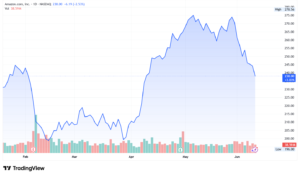
Investors reacted cautiously. Amazon stock slips slightly following the announcement of the deal.
A Defining Moment for the Future of Carbon Credits
Amazon’s UK expansion reflects a broader change in climate finance. Carbon credits are becoming a strategic tool for companies working toward net-zero goals.
The market’s future will depend on quality, transparency, and measurable climate benefits. Buyers increasingly want proof that credits deliver real emissions reductions or removals. Amazon is betting that stricter standards and stronger project screening can help build that confidence.
As net-zero deadlines draw closer, demand for trusted carbon credits is expected to grow. If that happens, access to credible carbon markets could become as important to many companies as access to renewable energy is today.