

The European Central Bank (ECB) is working hard to cut the carbon footprint of its investment portfolios. It aims to support Europe’s green transition. Recent climate disclosures show that by 2025, the ECB and Eurosystem reduced portfolio emissions and increased green bond investments. They also introduced new reporting methods for clearer decarbonization insights.
While emissions are decreasing, future progress depends more on companies reducing their greenhouse gas emissions than on central bank strategies. The ECB is also focusing on nature-related risks alongside climate change.
ECB Portfolio Emissions Continue to Fall
The ECB released its fourth annual climate disclosures, covering various portfolios, including monetary policy and foreign reserves.
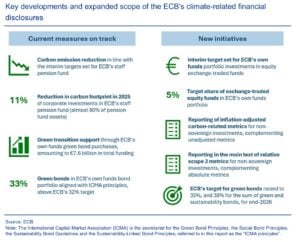
- It revealed that emissions from these portfolios fell again in 2025. This decline is partly due to a 13% reduction in the portfolios as bonds matured without full replacements.
A smaller investment portfolio leads to lower financed emissions. However, the ECB stressed that reducing the portfolio is just one part of the story. The central bank will continue pursuing climate-related investment goals where possible.
The Eurosystem is on track to meet its interim emissions reduction targets for corporate bond holdings. These targets use relative carbon intensity, comparing emissions to company revenue, aligning with the Paris Agreement and the EU’s climate neutrality goals.
New Inflation-Adjusted Metrics Show Real Climate Progress
A key change this year is the introduction of inflation-adjusted emissions metrics.
Previously, carbon intensity calculations used nominal revenues. High inflation could make carbon intensity look better, even if emissions stayed the same.
Now, the ECB adjusts revenues for inflation before calculating carbon intensity. This gives a clearer view of decarbonization, showing real emissions declines from operational changes and cleaner practices.
The bank believes these new indicators enhance transparency and help investors understand long-term climate performance.
Scope 3 Emissions Included for the First Time
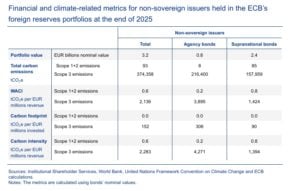
Another major improvement is the inclusion of Scope 3 emissions for non-sovereign holdings.
Scope 3 emissions are indirect greenhouse gas emissions from a company’s value chain, including those from suppliers and transportation. For many sectors, these emissions account for the largest share of total carbon output.
The ECB noted that improvements in emissions reporting now allow it to share these figures, though some limitations remain due to incomplete company reporting. Adding Scope 3 data gives investors a fuller picture of portfolio impacts and aligns with growing international reporting standards.
Green Bond Investments Continue to Expand
In addition to lowering emissions, the ECB is boosting investments that support climate solutions.
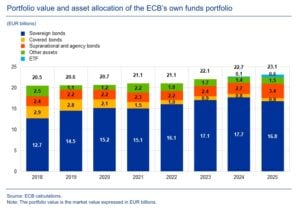
- By the end of 2025, the ECB’s own funds portfolio increased its green bond share to 33%, amounting to about €7.6 billion in projects supporting the green transition.
These investments fund renewable energy, energy efficiency, sustainable infrastructure, and clean transportation across Europe.
- The ECB aims to raise the green bond allocation to 35% in 2026, showing its commitment to sustainable finance.
Additionally, the ECB’s staff pension fund also made progress, with its corporate investments’ carbon footprint declining again in 2025, keeping it on track for climate goals.
ECB Puts Nature and Biodiversity Higher on Its Green Agenda
Climate change is no longer the ECB’s only environmental focus. The bank is expanding its assessment of nature-related risks, recognizing links between biodiversity loss, ecosystem degradation, and climate change.
Following last year’s disclosures, the bank again reported on portfolio exposure to industries that significantly impact nature, in line with the Taskforce on Nature-related Financial Disclosures (TNFD).
Nature-related reporting is growing. The ECB expects better data, and global standards will improve disclosure quality. The bank plans to gradually enhance these disclosures in future reports.
More Transparency, Stronger Climate Action
The ECB emphasizes that publishing detailed climate disclosures is key to improving transparency in financial markets.
National central banks in the Eurosystem, such as the Bundesbank, shared their climate reports with the ECB. This shows a united push to improve climate reporting in Europe.
The ECB will continue to include climate change and nature loss in its policies. While portfolio emissions are improving, future progress will depend more on companies, banks, and the broader economy taking faster action to reduce real-world emissions. They can’t just depend on financial portfolio changes.
Banks’ Critical Role in Financing Emissions
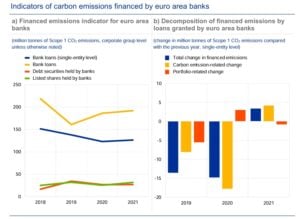
The report also emphasizes the crucial role banks have in financing corporate carbon emissions. Banks support businesses mainly through loans and, to a lesser extent, corporate bond investments. Thus, their lending choices heavily impact the financial system’s emissions.
It emphasized that financed emissions linked to euro area banks have generally decreased since 2018. However, progress has been uneven. After a significant drop during the COVID-19 pandemic, financed emissions rose slightly in 2021 as economic activity picked up.
But Future Emissions Cuts Will Become More Difficult
Despite ongoing reductions, the ECB recognizes that cutting emissions will become harder in the coming years.
Previously, the central bank favored reinvesting in companies with strong climate performance when bonds matured. But as monetary policy portfolios shrink, there are fewer opportunities to adjust for lower-emission companies.
Future reductions in financed emissions will rely more on businesses actively lowering their greenhouse gas emissions. Passive portfolio reduction alone won’t drive significant climate gains. Companies need to accelerate decarbonization through cleaner technologies and renewable energy.
Notably, the ECB found that banks have made limited changes to their lending portfolios. Most of the decline in financed emissions came from shifts in corporate emissions, not from banks moving loans to lower-carbon firms.
These findings indicate that European banks have not yet significantly reduced lending to high-emission businesses. Stronger financial sector action is essential for Europe to transition to a low-carbon economy.