

The race for uranium supplies is changing. The U.S. is expanding nuclear power to meet rising electricity demand. Companies are now exploring new fuel sources beyond traditional mining.
Austin-based SuperCritical Materials has secured an exclusive license from the U.S. Department of Energy (DOE). Their goal is to commercialize a patented technology that extracts uranium from seawater. The company believes this breakthrough will enhance domestic nuclear fuel security and lessen reliance on foreign uranium, especially as advanced reactors near large-scale deployment.
This technology was developed by the DOE’s Office of Nuclear Energy, with research led by Pacific Northwest National Laboratory (PNNL). After years of lab work, SuperCritical now has exclusive rights to manufacture and use this process in the U.S. before expanding to allied nations.
A Growing Need for Domestic Uranium
The DOE license comes as the U.S. works to rebuild its uranium industry after years of relying on imports.
- The EIA reports that U.S. uranium concentrate (U₃O₈) production reached 1.04 million pounds in the first quarter of 2026.
- It’s a slight 0.4% decline from 1.04 million pounds produced in the fourth quarter of 2025.
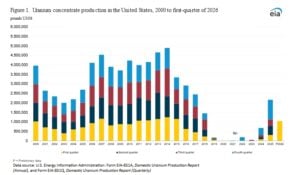
But, despite the small quarterly dip, domestic uranium production remains significantly higher than it was just a few years ago. Thus, while U.S. output remains below reactor demand, production is rising from historic lows, reflecting new investments in the nuclear fuel supply chain.
Despite this recovery, the U.S. still imports much of the uranium for its reactors. As nuclear generation grows and advanced reactors need new fuel types like HALEU, experts expect more domestic production capacity will be necessary. Technologies like seawater extraction could eventually complement traditional sources if they become commercially viable.
What Is Seawater Uranium Mining
Uranium fuels nuclear reactors, but mining alone may not meet future needs.
- The company revealed that the world’s oceans hold about 4.5 billion metric tons of dissolved uranium, over 1,000 times more than known land reserves. While the concentration is low, the ocean’s vastness makes seawater a significant untapped resource.
SuperCritical believes advances in chemistry and materials science could enable the economic recovery of some of this uranium. They also aim to extract other important minerals.
The company states its technology could be vital in the nuclear fuel supply chain. This would support utilities, reactor developers, and governments seeking long-term fuel security.
How the Technology Works
Instead of mining, the patented process captures dissolved uranium from seawater using specially treated acrylic fibers.
Here’s how it works:
- Acrylic fibers with proprietary materials are immersed in seawater.
- The fibers attract uranium and other dissolved metals through chemical reactions.
- Once saturated, the fibers are removed and placed in a solution that separates the metals.
- The fibers are treated and reused.
SuperCritical notes the system can run continuously due to the reusable fibers. The process is also environmentally friendly and requires less complex permitting than offshore oil and gas projects.
For early commercial operations, the recovered uranium concentrate, or yellowcake, could be processed at existing facilities in Texas. This avoids the need for new plants.
Here’s a picture of the setup
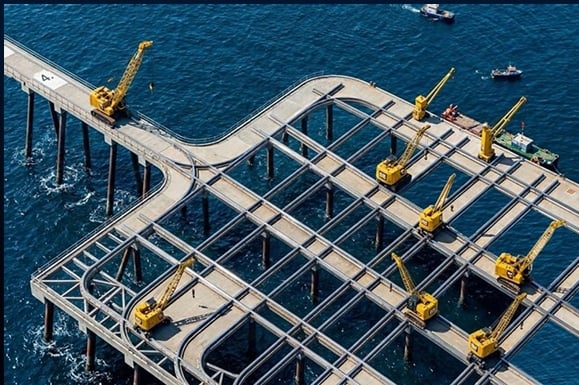
The technology may also increase supplies of other strategic minerals.
The U.S. government lists about 50 minerals and elements as critical to national security and economic competitiveness. The U.S. relies heavily on imports for many of these materials, while China dominates global production of rare earth elements.
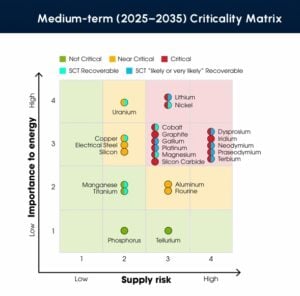
The company claims its process could recover 23 important metals dissolved in seawater along with uranium. While commercial recovery rates need testing on an industrial scale, the company believes the technology could help diversify mineral supply chains.
This effort aligns with recent federal initiatives to boost domestic mineral production, strengthen the nuclear industry, and expand access to offshore resources.
Supporting America’s Growing Nuclear Ambitions
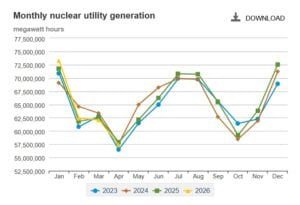
The DOE license arrives as the U.S. aims to grow nuclear power to meet rising electricity demand from AI, advanced manufacturing, data centers, and electrification.
SuperCritical reports that policymakers are shifting from building reactors to securing the fuel they need.
As advanced reactor deployment speeds up, pressure rises across all stages of the nuclear fuel cycle, including:
- Uranium production
- Conversion
- Enrichment
- High-Assay Low-Enriched Uranium (HALEU) production
- Fuel fabrication
The company warns these upstream challenges could pose major issues for the nuclear industry’s future.
Building the “Fuel Layer” of the Intelligence Economy
SuperCritical sees itself as building the “fuel layer” of the emerging Intelligence Economy—an economy driven by AI, robotics, and advanced computing. Just as coal fueled the Industrial Revolution, abundant nuclear energy could power the next economic wave.
Alexander Canon Bryan, Founder and Chief Executive Officer of SuperCritical Materials, noted:
“Our objective is straightforward. If the Intelligence Economy requires abundant, reliable nuclear energy, then it will also require abundant, reliable nuclear fuel. SuperCritical is building the infrastructure needed to help supply that fuel. We are proud to advance technology developed by the U.S. Department of Energy and contribute to strengthening America’s energy security, industrial competitiveness, and technological leadership.”
Looking Ahead
SuperCritical believes unconventional fuel sources are vital for meeting this demand. The company plans to commercialize DOE-developed technology. This will allow them to convert seawater into a sustainable uranium source and strengthen the U.S. nuclear fuel supply chain.
Though challenges remain, the DOE license marks an important milestone. If the technology succeeds in industrial use, it could provide the U.S. and its allies with a secure source of uranium and critical minerals for decades.