

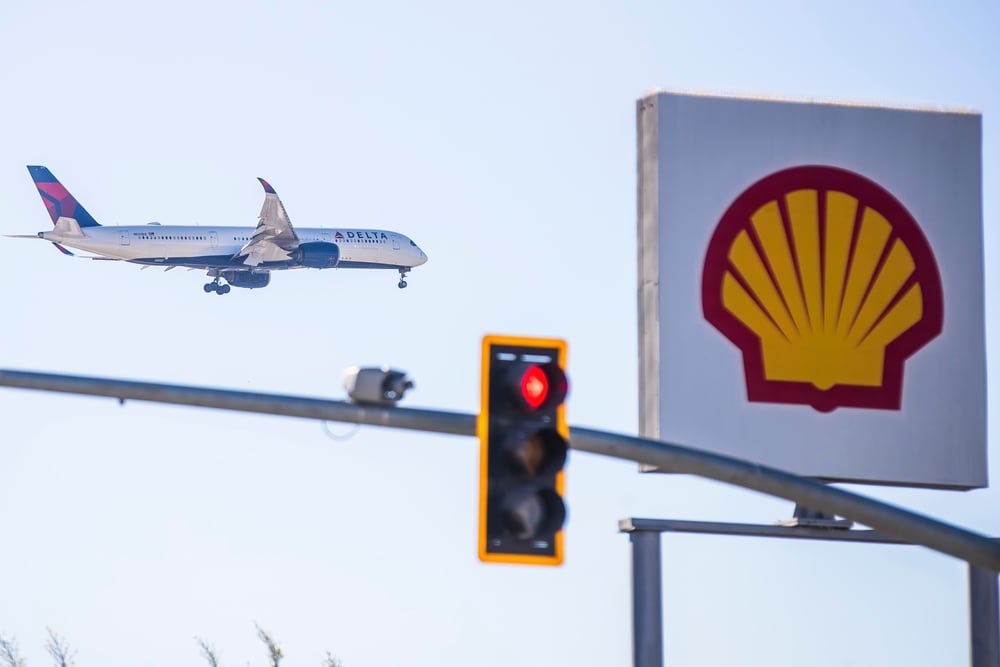
Delta Air Lines and Shell are deepening their partnership to help expand sustainable aviation fuel (SAF) across the United States. The companies have signed a five-year agreement to increase SAF supply and strengthen the infrastructure needed to deliver it at airports.
The deal goes beyond supplying cleaner fuel. It also focuses on building the storage, blending, and distribution network needed to scale SAF across Delta’s operations.
The timing is significant. Airlines face growing pressure to cut emissions while passenger demand continues to recover. Delta aims to reach net-zero greenhouse gas emissions by 2050, while Shell is expanding its lower-carbon fuels business as part of its energy transition strategy.
Their SAF agreement will expand production for flights involving five major airports:
- Los Angeles International Airport (LAX),
- Portland International Airport (PDX),
- John F. Kennedy International Airport (JFK),
- Logan International Airport (BOS), and
- Minneapolis-St. Paul International Airport (MSP).
Aviation Has Few Low-Carbon Alternatives
Aviation remains one of the world’s hardest industries to decarbonize. According to the International Energy Agency (IEA), aviation produces about 2.5% of global energy-related CO₂ emissions.
Air travel demand also continues to grow, increasing fuel consumption. Also, long-haul aircraft still cannot rely on batteries or hydrogen at a commercial scale.
That makes sustainable aviation fuel one of the few technologies available today that can significantly reduce lifecycle emissions while using existing aircraft and airport infrastructure.
The International Civil Aviation Organization (ICAO) has adopted a long-term goal for international aviation to achieve net-zero carbon emissions by 2050. Airlines worldwide have also committed to the same target through the IATA.
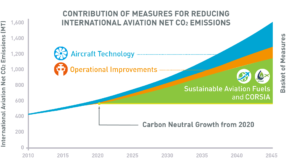
Meeting that goal will require a mix of cleaner fuels, more efficient aircraft, improved operations, and new propulsion technologies.
SAF Production Is Growing, But Supply Remains Tight
Sustainable aviation fuel production is rising quickly, but it still represents only a tiny share of global jet fuel. According to the IEA and IATA:
- Global SAF production reached about 2 million tonnes, or 2.5 billion liters, in 2025.
- That represents about 0.7% of global airline fuel consumption, more than double the share in 2024.
Production is expected to continue increasing in 2026 as new refineries and expansion projects come online, although it will still remain well below demand.
The numbers highlight why airlines continue signing long-term supply agreements. Demand is growing much faster than production, driving investment across the entire supply chain—from feedstock collection and fuel production to airport infrastructure.
Delta Is Betting on SAF to Reach Net Zero
Delta has made sustainable aviation fuel a core part of its climate strategy. The airline’s roadmap to net-zero emissions by 2050 focuses on cutting emissions directly across its operations instead of relying mainly on carbon offsets.
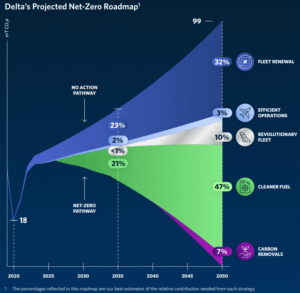
Its strategy includes expanding sustainable aviation fuel use, modernizing its fleet with more fuel-efficient aircraft, improving operational efficiency, and supporting next-generation aviation technologies.
Fleet renewal is already delivering results. New-generation aircraft such as the Airbus A321neo burn about 20% less fuel per seat than the older aircraft they replace, reducing both fuel costs and emissions.
Delta has also invested in flight optimization, lighter onboard equipment, and other operational improvements that reduce fuel burn across its network. The airline continues to describe SAF as its largest long-term opportunity to cut aviation emissions because it works with today’s aircraft and fueling infrastructure.
Amelia DeLuca, the airline’s Chief Sustainability Officer, remarked:
“Current instability and uncertainty have made one thing very clear to consumers and businesses alike — supply diversity matters. With Shell, we’re proving that scaling SAF isn’t theoretical, it’s achievable. This is about activating real supply chains at scale and creating a model that others can build on as we work across the industry to expand lower-impact travel.”
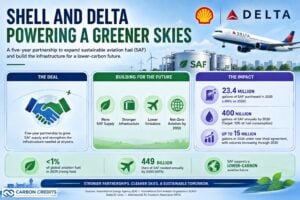
Delta has disclosed substantial procurement commitments, even if it has not disclosed their total value:
- Bought 23.4 million gallons of SAF in 2025, an 80% increase from 2024. Since 2021, it has used 42 million gallons of SAF.
- Committed to sourcing 400 million gallons of SAF annually by 2030 to meet its target of using SAF for 10% of its fuel consumption.
The airline’s previously announced contracts include:
-
- 75 million gallons per year for seven years from Gevo (about 525 million gallons total),
- 10 million gallons from Shell for LAX under the 2023 agreement, and
- The new 2026 Shell agreement provides at least 15 million gallons in 2026, with options to increase volumes each year through 2030.
Shell Builds a Bigger Role in Low-Carbon Aviation
The agreement also supports Shell’s broader energy transition strategy. The company continues investing in several lower-carbon businesses, including SAF, renewable fuels, hydrogen, electric vehicle charging, and carbon capture and storage (CCS).
Reema Bari, Head of Aviation Americas at Shell, stated:
“This collaboration delivers on today’s fuel needs and tomorrow’s aviation solutions. By supplying conventional jet, SAF, and longer-term innovation, the deal will help strengthen energy security and contribute to the transformation of aviation.”
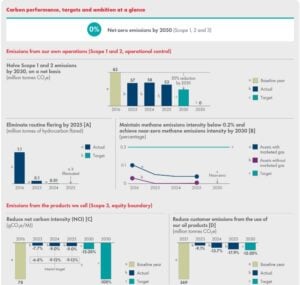
The energy giant aims to become a net-zero emissions energy business by 2050, in step with society’s progress toward achieving the goals of the Paris Agreement.
As governments introduce new aviation fuel policies and blending requirements, demand for SAF continues to grow. Expanding supply partnerships allows Shell to strengthen its position in one of the fastest-growing low-carbon fuel markets.
The Missing Link in SAF’s Growth Story
Producing more SAF is only part of the solution. The fuel must also reach airports efficiently. Unlike conventional jet fuel, SAF requires dedicated infrastructure, including:
- Storage tanks,
- Blending facilities,
- Quality testing systems, and
- Distribution and pipeline networks.
Without these investments, higher fuel production alone cannot meet growing airline demand.
As more airlines commit to SAF, airports must also expand their fuel handling systems. Industry experts increasingly see infrastructure as one of the biggest barriers to scaling sustainable aviation fuel.
Infrastructure is becoming one of the industry’s biggest challenges. According to the International Air Transport Association, airlines will need 449 billion liters of SAF each year by 2050 to reach the industry’s net-zero target.
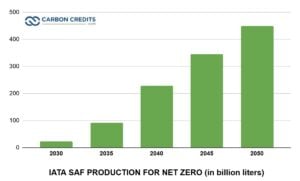
Building the fuel alone will not be enough. Airports must also develop the facilities needed to receive and deliver those much larger volumes.
Carbon Markets Help Fuel the SAF Boom
Carbon markets are becoming an important driver of SAF investment.
Under the Carbon Offsetting and Reduction Scheme for International Aviation (CORSIA), airlines can reduce their compliance obligations by using eligible sustainable aviation fuels that deliver verified lifecycle emissions reductions.
Many SAF pathways also qualify for programs such as the U.S. Low Carbon Fuel Standard (LCFS) and federal clean fuel incentives. These policies improve project economics and encourage producers to expand capacity.
The industry is also adopting book-and-claim systems and SAF certificates. These mechanisms allow companies to support SAF production even when physical fuel cannot be delivered to every airport, thereby increasing market demand as infrastructure continues to expand.
Laying the Runway for Net-Zero Flight
The Delta-Shell partnership highlights how the aviation industry is evolving.
Although SAF still supplies less than 1% of global aviation fuel, production continues to increase as airlines strengthen their climate commitments and governments expand support for cleaner fuels.
The agreement also reflects a broader shift across the aviation sector. Companies are investing across the entire SAF value chain—from production and logistics to airport infrastructure—to prepare for much larger volumes in the years ahead.
As the industry works toward its 2050 net-zero goal, expanding fuel supply alone will not be enough. Building a reliable distribution network will be essential to making sustainable aviation fuel available wherever aircraft operate.