

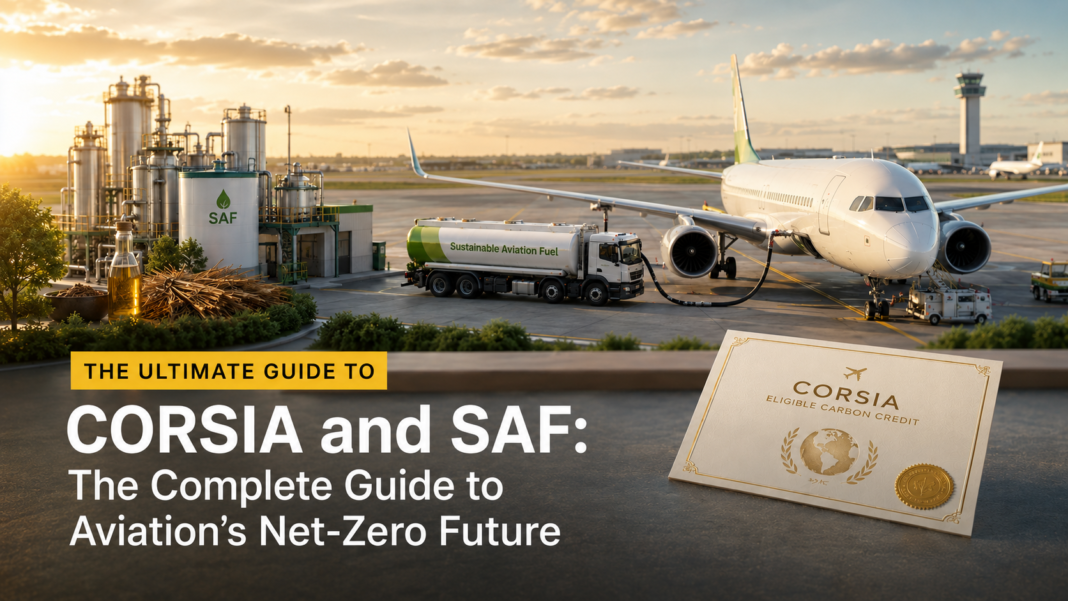
Aviation is entering a new phase in its efforts to cut carbon emissions. As air travel grows, airlines face pressure to reduce emissions while meeting the demands of long-distance flight. Carbon Offsetting and Reduction Scheme for International Aviation (CORSIA) and sustainable aviation fuel (SAF) are becoming key tools, creating new policies, markets, and investment opportunities across the aviation industry.
This guide explains how CORSIA works, how SAF fits into aviation’s decarbonization strategy, and where the market is headed. It covers CORSIA rules and timelines, eligible carbon credits and fuels, SAF production pathways, market trends, costs, policy drivers, and the supply gap the industry must close to reach net zero.
CORSIA and SAF: Why Aviation Needs a New Decarbonization Strategy
Aviation is one of the harder sectors to decarbonize. Aircraft need energy-dense fuels that can support long flights without adding excessive weight. Unlike cars, most commercial aircraft cannot yet switch to large battery systems at scale.
Aviation produces about 2.5% of global human-caused CO₂ emissions, according to the International Air Transport Association (IATA). Its wider climate impact also includes non-CO₂ effects such as contrails and nitrogen oxide emissions.
This makes aviation’s transition more complex than simply replacing fossil fuels with electricity. More efficient aircraft, improved flight operations and new propulsion systems can all reduce emissions. However, sustainable aviation fuel could play a major role in the near term.
SAF can be produced from feedstocks such as used cooking oil, agricultural waste and other renewable materials. It can also be used in existing aircraft as a drop-in fuel, allowing airlines to reduce lifecycle emissions without replacing their fleets. IATA estimates SAF could provide about 65% of the emissions reductions needed for aviation to reach net-zero CO₂ emissions by 2050.
SAF is not the only solution. CORSIA, ICAO’s global market-based measure for international aviation, addresses emissions that remain after other reduction measures. Together, SAF and CORSIA form two important parts of aviation’s broader path toward net zero.
What Is CORSIA?
CORSIA is a global system created by the International Civil Aviation Organization (ICAO) to address the growth of CO₂ emissions from international aviation. It works alongside cleaner fuels, aircraft efficiency, and improved flight operations.
CORSIA’s offsetting requirements apply to eligible international flights between participating states. Domestic aviation is outside the scheme’s offsetting system. Airlines covered by CORSIA must also monitor, report, and verify their emissions under the program’s MRV requirements.
For 2024–2035, CORSIA uses a baseline equal to 85% of 2019 emissions. When an airline has an offsetting requirement, it must cancel eligible emissions units to cover the required amount.
CORSIA is therefore different from a conventional carbon tax. It creates a framework for managing specific international aviation emissions through approved emissions units.
The scheme also recognizes the emissions benefits of CORSIA Eligible Fuels, including qualifying SAF. This creates an important link between aviation fuel markets and carbon markets.
- In simple terms, SAF helps reduce aviation’s emissions, while CORSIA provides a framework for addressing some emissions that remain.
CORSIA Timeline: From Pilot Phase to Full Implementation
CORSIA was adopted by ICAO in 2016 and is being introduced in stages. This phased approach gives airlines, governments, and carbon-market participants time to build the systems needed for monitoring emissions and meeting offsetting requirements.
The Pilot Phase ran from 2021 to 2023. During this period, participation was voluntary, allowing countries and airlines to gain experience with CORSIA’s monitoring, reporting, and verification requirements.
The First Phase covers 2024 to 2026, with states participating voluntarily. However, airlines operating on routes between participating states can still be subject to CORSIA offsetting requirements. This is the phase CORSIA is currently in.
The Second Phase will run from 2027 to 2035. Participation becomes broader, although ICAO provides exemptions for certain states based on factors such as their level of international aviation activity and development status.
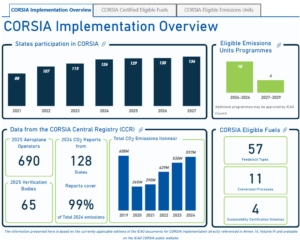
As of 2026, 130 states participate voluntarily in CORSIA. ICAO lists 134 participating states from 2027, when the Second Phase begins. Together, these phases are designed to expand the system while giving countries time to establish the necessary regulatory and reporting frameworks.
Beyond 2035, CORSIA will continue to operate as part of ICAO’s wider strategy for achieving net-zero carbon emissions from international aviation by 2050.
How CORSIA Calculates Airline Offset Requirements
CORSIA does not require airlines to offset all of their international aviation emissions. Instead, it focuses on emissions above a set baseline.
- From 2024 to 2032, the system mainly uses the growth of international aviation as a whole (100%). This is called the sectoral approach. It means an airline’s offset requirement is linked to the industry’s overall emissions growth, rather than only its own growth.
- From 2033 to 2035, the calculation will use both industry-wide and airline-specific emissions growth. The sectoral share will be 85%, while the airline-specific share will be 15%.
Airlines can also reduce their CORSIA obligation by using CORSIA Eligible Fuels, including qualifying SAF. They must provide records showing the amount of fuel used and its emissions savings.
This gives airlines two main ways to lower their CORSIA costs:
- reduce emissions, and
- use eligible lower-carbon fuels.
CORSIA Carbon Credits: What Can Airlines Use?
Airlines with a CORSIA offsetting requirement must cancel approved CORSIA Eligible Emissions Units (carbon credits) to cover it. These are not the same as any carbon credits sold in the voluntary carbon market. ICAO has a specific approval process for carbon credit programs that want to supply units for CORSIA.
The organization checks programs against rules covering areas such as additionality, monitoring, verification, and double counting. These rules are designed to make sure the claimed emissions reductions are real and properly tracked.
ICAO updates its list of eligible programs and units over time. As of April 2026, the framework includes programs such as the American Carbon Registry, Climate Action Reserve, Gold Standard, Isometric, and Verra’s Verified Carbon Standard, subject to specific eligibility conditions.
Importantly, being part of an approved program does not mean every credit from that program can be used under CORSIA. Eligibility can depend on factors such as the credit type, vintage, compliance period, and additional authorization requirements.
This has created a potential supply problem…
A July 2026 analysis from Sylvera estimates that CORSIA could create demand for about 163 million eligible emissions units (EEUs) during its first compliance phase, rising to 198 million credits under full implementation. Yet only about 38 million credits currently qualify, covering just 23% of expected first-phase demand. This creates a potential 125 million-credit supply gap.
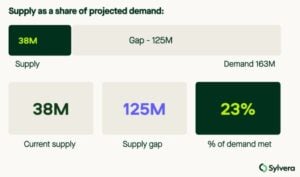
The problem is not a lack of issued credits. About 300 million credits have been issued. However, many can’t qualify for CORSIA. They lack the necessary host-country Letters of Authorization or Corresponding Adjustments under Article 6 of the Paris Agreement.
By January 2028, the eligible supply might hit 640 million credits. However, Sylvera estimates that only about 104 million could be eligible due to authorization risks. Just 48 million are fully confirmed.
Airline purchases also remain limited. Only around 400,000 tonnes of CORSIA credits had been retired, equal to about 0.2% of expected first-phase demand. Delayed buying could create a rush for eligible credits as compliance deadlines approach.
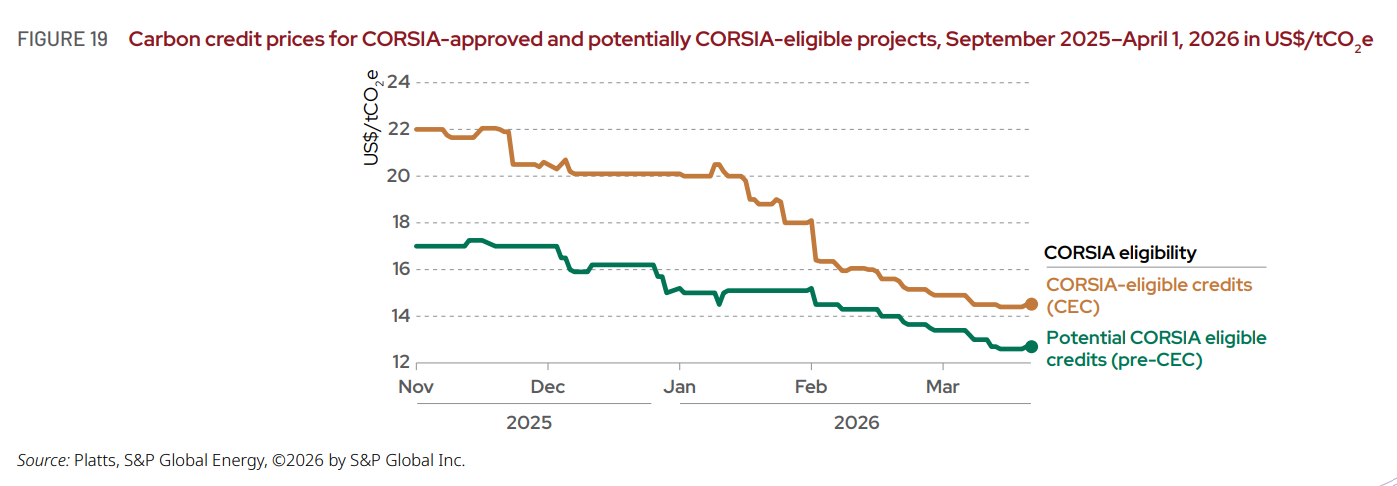
That shortage could push prices higher. Sylvera’s modeling puts first-phase credit prices at about $15 per tonne in a low case, $33 in a base case, and $53 in a high case by January 2028.
The long-term cost could be much larger. An MSCI Carbon Markets analysis shows that if supply tightens, CORSIA compliance costs might hit $127 billion from 2024 to 2035. By 2035, eligible credit prices could reach nearly $100 per tonne. Estimated exposure includes about $8 billion for Emirates, $6 billion for Qatar Airways, and $5 billion for United Airlines.
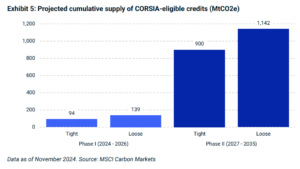
These figures show why CORSIA is becoming a distinct carbon market. The challenge is not simply finding credits, but securing enough high-quality, authorized units that meet CORSIA’s eligibility rules.
What Is Sustainable Aviation Fuel (SAF)?
Sustainable aviation fuel is aviation fuel made from renewable or waste-based materials. It is designed to replace part of the fossil jet fuel used by aircraft while producing lower emissions over its full lifecycle.
SAF can be made from feedstocks such as used cooking oil, animal fats, crop residues, forestry waste, and other biomass. Newer pathways can also use renewable electricity, hydrogen, and captured carbon to make synthetic fuels.
One of SAF’s main advantages is that it can work with today’s aircraft and fuel systems. Airlines can use approved SAF by blending it with conventional jet fuel, without replacing their existing fleets.
However, SAF is not automatically low-carbon. Its climate benefits depend on the feedstock, production method, energy source, and land-use impacts. CORSIA therefore uses lifecycle emissions to measure the climate performance of eligible fuels.
SAF also remains a very small part of the global fuel market. IATA expects global SAF production to reach about 2.4 million tonnes in 2026, equal to only 0.8% of total jet fuel use. But it must increase tremendously to 449 million tonnes by 2050 for net-zero aviation.
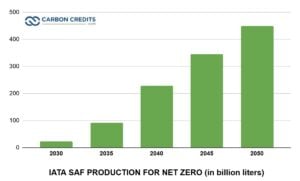
This large gap between current supply and future demand is one of the biggest challenges facing aviation’s net-zero plans.
SAF Feedstocks and Production Technologies: How SAF is Made
SAF can be made from many different materials. The choice of feedstock affects the fuel’s cost, emissions, and ability to scale.
Today, some of the main feedstocks include used cooking oil, animal fats, agricultural residues, forestry waste, and other forms of biomass. Waste and residue feedstocks are attractive because they can avoid some of the land and food concerns linked to conventional crops. ICAO groups SAF feedstocks into categories such as primary products, by-products, wastes and residues.
Several technologies can turn these materials into jet fuel. One of the most widely used is HEFA, which processes oils and fats with hydrogen. Other pathways include Fischer-Tropsch (FT), which can turn biomass or other carbon sources into fuel, and alcohol-to-jet (ATJ), which converts alcohols such as ethanol into aviation fuel.
Another emerging option is e-SAF, also called power-to-liquid fuel. It uses renewable electricity, hydrogen, and captured carbon to produce synthetic aviation fuel. This could greatly expand SAF supply because it is less dependent on biomass.
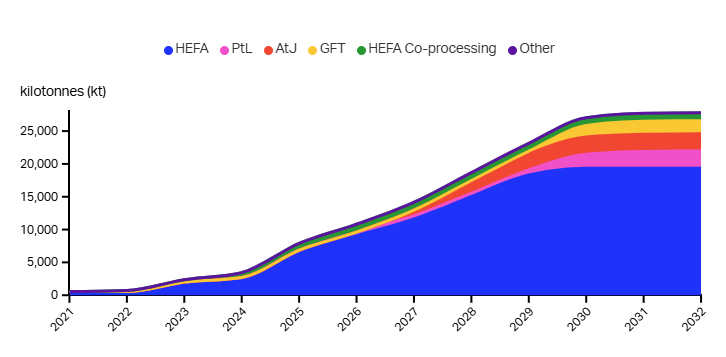
However, each pathway faces challenges. Waste feedstocks are limited, while newer technologies are still expensive and need more production capacity.
- This creates a key issue for the SAF market: the aviation industry needs much more fuel, but sustainable feedstocks and production capacity remain limited.
What Makes SAF Eligible Under CORSIA?
Not all SAF automatically qualifies under CORSIA. To receive CORSIA benefits, the fuel must meet ICAO sustainability rules and come from a producer certified under an ICAO-approved sustainability certification scheme.
One key requirement is emissions performance. CORSIA SAF produced from 2024 onward must achieve at least a 10% reduction in lifecycle greenhouse gas emissions compared with the baseline aviation fuel.
ICAO also considers factors such as land use, carbon stocks and the sustainability of the feedstock. This helps prevent fuels with poor environmental performance from receiving CORSIA benefits.
The system measures emissions across the fuel’s full lifecycle. This can include feedstock production, processing, transport, fuel production and aircraft use. It can also account for emissions linked to land-use change.
For airlines, this matters because qualifying SAF can lower their CORSIA offsetting requirement. The fuel must be properly certified, and its emissions savings must be supported by the required records. This creates a strong link between SAF production, sustainability certification, and the aviation carbon market.
ICAO’s CORSIA Eligible Fuels page was updated in June 2026. It now lists the Fourth Edition of the CORSIA Approved Sustainability Certification Schemes, and on June 22, 2026, ICAO approved Bonsucro as a new CORSIA-approved sustainability certification scheme.
The SAF Supply Gap: From 2.4M Tonnes to 500M
The biggest question for SAF is whether production can grow fast enough to meet future demand. As mentioned, IATA expects global SAF production to reach only 2.4 million tonnes in 2026. Yet, its net-zero pathway points to millions of tonnes of SAF per year by 2050.
- That means production must increase by more than 200 times from today’s level.
The challenge is not only building more SAF plants. The industry also needs enough sustainable feedstock, hydrogen, renewable power, refining capacity, and transport infrastructure.
Waste oils and fats are useful today, but their supply is limited. Other options, such as agricultural and forestry waste, could provide more fuel but require large collection and processing networks.
E-SAF could eventually reduce some feedstock limits by using renewable electricity, hydrogen and captured carbon. But the technology remains expensive and needs much more clean power.
The 2030s will therefore be critical. Governments will need stronger policies, while airlines and fuel producers will need to commit more capital.
If production grows slowly, SAF could remain a scarce and expensive fuel. If investment and technology scale quickly, it could become a much larger part of the global aviation fuel market.
- RELEVANT: SAF Crisis Deepens: IATA Says Aviation’s Net Zero Goal Is at Risk, but Brazil Offers New Hope
What Could Slow CORSIA and SAF Growth?
CORSIA and SAF face different challenges, but they are connected by the same goal: reducing aviation’s climate impact.
- For CORSIA, one challenge is coverage. The system applies to international aviation, while domestic flights are outside its offsetting system. Its impact also depends on how many states participate and how effectively airlines follow the rules.
- SAF faces a larger physical challenge. There is simply not enough low-carbon fuel available today. Production must grow much faster, while sustainable feedstocks remain limited.
- Cost is another major barrier. Airlines operate in a price-sensitive industry, so buying large amounts of expensive SAF can be difficult without policy support or customer demand.
- There is also a need for clear sustainability rules. SAF should deliver real emissions cuts without causing major damage through land-use change or other environmental impacts.
These challenges do not mean SAF or CORSIA will fail. They show why aviation needs a mix of solutions rather than relying on one technology or policy.
Conclusion: CORSIA and SAF Have Different Jobs
CORSIA and SAF are becoming important parts of aviation’s climate strategy, but they serve different purposes.
SAF tackles emissions at the fuel level. CORSIA helps address emissions that remain from international aviation. Together, they support a wider strategy that also includes better aircraft, more efficient operations and new technologies.
Closing the huge SAF production gap will require more than airline demand. Governments will need effective policies, producers will need major investment, and the industry will need new technologies and sustainable feedstocks.
CORSIA will also continue to evolve as its Second Phase begins in 2027. ICAO’s current framework already includes rules for eligible carbon units and fuels, giving the aviation industry a common system for managing international emissions.
The long-term outcome will depend on how quickly these systems can scale. For now, one point is clear: aviation’s path to net zero will depend heavily on making cleaner fuels available at much greater scale while strengthening the global rules that support emissions reductions.