


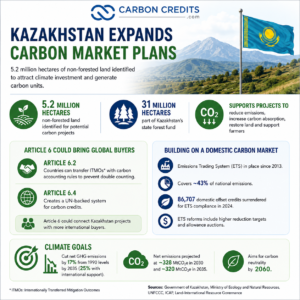
Kazakhstan has identified 5.2 million hectares of non-forested land for possible carbon projects. The move could help the country attract climate investment and create carbon units or credits for domestic and international markets.
The land is part of Kazakhstan’s 31 million-hectare state forest fund, according to Ecology and Natural Resources Minister Yerlan Nyssanbayev. The government says the land could support projects that cut emissions or increase carbon absorption.
Kazakhstan is also updating its carbon market rules and preparing to use Article 6 of the Paris Agreement for international carbon trading. The country aims to reach carbon neutrality by 2060. Its latest climate plan targets a 17% cut in net greenhouse gas emissions from 1990 levels by 2035, with a deeper 25% cut if it receives international support.
5.2 Million Hectares Could Support Carbon Projects
The 5.2 million hectares offer a large area for new carbon projects. However, Kazakhstan has not said that all of the land will produce carbon credits.
Minister Nyssanbayev said the land could support projects that reduce emissions and absorb carbon. The Asian nation sees opportunities in areas such as forestry, agriculture and energy efficiency. The government also wants carbon projects to help restore damaged land and expand green areas. Farmers could also gain new ways to take part in carbon markets.
However, the size of the land area does not tell us how many carbon units it could produce. Actual credit volumes will depend on the projects developed, the methods they use, and the results they can measure and verify.
New Rules Open a Path to Global Carbon Markets
Kazakhstan is also changing the rules for its carbon market. New rules on greenhouse gas emissions and carbon absorption took effect on August 10, 2026. They set procedures for climate projects under Article 6 of the Paris Agreement.
The rules cover validation, verification, monitoring, authorization, and baseline setting. They also set procedures for transferring verified emissions reductions or carbon removals to other countries.
This gives project developers a clearer process for moving from project design to carbon unit issuance and, potentially, international sales. But project approval does not automatically allow developers to sell all units abroad.
Projects must meet the required rules, monitor their results, and complete verification. International transfers also need government approval.
Article 6 Could Bring International Buyers
Article 6 gives countries a way to work together on emissions reductions. Under Article 6.2, countries can transfer internationally transferred mitigation outcomes, or ITMOs. The system includes carbon accounting and reporting rules to prevent double counting.
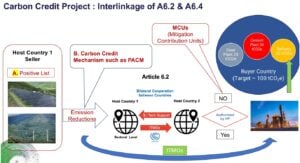
Article 6.4 creates a separate UN-backed system for carbon credits.
Kazakhstan’s latest climate plan also points to Article 6 as a way to attract international climate finance. The plan says Kazakhstan’s legal system allows the issuance and transfer of ITMOs, the use of corresponding adjustments, and future links between its national carbon market and wider regional or global markets.
For project developers, this could create access to more international buyers.
For buyers, however, project quality will remain critical. Projects must show that their emissions reductions or carbon removals are real and measurable. They must also meet the accounting rules under Article 6.
Kazakhstan Already Has a Domestic Carbon Market
Kazakhstan is not starting from zero. The country has operated an Emissions Trading System (ETS) since 2013. The system covers major facilities in sectors such as power, oil and gas, mining, metals, chemicals and manufacturing. Facilities that emit more than 20,000 tonnes of CO2 a year fall under the main ETS threshold.
Kazakhstan’s Ministry of Ecology and Natural Resources says the ETS covers about 43% of the country’s national emissions.
The country also allows carbon projects outside the ETS to generate domestic carbon credits. Companies covered by the ETS can use these credits to help meet their obligations.
In 2024, 86,707 domestic offset credits were surrendered for ETS compliance, according to the International Carbon Action Partnership. The new plan aims to build on this existing market and give carbon projects a path to international buyers.
ETS Changes Could Strengthen the Market
Kazakhstan is also working to make its ETS stronger. The government has discussed raising the annual emissions reduction rate to at least 2.73% during 2026–2030. That compares with 2.25% in 2024 and 2.26% in 2025.
The International Carbon Action Partnership says Kazakhstan’s draft national allocation plan for 2026–2030 proposed annual cap cuts of 10.4% to 23% from the 2025 level. The government is also developing an auction system for emissions allowances.
The Asian country received more support for these efforts in 2025. The World Bank’s Partnership for Market Implementation provided the country with a $4.8 million grant to strengthen its ETS, study allowance auctions, and prepare for international carbon markets under Article 6.
The project runs through June 30, 2028. These changes could help Kazakhstan build a stronger domestic carbon market while preparing for international trading.
Climate Goals Add Pressure for Investment
Kazakhstan’s carbon market plans also support its wider climate goals. Under its latest climate plan, Kazakhstan aims to cut net greenhouse gas emissions by 17% from 1990 levels by 2035. With international support, the country could target a 25% reduction.
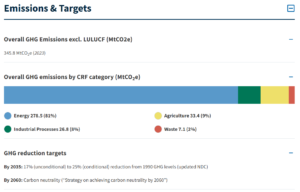
Kazakhstan also aims to reach carbon neutrality by 2060. The country expects changes in its power sector to help lower emissions. Under its main climate pathway, Kazakhstan projects net emissions of about 328 million tonnes of CO2e in 2030 and about 320 million tonnes in 2035.
Carbon projects can help fund emissions cuts and carbon removal. Still, carbon credits alone cannot deliver Kazakhstan’s climate goals. The country must also reduce emissions from energy and heavy industry, where fossil fuels remain important.
Exporters Face a Growing Carbon Challenge
Kazakhstan’s carbon market plans also matter for its exporters. The European Union’s Carbon Border Adjustment Mechanism (CBAM) entered its full phase in 2026. Kazakhstan has highlighted the possible impact on its industrial exporters and the need for better emissions data and carbon pricing.
This is important for carbon-intensive industries such as metals. A stronger domestic carbon market could help Kazakh companies measure emissions more accurately and prepare for rising carbon costs.
It could also make the country’s carbon projects more attractive to international investors if Kazakhstan can provide reliable monitoring, verification and accounting.
Land Is Only the Starting Point
Kazakhstan’s decision to identify 5.2 million hectares for potential carbon projects provides the country with a large base for new emissions reduction and carbon removal projects. But land alone will not create a successful carbon market.
Developers need clear rules, good monitoring and independent verification. International buyers also need confidence that credits represent real emissions reductions or carbon removals.
Kazakhstan already has a domestic ETS. It is now building new rules that could connect its carbon market with international climate finance.
If the new system works as planned, the 5.2 million hectares could become an important source of future carbon projects. The broader market reforms could also give those projects a path to buyers in Kazakhstan and abroad.
The next test will be how quickly Kazakhstan turns the available land and new rules into verified, investable, and internationally transferable carbon units.