

EU Carbon Prices May Push Bitcoin Mining Toward Russia, Study Finds
A new study suggests that higher European Union carbon prices may be linked to more Bitcoin mining activity in Russia, raising concerns about carbon leakage from Europe’s climate policies.
The study, “Does Carbon Pricing Displace Crypto-Mining Emissions? Quantile Evidence on Carbon Leakage from EU27, Russian and Rest-of-World Power Grids,” was submitted to MDPI. Researchers analyzed daily data from January 2019 to January 2026.
The researchers found a significant link between Bitcoin returns, EU carbon allowance returns, and Russian power sector emissions. They say the result is consistent with mining activity shifting toward Russia when Bitcoin prices and EU carbon prices rise.
However, the study does not prove that mining machines physically moved from Europe to Russia. The authors say miners with equipment in both markets could instead switch machines on or off depending on which location offers better returns.
That distinction is important for carbon credit market policy.
How EU Carbon Pricing Can Affect Bitcoin Mining
The EU’s Emissions Trading System (ETS) puts a price on greenhouse gas emissions from covered sectors. Companies generally need one allowance for each tonne of CO2 they emit.
Carbon costs can affect electricity prices, especially where fossil fuel power plants set wholesale prices. That matters for Bitcoin miners because electricity is one of their highest operating costs.
Bitcoin uses a proof-of-work system. Miners run specialized computers to process transactions and secure the network. When electricity becomes more expensive, mining becomes less profitable, but higher Bitcoin prices can improve mining returns.
The new study examines what happens when these two factors work together with EU carbon prices.
What the Study Found
The researchers used 2,550 daily observations covering January 2019 through January 2026. They compared power sector CO2 emissions in the EU27, Russia, and the rest of the world with Bitcoin returns and EU carbon allowance returns.
Russia showed the strongest result.
The interaction between Bitcoin returns and EU carbon allowance returns was positive and statistically significant in Russia’s lower emissions range, with a beta of 0.066 and a p-value of 0.001.
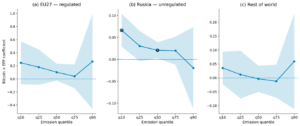
The relationship also remained significant under other tests. The study reports p = 0.012 using ordinary least squares with robust errors and p = 0.010 in a dynamic model that accounts for past emissions. Russia was the only region where the overall model was jointly significant.
The same relationship did not appear consistently in the EU27 or the rest of the world.
The researchers say the Russian effect emerged mainly after 2020, around the time of China’s crackdown on Bitcoin mining and a sharp rise in European carbon allowance prices.
Russia Could Offer Lower Mining Costs
The study points to Russia as a possible destination because it does not have an EU-style carbon pricing system.
For miners, that can create a cost difference. If carbon costs push up electricity prices in Europe while Bitcoin prices remain attractive, miners may have an incentive to use equipment in locations with lower power costs.
The researchers suggest that some companies could hold mining hardware in both regions and change where they run the machines. This would look like a migration in the data even if no physical equipment crossed the border.
The study therefore describes the result as possible operational carbon leakage. Carbon leakage occurs when climate policies reduce emissions in one place but cause some activity and emissions to move elsewhere.
Russia’s Mining Rules Could Limit the Shift
Russia’s position is not as simple as offering cheaper power. The country introduced a legal framework for cryptocurrency mining in 2024. It has also restricted mining in regions facing electricity shortages.
The restrictions became important from 2025, when Russia banned mining in several areas and introduced seasonal limits in others. Further restrictions could make it harder for miners to relocate operations to Russia solely to avoid higher energy costs.
The study also recognizes these limits. It notes that Russia’s changing mining rules could reduce operators’ ability to shift activity between countries.
This means carbon pricing is only one part of the mining location decision. Electricity prices, regulations, hardware efficiency, and access to the grid also matter.
Bitcoin Prices Can Change the Equation
Bitcoin’s price is another major part of the equation. When Bitcoin becomes more valuable, miners can potentially earn more from the same amount of computing power. That can make higher electricity costs easier to absorb.
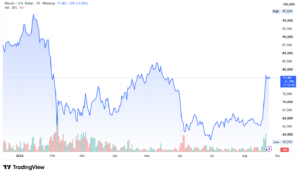
Bitcoin has remained highly volatile in 2026, making mining economics change quickly. This is why the study looks at Bitcoin returns rather than Bitcoin’s price alone. It tests whether changes in Bitcoin profitability interact with changes in European carbon prices and power sector emissions.
The research does not say carbon pricing alone causes mining to move. Instead, it finds a statistical relationship that becomes stronger when Bitcoin returns and EU carbon allowance returns rise together.
- RELEVANT: WULF Stock Climbs on $31 Target as TeraWulf Bets Big on Low-Carbon, Nuclear-Powered Bitcoin Mining
Crypto’s Power Footprint Raises the Stakes
The issue matters because Bitcoin mining consumes large amounts of electricity.
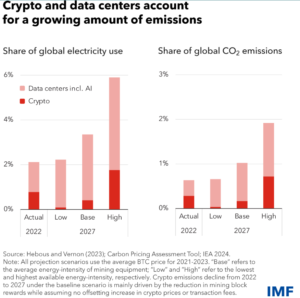
The International Monetary Fund (IMF) has sharply increased its estimates on the environmental footprint of digital technology. When combining crypto mining with Artificial Intelligence (AI) data centers, their collective electricity consumption has surged to 2% of global electricity.
This combined power demand is now equivalent to the entire power grid of Japan, the world’s fifth-largest energy user.
Individually, crypto mining remains a major source of pollution. The IMF projects that crypto mining alone will account for 0.7% of global carbon dioxide emissions by 2027. This is a dramatic increase from the 0.33% estimated back in 2022.
To help curb these rising emissions, the IMF proposes a targeted electricity tax of $0.047 per kilowatt-hour on crypto mining operations worldwide. Including local air pollution costs would raise the figure to about $0.089 per kWh.
These estimates show why electricity and carbon costs can have a major effect on mining economics.
They also explain the policy concern. If carbon pricing makes mining more expensive in one market but miners simply increase activity in a less regulated market, global emissions may not fall as much as expected.
The Study Comes With Important Caveats
The findings should not be treated as proof that EU carbon prices directly caused Bitcoin miners to move to Russia. The paper is currently a preprint, not a final peer-reviewed study. More importantly, the researchers did not track individual mining companies or physical mining equipment.
The study also notes that China’s May 2021 Bitcoin mining ban disrupted the relationship between mining activity and emissions. Other factors affecting Russian power sector emissions are not fully captured by the model.
These limits make the results better viewed as evidence of a possible link rather than a definitive cause-and-effect finding. Still, the Russia result is notable because the same relationship did not appear in the EU27 or the rest of the world.
Could Bitcoin Become a New Carbon Leakage Test?
The findings raise a wider question for carbon markets. Carbon pricing aims to make pollution more expensive and encourage cleaner energy.
The EU ETS has helped drive large emissions reductions in covered sectors. However, mobile activities such as Bitcoin mining can respond quickly to changes in electricity costs.
That makes Bitcoin different from industries such as steel or cement, where moving an entire production plant is costly and slow.
For policymakers, the challenge is therefore not only reducing emissions inside a carbon pricing system. It is also limiting the risk that energy-intensive activity shifts to markets with weaker climate rules.
The new study does not prove that EU carbon pricing is pushing Bitcoin miners into Russia. Yet, it provides statistical evidence consistent with that possibility.
As Bitcoin prices, mining technology and carbon costs continue to change, the issue could become more important for policymakers trying to cut emissions without simply moving them across borders.