


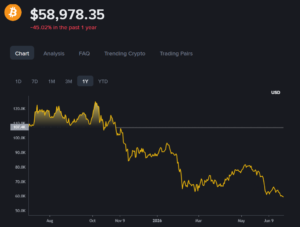
Bitcoin is back in the spotlight after a sharp price drop. After climbing above $126,000 late last year, the world’s largest cryptocurrency has fallen below $60,000, losing more than half its value.
Investors have responded to weaker economic conditions. Higher interest rates, profit-taking, and a lower appetite for risk also played a role. While much of the attention is on Bitcoin’s price, another shift is taking place behind the scenes.
The Bitcoin mining industry is becoming cleaner.
For years, Bitcoin faced criticism for its high electricity use and carbon emissions. Environmental groups compared its energy use to that of whole countries. This raised concerns about whether the cryptocurrency can fit into a low-carbon future.
Today, that picture is changing.
Many mining companies are investing in renewable energy. They are capturing methane that would otherwise go into the atmosphere. This helps support power grids and improve energy efficiency. These efforts aren’t removing Bitcoin’s environmental footprint.
However, they do lessen its impact. Governments, investors, and businesses are now focusing more on sustainability and net-zero emissions.
Bitcoin’s Energy Appetite Remains Massive
Bitcoin remains one of the world’s most energy-intensive digital networks. According to the Cambridge Centre for Alternative Finance, Bitcoin mining consumes electricity on a national scale. Demand changes with mining activity but remains among the highest of any digital infrastructure systems.
The International Energy Agency (IEA) notes that cryptocurrency mining, data centers, and artificial intelligence are among the fastest-growing sources of global electricity demand.
Mining relies on specialized computers that solve complex mathematical problems to secure the Bitcoin network. As Bitcoin’s value grew over the last ten years, companies added more machines. This also raised electricity demand.
However, electricity use tells only part of the story. The environmental impact also depends on where that power comes from.
After China banned commercial Bitcoin mining in 2021, many miners relocated. They moved to places like the United States, Canada, Iceland, Norway, Paraguay, and other parts of Latin America. Many of these locations offer cleaner electricity or abundant renewable energy, helping lower the industry’s carbon intensity.
Renewables Are Rewriting Bitcoin’s Energy Mix
Bitcoin mining is steadily shifting toward cleaner energy.
The latest Cambridge Digital Mining Industry Report shows that 52.4% of the electricity used by miners comes from sustainable sources. This includes renewables and nuclear power. Hydropower, wind, and solar account for much of that supply.
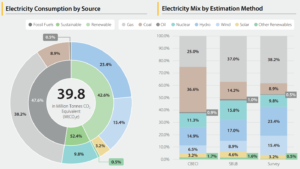
Natural gas remains the largest single fuel source because many miners use excess gas that would otherwise be flared at oil fields. This marks a major shift from several years ago, when coal supplied much of the industry’s electricity.
Today, miners increasingly build operations where electricity is affordable, reliable, and cleaner. Hydropower supports mining in Canada, Paraguay, and Scandinavia, while wind and solar continue to attract miners in Texas and other parts of the United States. Nuclear energy is also emerging as another source of carbon-free electricity.
Some companies generate electricity from landfill gas and agricultural biogas. This helps reduce methane emissions that would otherwise enter the atmosphere.
These changes do not make Bitcoin carbon neutral, but they are lowering the emissions linked to every Bitcoin mined.
Methane: From Waste Gas to Digital Gold
One of the industry’s fastest-growing sustainability strategies focuses on methane. Methane traps about 80 times more heat than carbon dioxide over a 20-year period, making it one of the most powerful greenhouse gases.
Some Bitcoin miners use mobile data centers to turn methane into electricity. This helps stop methane from escaping from oil wells, landfills, or wastewater facilities.
Companies including MARA Holdings, Crusoe Energy, and Upstream Data have helped pioneer this approach in North America.
The process cuts methane emissions while generating electricity for Bitcoin mining. Studies show that burning methane can help the climate. This is important because methane has a much stronger warming effect in the short term.
Methane-powered mining is still a small part of the industry. But analysts expect it to grow. Energy producers want new ways to cut emissions and use stranded gas resources.
The Biggest Bitcoin Miners Are Going Green
Many of the world’s largest Bitcoin mining companies now see sustainability as part of their long-term strategy.
MARA Holdings, the world’s largest publicly traded Bitcoin miner by market value, is expanding its use of landfill gas, methane capture, and renewable electricity. The company has also invested in technologies that convert stranded natural gas into electricity instead of flaring it.
CleanSpark continues to grow its U.S. operations by acquiring energy-efficient facilities powered by lower-carbon electricity. The company says cleaner energy helps reduce operating costs while supporting long-term growth.
Riot Platforms works with the Electric Reliability Council of Texas (ERCOT) through a demand response program. During periods of high electricity demand, Riot can temporarily reduce mining operations and return power to the grid. This helps improve grid reliability while creating another source of revenue.
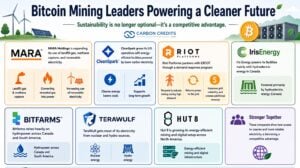
Other miners are following similar strategies. Iris Energy powers its facilities mainly with hydroelectric energy in Canada. Bitfarms also relies heavily on hydropower across Canada and South America.
TeraWulf gets most of its electricity from nuclear and hydro sources. Meanwhile, Hut 8 is growing its energy-efficient mining and digital setup across North America.
Together, these companies show how access to cleaner and more reliable electricity is becoming a competitive advantage.
Can Bitcoin Help Stabilize the Power Grid?
Bitcoin miners were once seen only as major electricity users. Today, some utilities view them as flexible energy consumers that can help balance the power grid.
Unlike factories or hospitals, Bitcoin mining operations can shut down within minutes when electricity demand spikes. This allows miners to reduce consumption during heat waves, storms, or other periods of grid stress.
In Texas, some mining companies join demand response programs. They temporarily shut down equipment when electricity demand is high. This allows more power to flow to homes and businesses.
Mining can also support renewable energy projects. Wind and solar farms often produce more electricity than the grid needs during certain hours. Instead of wasting that excess power, miners can use it until demand increases. This improves project economics while reducing wasted renewable energy.
Now, some analysts say Bitcoin mining is a flexible industrial load. It can support renewable energy rather than compete with it.
The Green Transition Is Far From Complete
Despite this progress, Bitcoin’s environmental concerns are still evident:
- Bitcoin mining still uses large amounts of electricity, and coal-powered operations continue to produce high emissions.
- Electronic waste is growing as older mining machines are replaced with newer, more efficient models.
- Inconsistent sustainability reporting makes it harder for investors to compare environmental performance, increasing the need for clearer disclosures.
Bitcoin’s Future May Depend on More Than Price
Bitcoin’s recent drop below $60,000 has renewed attention on the cryptocurrency market. Yet, its biggest long-term story may be unfolding beyond price charts.
In recent years, the industry has moved toward cleaner electricity and renewable energy. It focuses on reducing methane and integrating more closely with power grids. At the same time, new mining equipment has become more energy efficient, helping lower electricity use per unit of computing power.
Challenges remain, but sustainability is becoming an important factor in how mining companies compete for investment and future growth.
As governments, investors, and businesses continue pursuing net-zero goals, Bitcoin’s environmental performance is likely to receive as much attention as its market value. The next phase of the industry’s growth may depend not only on the price of Bitcoin, but also on how successfully it reduces its environmental footprint.