


South Africa’s power sector is beginning to show signs of a structural shift as renewable energy expands and aging coal plants face growing pressure.
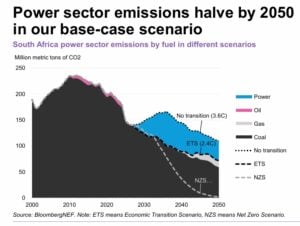
- Power-sector emissions fell 19% in 2025 to 148 million metric tons of carbon dioxide (MtCO2), according to BloombergNEF’s South Africa Transition Factbook 2026. The decline marks the largest annual drop under BloombergNEF’s Economic Transition Scenario (ETS).
The reduction is particularly important because electricity generation remains one of South Africa’s biggest sources of carbon emissions. Coal continues to dominate the country’s power system, but its role is gradually shrinking as solar, wind and battery storage gain momentum.
However, South Africa’s energy transition is far from complete. The country must expand clean power while maintaining grid reliability, replacing aging coal capacity and building enough transmission infrastructure to connect new renewable projects.
South Africa’s Power-Sector Emissions Face a Long Decline
The emission reduction came despite a slight increase in coal generation. Coal output rose about 1% as newer Kusile units improved the efficiency of the coal fleet. At the same time, electricity generation from oil-fired plants, including Acacia and Port Rex, declined.
The development highlights an important feature of South Africa’s transition. Improving the efficiency of existing generation can lower emissions even before large amounts of coal capacity are retired.
Still, lasting emissions reductions will depend on changing the country’s electricity mix.
- BloombergNEF expects power-sector emissions to fall 52% from 2025 levels by 2050 under its Economic Transition Scenario. Emissions would reach about 71 MtCO2 by then.
- The decline would be far greater under BloombergNEF’s Net Zero Scenario. Under that pathway, power-sector emissions could fall to only 1.9 MtCO2 by 2050.
Such a transformation would require a much faster expansion of renewable energy, alongside nuclear, gas, battery storage and carbon capture technologies.
Coal Remains the Biggest Emissions Challenge
South Africa’s electricity system remains heavily dependent on coal.
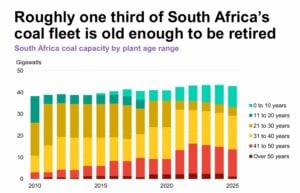
- The country had approximately 67 gigawatts (GW) of installed power capacity in 2025, including around 43 GW of coal capacity. Coal generated approximately 185 terawatt-hours (TWh), accounting for 78% of total electricity generation.
Even so, coal’s dominance has weakened over the past decade. Its share of electricity generation fell from about 90% in 2015 to 78% in 2025.
Meanwhile, solar and wind have moved in the opposite direction. Their combined share of generation increased from just 2% in 2015 to 13% in 2025.
The age of South Africa’s coal fleet adds further pressure. More than 12 GW of coal capacity was already over 40 years old in 2025, while another 16 GW was between 30 and 40 years old.
Consequently, coal retirements are becoming an increasingly important part of the country’s emissions strategy.
South Africa’s 2025 Integrated Resource Plan targets retiring around 8 GW of coal capacity by 2030. The plan also calls for 14 GW of renewable energy and 6 GW of gas capacity to replace some of the retiring generation.
Solar and Wind Could Reshape South Africa’s Power Mix
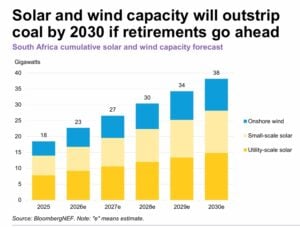
Renewable energy is expected to grow in importance as South Africa moves away from its coal-heavy electricity system. The forecasts combined solar and wind capacity to rise from around 18 GW in 2025 to 38 GW by 2030.
- Solar is expected to account for much of this growth. Utility-scale solar capacity could increase from 7.8 GW in 2025 to 14.8 GW in 2030.
- Small-scale solar is also expanding rapidly. The capacity in this segment is expected to more than double to approximately 13.4 GW by 2030.
- Wind power will contribute as well, with capacity expected to reach roughly 10 GW by the end of the decade.
Battery storage will become increasingly important alongside these technologies. Solar and wind output varies according to weather conditions and time of day. Storage can help shift electricity into periods when demand is higher, reducing the need to rely on fossil-fuel generation.
As a result, South Africa’s energy transition is not simply about replacing coal with renewable power. It also requires a more flexible electricity system capable of integrating large amounts of variable renewable generation.
Corporate Renewable Energy Deals Are Accelerating
Private companies are also playing a growing role in South Africa’s renewable energy expansion.
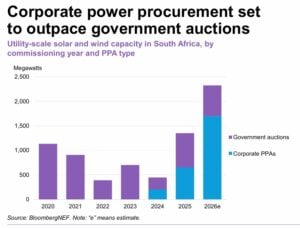
Corporate power purchase agreements (PPAs) are expected to support a significant portion of new utility-scale solar and wind projects. They could support 73% of the expected 2.3 GW of utility-scale solar and wind additions in 2026.
Companies supported approximately 670 MW, or 48%, of tracked renewable capacity added in 2025. Major corporate buyers have included mining and industrial companies such as Sibanye Stillwater, Rio Tinto, Tronox, Air Liquide and Sasol.
Since 2020, companies in South Africa have signed agreements to procure around 5 GW of clean electricity.
This trend could become increasingly important for the country’s emissions outlook. Businesses can secure renewable electricity directly while developers gain greater certainty over future revenues.
At the same time, declining renewable costs are making clean power increasingly competitive with conventional generation.
Grid Investment Could Determine the Speed of Decarbonization
South Africa’s renewable ambitions face one major obstacle: the power grid.
More solar and wind projects will require additional transmission infrastructure to connect new generation and move electricity to areas with high demand.
Without sufficient grid capacity, renewable projects can face delays even when financing and demand are available.
Battery storage could help address some of the system’s flexibility needs. However, storage alone cannot replace the need for a stronger transmission network.
The country is also moving toward greater private-sector participation in electricity markets. These reforms could create additional opportunities for renewable developers, storage companies and infrastructure investors.
At the same time, maintaining reliable electricity remains critical. The country has experienced years of power shortages and load shedding, making energy security a central part of the transition.
The challenge will therefore be to retire aging coal plants without creating new electricity shortages.
South Africa’s Energy Transition Enters a Critical Phase
South Africa’s power sector remains one of the world’s more carbon-intensive electricity systems. Yet the latest data shows the foundations of a major transition are taking shape.
The next stage will be harder. The country needs to accelerate renewable deployment while retiring aging coal capacity, expanding transmission infrastructure and keeping electricity reliable and affordable.
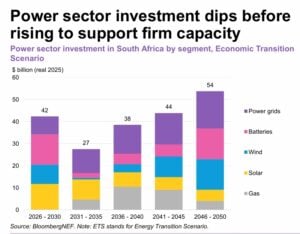
For South Africa, the energy transition is therefore becoming less about whether coal will decline and more about how quickly clean electricity, storage and grid infrastructure can take its place.
The answer will have major implications not only for the country’s climate targets, but also for its future industrial competitiveness and demand for carbon-free electricity.