

U.S.-based Chestnut Carbon has reached an agreement to deliver Improved Forest Management (IFM) carbon credits to Royal Bank of Canada (RBC) as corporate demand shifts toward higher-quality carbon removal projects.
The deal will direct carbon-market funding toward privately owned forests across the U.S. It also gives landowners another source of long-term income while supporting practices designed to improve forest health.
Brian Hong, Director, Environmental Markets Solutions Group at RBC
“Directing capital to high-quality, third-party verified climate solutions is important to how RBC can support clients in the transition to a low-carbon and resilient economy. This project is compelling to us because it makes responsible forest stewardship economically viable for landowners while delivering environmental benefits at scale across the United States.”
Why Chestnut’s IFM Carbon Credits Matter
Chestnut’s IFM portfolio covers more than 200,000 acres across 37 U.S. states. The company works with private forest owners through its Forest Carbon Works conservation program.
Broadly speaking, Improved Forest Management projects seek to increase or maintain the amount of carbon stored in forests through better management practices.
These can include:
- longer harvest rotations
- retaining larger trees
- selective thinning
- improving forest structure
- prescribed burns
Such practices can also help forests deal with climate-related threats. Healthier forests can be better prepared for wildfire, drought, and other disturbances.
Brian DiMarino, Chief Commercial and Operating Officer at Chestnut, said:
“We’re incredibly proud to be a part of RBC’s commitment to impact through high-quality nature-based carbon removal. Leading financial institutions continue to recognize that nature-based carbon removal is critical in addressing climate change. Lasting conservation happens when economic opportunity is aligned with responsible forest stewardship.”
The Case for Forest Carbon
However, forest management cannot remove every risk. Instead, the goal is to improve resilience while maintaining the long-term productivity of the land.
For private landowners, carbon finance can add another economic reason to keep forests standing. It can provide income without requiring owners to sell land for development or increase harvesting.
Chestnut says its portfolio focuses on privately owned, at-risk U.S. forests. The company also uses a removals-focused approach, with carbon stored in forests forming the basis of its credits.
That focus matters as buyers become more selective about the type of climate benefit they are purchasing.
Carbon Market Buyers Are Paying More for Quality
The carbon market is increasingly moving from a volume-driven model toward one that places a greater value on quality.
Sylvera’s latest data supports that shift. In the first half of 2026, BBB+ rated IFM credits averaged $18.65 per credit, up from $16.34 in the same period of 2025. By comparison, IFM credits rated BB or lower fell to $13.06 from $15.02.
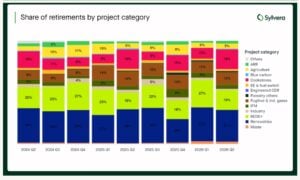
As a result, the price gap between high- and lower-rated IFM credits widened to $5.59 in H1 2026, from just $1.32 a year earlier.
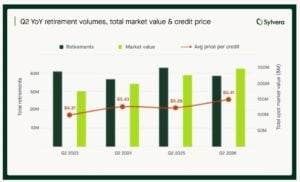
- The broader market shows a similar pattern. In Q2 2026, credits rated BBB or higher represented only 27% of rated retirement volume but 51% of rated market value. In other words, higher-quality credits accounted for a much larger share of market value than their volume would suggest.
- Total retirement market value for Q2 2026 was $247 million.
This trend could benefit well-structured IFM projects. Buyers increasingly want stronger evidence around additionality, permanence, and the amount of carbon actually stored.
Rise In Demand for Nature-Based Removals
The shift toward removals is also visible in corporate purchasing activity.
MSCI found that publicly disclosed, multiyear offtake agreements for nature-based carbon credits reached a record in 2024. Companies announced 10 such deals in the first half of 2024 alone, compared with five during all of 2023.
More importantly, nine of those 10 deals focused entirely on removal credits. These agreements allow companies to secure future supplies of carbon credits while giving project developers greater certainty to invest in projects.
MSCI’s broader market analysis also shows the growing flow of capital toward removals. Between 2021 and the third quarter of 2024, about $43 billion was committed or directly raised for carbon-credit activities, with most of the capital going toward carbon-removal projects, including nature-based and engineered removals.
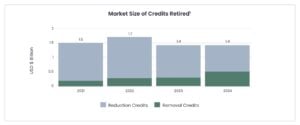
This is why long-term agreements such as the Chestnut-RBC deal could become more important. They can give developers predictable demand while helping buyers secure access to higher-quality projects.
RBC Reports 59,519 Carbon Credit Retirements
The Chestnut agreement adds to RBC’s broader use of carbon credits.
According to its 2025 Sustainability Report, RBC purchased and retired 59,519 carbon credits to match its Scope 1 emissions, Scope 2 market-based emissions and business-travel emissions.
RBC says it sources credits from third-party verified projects and considers factors such as additionality, permanence, location, technology, credit vintage, and environmental and community benefits. Its carbon-credit procurement includes projects registered with Verra, the American Carbon Registry, and Climate Action Reserve.
However, the bank does not disclose the amount it paid for its 2025 carbon credits. Therefore, the financial value of the 59,519 credits cannot be calculated from the sustainability report.
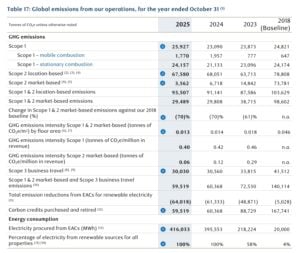
A Small Operational Footprint, But Larger Financing Exposure
Carbon credits address only one part of RBC’s climate footprint.
- The bank reported about 29.7 million tonnes of disclosed financed emissions across the sectors covered by its PCAF reporting. Oil and gas represented the largest share, at about 26.4 million tonnes of CO₂e.
At the same time, RBC reported C$29 billion in authorized lending exposure to low-carbon energy and enabling activities, including C$10.2 billion in renewable energy.
The contrast is significant. RBC’s operational emissions are measured in tens of thousands of tonnes, while its financed emissions run into the tens of millions.
Carbon Finance Gives IFM Projects a New Opportunity
Still, the Chestnut agreement shows how carbon finance can support action beyond a company’s direct operations. It connects corporate demand with private landowners and forest-management projects.
As the carbon market matures, buyers are likely to focus less on simply purchasing credits and more on where the carbon is stored, how long it stays there, and whether the claimed climate benefit is credible.
For IFM developers such as Chestnut, that shift could create a stronger market for projects that combine carbon removal with healthier and more resilient forests.