


Google is expanding its focus on methane emissions with a new agreement to purchase 1 million carbon credits from Mitti Labs, a climate technology startup working with smallholder rice farmers in India.
The four-year agreement will support the rollout of water-saving irrigation practices across more than 100,000 hectares of rice farms by 2030. The program is expected to involve more than 70,000 farmers and reduce methane emissions from rice cultivation while cutting water use.
The deal is Google’s largest superpollutant elimination agreement to date. It also adds to the technology giant’s growing carbon removal strategy, which includes investments in durable carbon removal, nature-based projects and solutions targeting gases other than CO₂.
Why Methane Matters for Climate Action
Methane is particularly important because it has a much stronger warming effect than CO₂ over shorter time periods.
The gas remains in the atmosphere for roughly a decade before breaking down. As a result, reducing methane emissions can slow near-term warming more quickly than cutting emissions of longer-lived greenhouse gases alone.
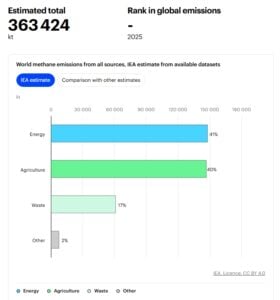
Agriculture is one of the largest sources of human-caused methane, with livestock and rice cultivation among the key contributors.
Rice Farming Adds to Water Stress
Rice cultivation is a major source of agricultural methane.
Much of the crop is grown in regions where water resources are already under pressure. Continuous flooding can require significant amounts of irrigation water, adding another challenge for farmers and local water systems.
How Mitti Labs Is Reducing Rice Methane Emissions
Rice cultivation is a major source of human-caused methane emissions. Traditional rice farming often keeps fields continuously flooded. Under these oxygen-poor conditions, microbes in the soil produce methane, which then escapes into the atmosphere.
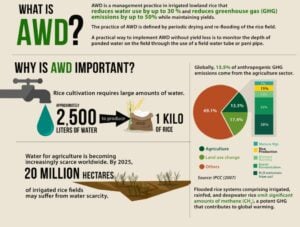
Mitti Labs is addressing this problem through a technique known as Alternate Wetting and Drying, or AWD.
Instead of keeping rice fields flooded throughout the growing season, farmers periodically drain the fields before reflooding them. This changes the conditions in the soil and limits methane production.
According to Mitti Labs, AWD can:
- Cut methane emissions from rice fields by up to 50%.
- Reduce irrigation water use by close to 40%.
- Maintain rice yields when properly implemented.
The approach therefore offers two benefits at the same time. Farmers can reduce the amount of water needed to grow rice while also lowering emissions from their fields.
For Google, the project provides a way to address a potent greenhouse gas while supporting agricultural communities.
3 Million Tonnes of CO₂ Savings
Mitti Labs says its program could save about 1.5 trillion liters of water as AWD expands across the targeted farmland. The company compares the volume with roughly three years of Bengaluru’s annual water supply.
The climate impact is also significant. The company estimates that the program could eliminate the equivalent of 3 million tonnes of CO₂ over 20 years. Using the conventional 100-year global warming potential approach, the impact is equivalent to about 1 million tonnes of CO₂e.
The different figures reflect the way methane is measured over different time horizons rather than a change in the underlying emissions reduction.
Mitti Labs’ Satellite Technology Helps Verify Results
Scaling AWD across thousands of small farms presents a measurement challenge. Farmers operate individual plots, and field conditions can change throughout the growing season.
Mitti Labs uses satellite technology and field data to monitor these changes.
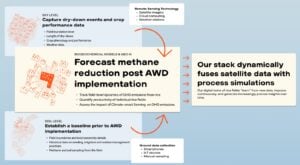
- Its GeoAI platform combines satellite radar imagery with information collected directly from farms. The system can track factors such as flooding, soil moisture, and crop conditions at the individual field level.
The company developed the technology with support from NASA and uses remote sensing to monitor large agricultural areas without relying entirely on physical inspections.
This is important for carbon markets because buyers need evidence that projects are actually delivering the claimed emissions reductions.
Mitti Labs combines its satellite-based monitoring with on-the-ground data and farmer engagement. The approach is designed to verify whether farmers are adopting AWD and whether the changes are producing the expected environmental benefits.
Mitti Labs next-gen dMRV
Methane Credits Get Sylvera A Rating
The company says its methane credits have received an A rating from carbon ratings agency Sylvera, reflecting the strength of its implementation and measurement approach.
Google Builds a Broader Superpollutant Strategy
The Mitti Labs agreement is part of a wider shift in Google’s climate strategy.
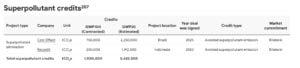
- The company has increasingly looked beyond conventional CO₂ removal to gases that can produce significant near-term warming. In 2025, Google contracted for 1 million tonnes of superpollutant credits
- It also announced plans to spend at least $50 million through 2030 on projects targeting methane, fluorinated gases and other non-CO₂ greenhouse gases.
Google has also worked on methane monitoring for more than a decade.
Its efforts have included partnerships focused on identifying methane leaks, supporting satellite-based monitoring and backing the development of artificial intelligence tools that can detect methane emissions.
The strategy reflects a broader recognition that climate action does not have to rely on one type of solution.
Reducing methane can deliver relatively rapid climate benefits, while removing CO₂ from the atmosphere can address the longer-term accumulation of carbon dioxide.
Carbon Removal Portfolio Tops 1.3 Million Tonnes
In 2025, the company signed 16 carbon removal agreements worth more than $100 million. Those contracts covered around 600,000 tonnes of CO₂ removal.
- Combined with earlier commitments, Google’s contracted carbon removal portfolio exceeded 1.3 million tonnes of CO₂ by the end of 2025.
- And its carbon reduction initiatives avoided over 58 million tCO2e in 2025.
The portfolio spans different approaches, including long-duration carbon removal and nature-based solutions. As explained before, targeting methane and other superpollutants is also a significant part of Google’s net zero plan.
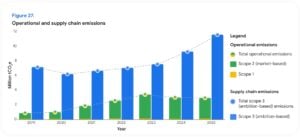
This creates a broader climate strategy built around different timescales. Methane reductions can help limit near-term warming, while durable carbon removal aims to keep CO₂ out of the atmosphere for much longer periods.
Agriculture Could Become a Larger Climate Solution
The Google-Mitti Labs agreement also highlights agriculture’s growing role in carbon markets.
Rice farmers do not need to completely change how they grow the crop. Instead, AWD modifies how they manage water during cultivation.
It could make the approach easier to scale, particularly in regions where farmers already face water shortages and rising climate risks.
For carbon markets, however, scale will need to be matched with strong measurement. Projects involving thousands of smallholder farms must demonstrate that emission reductions are real, measurable, and sustained.
Mitti Labs is betting that satellite monitoring and field-level data can help solve that challenge.
If the program reaches its target of more than 100,000 hectares, it could become a major example of how digital technology can connect smallholder agriculture with climate finance.
For Google, the agreement adds another piece to a carbon strategy that is moving beyond traditional CO₂ removal. And for the carbon market, it shows how methane reduction, water conservation, and agricultural finance can increasingly overlap in a single project.