


The U.S. Commodity Futures Trading Commission (CFTC) is investigating parts of the voluntary carbon market, according to a Bloomberg report on September 15, 2026. The reported probe is looking at potentially problematic carbon projects and has reached beyond individual developers.
Investigators are seeking information from major U.S.-based carbon registries, validation and certification bodies, and third-party carbon rating firms, according to a person familiar with the matter cited by Bloomberg. The review is also expected to seek information through international channels.
The reported investigation comes as the voluntary carbon market faces continued questions over credit quality, project claims and weak demand.
BloombergNEF data cited in recent Bloomberg reporting shows annual voluntary carbon credit issuance fell 12% in 2025 from its 2021 peak. At the same time, the market is becoming more selective, with buyers increasingly focused on newer and higher-quality credits.
The CFTC has not publicly announced this new investigation. Its previous actions, however, show that the agency already has an enforcement role in voluntary carbon markets.
Probe Covers Projects and Market Gatekeepers
According to Bloomberg, the CFTC’s current review includes credits linked to orphan-well cleanup and projects designed to reduce emissions from deforestation and forest degradation. The focus on registries, validators, certifiers, and ratings firms is also significant.
These organizations play a key role in the voluntary carbon market. Registries record and issue credits. Validation and verification bodies check whether projects follow approved rules and whether claimed emissions reductions have been properly measured. Rating firms then assess the expected quality or risk of credits.
A problem at any point in this chain can affect the credibility of the resulting credit.
The investigation therefore appears broader than checking whether a single project made a false claim. It could look at how project information flows in the market. It can also check if the systems for creating, verifying, and assessing credits are functioning well.
Bloomberg reported that investigators are also considering information obtained under previous administrations, suggesting that the review may draw on earlier regulatory concerns.
CFTC Already Has a Carbon Market Enforcement Record
The CFTC is not new to voluntary carbon markets. In October 2024, it brought its first fraud cases involving voluntary carbon credits. The agency charged former carbon credit developer CEO Kenneth Newcombe with fraud and false or misleading reporting.
The CFTC also settled charges against CQC Impact Investors and its former chief operating officer. The agency found that CQC submitted false and misleading information. This led to the issuance of millions more credits than it should have received. CQC agreed to pay a $1 million civil monetary penalty and cancel or retire credits linked to the misconduct.
The case showed why regulators might step in. Most voluntary carbon credits are traded outside regular exchanges.
The CFTC has anti-fraud authority over the spot voluntary carbon market and broader oversight of derivatives based on carbon credits. CFTC officials have said that fraud in the underlying market can hurt the integrity of carbon credit futures and other derivatives.
Carbon Credit Derivatives Put Regulators on Guard
The CFTC’s role became clearer in 2024 when it issued guidance for exchanges listing voluntary carbon credit derivative contracts.
The guidance covered issues such as whether contracts could be manipulated and whether the underlying credits were sufficiently transparent and verifiable. The agency said high-integrity derivatives depend on credible underlying carbon credits.
However, the CFTC withdrew that guidance in September 2025.
The agency stated that current Commodity Exchange Act rules already cover voluntary carbon credit derivatives. They believe the separate guidance focuses too much on these products. The withdrawal did not remove the CFTC’s underlying regulatory authority over carbon derivatives.
The latest reported probe, therefore, comes after a significant change in how the CFTC approached its carbon market guidance.
The Voluntary Market Has Been Under Pressure
The investigation arrives during a difficult period for the VCM. MSCI estimates that 202 million tonnes of carbon credits were retired in 2025, roughly matching the record level reached in 2021. But demand has been relatively flat for several years, even as the market has shifted toward higher-quality credits.
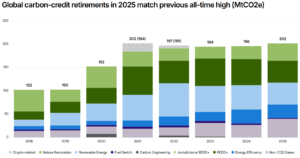
The primary carbon credit market was worth about $1.4 billion in 2025, according to MSCI. That value has stayed around the same level for four consecutive years. Yet, investment in future carbon supply is growing.
MSCI estimates that global capital in the carbon credit market hit a record $22 billion in 2025. This is a 72% increase from 2024 and over five times the amount in 2021. Much of that money is being directed toward future credit supply rather than immediate spot market demand.
This split is important. Investors may be willing to finance future projects, but buyers are increasingly selective about which existing credits they retire. That makes confidence in project quality even more important.
The market is also changing in terms of what buyers want.
MSCI found that about 10% of credits retired in 2025 were associated with carbon removals, while around 90% came from emissions reduction projects. Nature-based removals accounted for most removal retirements. Meanwhile, demand for renewable energy credits continued to weaken.
BloombergNEF also expects the market to shift toward higher-quality projects. Its 2025 long-term outlook predicts that global carbon credit supply might increase 20 to 35 times by 2050 from today’s levels.
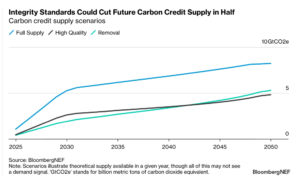
This growth depends on a market reset toward higher integrity. Its high-quality scenario projects theoretical supply of 2.6 billion tonnes in 2030 and 4.8 billion tonnes in 2050.
That potential growth depends on trust. A broader regulatory review could affect which project types, methods, and market players can attract capital.
Registries Could Face Deeper Regulatory Scrutiny
Registries are central to the voluntary market because they track project records, credit issuance, ownership, and retirement. If regulators identify weaknesses in the information submitted to registries, the impact could extend beyond individual credits.
Projects may face additional scrutiny, while buyers could demand stronger evidence before purchasing credits. Validation and verification bodies could also face more pressure to show that their processes are consistent and reliable.
That could raise costs for some developers in the short term. But stronger checks could also make it easier for buyers to distinguish credible credits from projects with weak claims.
This matters a lot since the market is still split. It has different standards, methods, registries, and rating systems. CFTC officials have pointed out that fragmentation and missing information hurt price discovery and market trust.
Stronger Oversight Could Reshape Market Trust
A broader regulatory review could raise costs for developers, registries, validators, and ratings firms as they face stronger documentation and verification requirements.
Smaller projects may struggle with the added costs. But tighter oversight could also reduce low-quality credits and increase the value of projects with strong additionality, accurate measurement, and durable climate benefits.
The investigation comes as the voluntary carbon market faces flat demand and growing scrutiny. It does not suggest that all projects or credits in the categories being examined are problematic.
Ultimately, the impact may depend on whether stronger oversight improves data, verification, and transparency. For developers and buyers, the direction is clear: carbon credits will need stronger evidence behind the climate benefits they claim.