

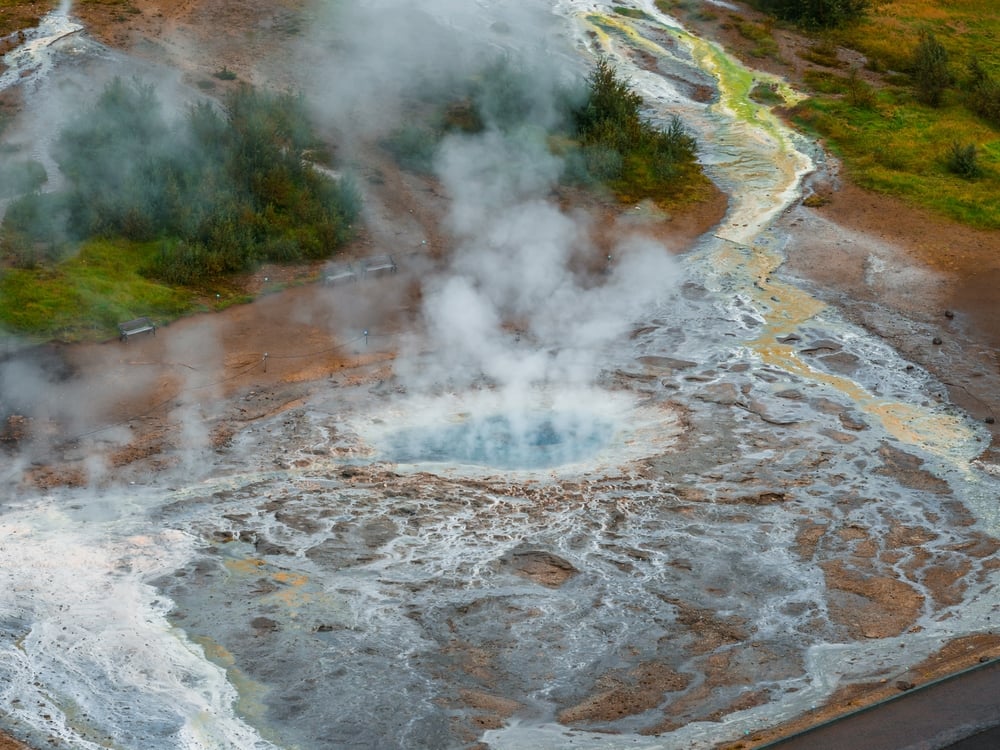
The U.S. geothermal energy market could be entering a new phase as the Department of Energy (DOE) moves to unlock resources that conventional geothermal plants cannot easily reach.
On September 21, the DOE announced more than $99 million for 21 projects across the U.S. The funding will support field tests of enhanced geothermal systems (EGS) and exploration drilling designed to find and confirm new geothermal resources.
Kyle Haustveit, DOE Under Secretary of Energy, said:
U.S. Geothermal Is Still a Small Market
The Energy Department is supporting geothermal innovation to unlock more of the U.S.’s domestic energy resources. Geothermal can.
Even though geothermal remains a relatively small part of the U.S. power mix, it can provide reliable, around-the-clock power. This further helps to meet rising electricity demand and strengthen energy security.
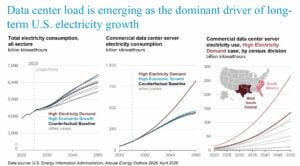
The latest data from the U.S. Energy Information Administration (EIA) show how much room geothermal has to grow.
- The U.S. had about 2.68 gigawatts (GW) of utility-scale geothermal capacity as of June 2026. Geothermal plants generated 7.78 billion kilowatt-hours during the first half of 2026, down about 1.1% from the same period in 2025.
In all of 2025, geothermal generated about 16 billion kilowatt-hours, roughly 0.4% of total U.S. utility-scale electricity generation.
California remains the largest geothermal power market, accounting for about 68.6% of U.S. geothermal generation in 2025. Nevada followed with 24.7%, while Utah, Hawaii, Oregon, Idaho, and New Mexico supplied the rest.
The numbers show both the strength and limitation of today’s geothermal industry. Existing projects are concentrated in areas with favorable underground heat, fluids, and natural permeability.
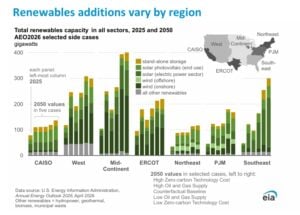
But next-generation geothermal aims to change that.
Five Projects Will Test Enhanced Geothermal Systems
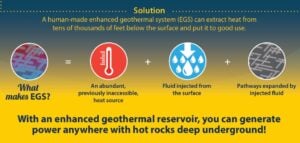
The DOE selected five projects for field-scale EGS testing:
- Fervo Energy will drill, complete, and stimulate EGS wells in Elmore County, Idaho. The project will also deploy a high-temperature geophone system designed to operate at or above 200°C and use seismic and geochemical data to study the engineered reservoir.
- Zanskar Geothermal and Minerals will test a horizontal injection well at the Lightning Dock geothermal field in New Mexico. The project aims to improve pressure support in an existing hydrothermal reservoir while also accessing heat from nearby impermeable rock.
- AlterG Resources will test EGS in Nevada using a deep horizontal well pair. The project will compare two hydraulic stimulation approaches, providing data on how different completion methods perform at commercially relevant depths.
- The University of Utah will develop and test an EGS doublet at the Dixie Valley West geothermal field in Nevada. The goal is to determine whether an engineered reservoir next to an existing geothermal system can deliver sustained circulation and useful thermal output.
- Quaise Energy will conduct an EGS demonstration near Newberry Volcano in Oregon. The site will target bottomhole temperatures of about 265°C to 365°C, pushing geothermal drilling into temperature ranges where conventional tools and materials face greater technical challenges.
Together, these projects could provide real-world data on drilling, reservoir stimulation, temperature, fluid flow, and long-term performance.
Why the Resource Potential Is Getting Attention: 2050 Forecast
The resource potential is much larger than today’s installed capacity suggests.
A 2025 U.S. Geological Survey assessment estimated that the Great Basin alone could contain about 135 GW of EGS electric-generation potential in the upper six kilometers of the Earth’s crust, assuming sufficient technological progress to commercialize these resources.
- The DOE has separately estimated that the U.S. could reach at least 90 GW of geothermal electricity capacity by 2050 with major advances in EGS technology.
However, EIA said that geothermal will contribute to around 1% of total U.S. electricity generation in 2050, with an estimated
generating capacity of 7 GW to 9 GW.
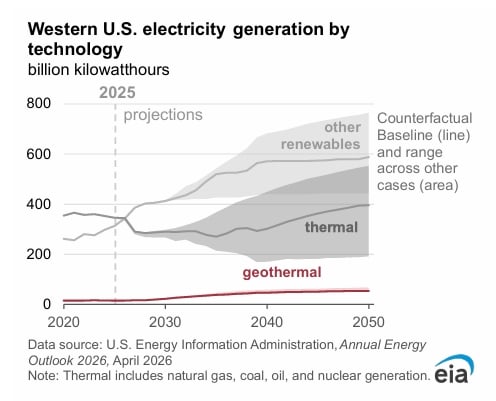
That gap between today’s roughly 2.7 GW of capacity and the potential resource base explains why exploration and field testing matter.
The immediate goal is not simply to build more geothermal plants. It is to reduce the uncertainty around finding resources, drilling into them, creating productive reservoirs, and operating them reliably.
Not an Instant Power Shift, But a Long-Term Push
The DOE says geothermal can provide firm and flexible electricity, making it a potential complement to variable sources such as wind and solar. And this characteristic could become increasingly valuable as U.S. electricity demand rises from data centers, manufacturing, electrification, and other large loads.
The new projects also create a growing pool of public subsurface data. The DOE plans to make information from the field tests and exploration work available through its Geothermal Data Repository.
For the geothermal industry, that could help turn individual drilling campaigns into a broader learning curve.
The $99 million program will not immediately transform the U.S. power market. But it targets some of geothermal’s biggest development hurdles: finding resources, drilling deeper, improving reservoir performance, and proving that next-generation systems can work outside traditional geothermal hotspots.
If those technical risks fall, the U.S. geothermal opportunity could extend well beyond the small group of states that dominate the market today.