

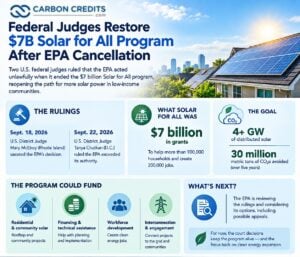
Two U.S. federal judges have ruled that the Environmental Protection Agency (EPA) acted unlawfully when it ended the $7 billion Solar for All program, reopening the path for a nationwide effort to expand solar power in low-income communities.
The first ruling came on September 18, 2026, when U.S. District Judge Mary McElroy in Rhode Island vacated the EPA’s decision to terminate the program. Four days later, U.S. District Judge Tanya Chutkan in Washington, D.C., also ruled that the EPA exceeded its authority when it canceled the program.
The rulings matter for climate and energy markets because Solar for All was designed to fund more than 4 gigawatts (GW) of distributed solar and cut an estimated 30 million metric tons of CO2 equivalent over five years.
However, the money is not immediately flowing again. The EPA is reviewing the rulings and considering its options, including possible appeals.
What “Solar for All” Was Designed to Do
The Solar for All program was created under the Inflation Reduction Act as part of the $27 billion Greenhouse Gas Reduction Fund. In April 2024, the EPA selected 60 recipients to receive the $7 billion in grants. The money went to states, territories, Tribal governments, municipalities, and nonprofits to develop or expand solar programs for low-income and disadvantaged households.
The original plan was ambitious. EPA estimated the program could help more than 900,000 households access residential or community solar. It projected more than $350 million in annual electricity-bill savings. That’s more than $8 billion over the 25-year life of the funded solar assets.
The program was also expected to support about 200,000 jobs nationwide. The grants were structured across several groups. EPA selected 49 state-level recipients for about $5.5 billion, six Tribal recipients for more than $500 million, and five multistate recipients for about $1 billion.
The Solar Projects Were Already Moving
The court rulings come after many recipients had already started building their programs. Solar for All money was intended to support more than simply installing rooftop panels. Grant recipients could use funding for financing, technical assistance, workforce development, interconnection and community engagement.
For example, the Illinois Solar for All program is still operating a 2026–2027 project cycle. Its current schedule includes applications for residential solar, public facilities, and community solar projects.
New Jersey’s $156 million award was designed to support residential and community solar, including projects serving low- and moderate-income households. The state gave the example of a 2.82-MW community solar project expected to serve about 440 households and save subscribers more than $111,000 a year.
These examples show the practical role the program was expected to play. The legal fight therefore concerns funding for programs that had already moved beyond the planning stage.
Why the Judges Rejected the Cancellation
The EPA ended Solar for All in August 2025, following passage of the federal spending law known as the One Big Beautiful Bill Act. The agency argued that the legislation removed its authority and funding to continue the program.
The EPA’s current website still states that Administrator Lee Zeldin announced the termination on August 7, 2025, saying the agency was acting to align with congressional intent. The courts reached a different conclusion about already obligated grants.
Judge McElroy found that Congress had funded and obligated the grants and that the EPA did not have authority to simply terminate them. She therefore vacated the termination decision.
Judge Chutkan reached a similar conclusion in the Harris County case. She ruled that EPA’s program-wide elimination decision was “arbitrary and capricious, contrary to law, and in excess of statutory authority.” She vacated that decision, meaning the EPA cannot continue acting on the basis that the spending law required or authorized Solar for All’s termination.
The D.C. ruling is particularly significant because it addressed the EPA’s broader decision to eliminate the program, rather than only one grant.
Solar for All Could Cut Emissions and Energy Costs
The program’s environmental value comes mainly from expanding distributed solar, including rooftop and community solar systems.
EPA estimated the 4-GW-plus program could reduce 30 million metric tons of CO2e cumulatively over five years. That estimate was based on expected generation and the emissions that would be avoided by producing more electricity from solar.
Distributed solar can also reduce exposure to rising electricity prices by allowing households and communities to generate part of their own power or subscribe to shared solar projects.
The climate benefit is also tied to the wider U.S. electricity transition.
The Energy Information Administration reported that wind and utility-scale solar generated 17% of U.S. electricity in 2025. Including small-scale solar, the combined share of wind and solar reached about 19%. Small-scale solar generation increased 11% in 2025, reaching about 93 billion kilowatt-hours.
Solar for All was designed to expand that growth into communities that have historically had less access to solar financing.
America’s Power Demand Adds to the Stakes
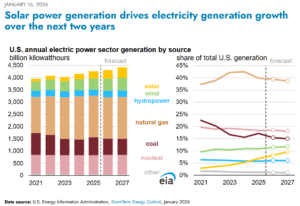
The potential return of Solar for All comes as U.S. electricity demand is entering a period of faster growth. EIA expects total U.S. electricity generation to increase 1.1% in 2026 and 2.6% in 2027. It also forecasts the combined share of wind and solar to rise from about 18% in 2025 to 21% in 2027.
Small-scale solar is already expanding rapidly. EIA estimates U.S. small-scale solar capacity reached about 59.5 GW at the end of 2025, up from 53.2 GW in 2024. Residential systems accounted for about 40.5 GW of that capacity.
That growth matters for the grid. Rooftop and community solar can produce electricity closer to where it is consumed and, when paired with storage, can also improve local resilience during outages.
Solar for All recipients were specifically allowed to use funding for storage and other enabling upgrades. EPA said the program could improve grid reliability and climate resilience in disadvantaged communities.
The $7B Question: What’s Next?
The court rulings do not mean every Solar for All project can immediately spend its grant money again. Judge Chutkan noted that the EPA has said the funds will remain in a Treasury account through September 30, 2031.
The agency had also paused the closeout process for Harris County while the case was pending. That provides a potential path for the grants to move forward, but legal and administrative steps remain.
The EPA has said it is reviewing the decisions and considering an appeal. The separate lawsuits also mean the future of the program could remain tied up in federal courts for some time.
For solar developers and community organizations, the uncertainty matters because project financing and construction schedules depend on when grant funding becomes available.
A Legal Test for U.S. Clean Energy Funding
The Solar for All rulings come at an important moment for U.S. clean energy. Solar deployment is growing, electricity demand is rising, and small-scale generation is becoming a larger part of the country’s power system.
At the same time, the federal government has changed its approach to several clean energy programmes, creating uncertainty for developers and investors. The two court decisions show that legal and funding risk can be as important to clean energy markets as technology and project economics.
The immediate issue is now implementation. The next stage will depend on whether the EPA accepts the rulings, appeals them, or begins restoring the affected grants. For now, two federal courts have made the same basic finding: the EPA could not use the 2025 spending law as authority to simply cancel the already obligated Solar for All programme.