


Gevo is increasingly relying on carbon credits and U.S. clean-fuel incentives to improve the economics of its renewable fuels business. Chief Executive Officer Paul Bloom said at a Water Tower Research conference on September 23 that Gevo now expects more than $60 million in 2026 non-GAAP adjusted EBITDA, up from its earlier $30 million target.
The company says carbon monetization, the Section 45Z Clean Fuel Production Credit, stronger operations, and new Canadian clean fuel opportunities are behind the higher outlook. The forecast is important because it shows how carbon value can add another revenue stream to low-carbon fuel production.
However, the $60 million figure is a company forecast, not reported earnings. Gevo must still deliver the expected tax-credit sales, carbon revenues, and operating improvements.
Carbon Value Is Becoming a Second Revenue Engine
Gevo’s strategy is built around getting value from both its fuel and the carbon benefits linked to that fuel. Its main asset is Gevo North Dakota, a low-carbon ethanol plant in Richardton, North Dakota, with carbon capture and storage (CCS) on site.
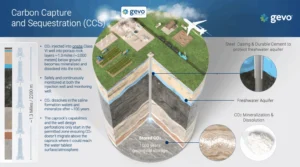
The facility produces about 67 million gallons of low-carbon ethanol a year and currently captures and stores roughly 180,000 metric tons of CO2 annually. The site has an operating Class VI well and enough permitted storage capacity to potentially reach 1 million tonnes of CO2 per year.
The captured biogenic CO2 can generate carbon removal certificates, while the plant’s low carbon intensity can also increase the value of fuel-related incentives.
Gevo calls this approach “carbon arbitrage.” The company can seek value from different carbon markets and choose where the carbon attribute has the highest value, although a particular carbon benefit cannot be sold twice.
Chief Executive Officer Paul Bloom said:
“For every ton of fuel we produce about a ton of carbon dioxide. We capture that carbon dioxide and sequester it in a deep well under our North Dakota facility.”
Bloom said the combined value of carbon and incentives can add roughly $1.50 per gallon beyond the underlying fuel commodity value. This is a company estimate and can vary with market prices and policy rules.
45Z Tax Credits Power Gevo’s 2026 Outlook
The Section 45Z Clean Fuel Production Credit is one of the biggest drivers of Gevo’s improved forecast. The company expects to monetize more than $70 million of 45Z tax credits during 2026, compared with $52 million in 2025.
Gevo also said it had already closed $20 million of 45Z credit sales after the second quarter and was targeting another $50 million by year-end.
The 45Z credit is a U.S. tax incentive for qualifying domestic clean transportation fuels. The credit is available for fuel produced after 2024 and sold through December 31, 2029, following changes made by federal legislation in 2025.
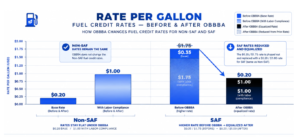
For fuel produced after 2025, eligible feedstocks must be produced or grown in the United States, Mexico, or Canada. The value of the credit depends on the fuel’s emissions performance and other requirements.
That makes carbon intensity extremely important for producers like Gevo. Lower lifecycle emissions can increase the amount of tax credit attached to qualifying fuel.
In September 2026, the IRS also issued Notice 2026-53, providing the 2026 emissions-rate table and additional guidance on 45Z, including treatment of regenerative agricultural practices.
Gevo Turns Tax Credits Into Cash
Gevo has demonstrated that 45Z credits can become actual cash rather than simply a future policy benefit. In 2025, Gevo North Dakota sold $52 million of 45Z tax credits. That included a $30 million sale in November, added to $22 million sold earlier in the year.
The structure is important for Gevo’s business model. The company can sell tax credits to third-party buyers, turning the incentive into cash rather than waiting to use the full value against its own tax liability.
Gevo’s low carbon intensity helps support that value.
The company says Gevo North Dakota has a carbon-intensity score in the low 20s grams of CO2e per megajoule under the GREET model variation proposed for 45Z. British Columbia has previously assigned the plant a score of 19 gCO2e/MJ.
Its on-site CCS is a major reason for the low score. This creates a direct connection between carbon management and fuel economics.
Canada Adds Another Carbon Revenue Channel
Gevo’s stronger 2026 outlook also includes a new pathway under Canada’s Clean Fuel Regulations (CFR). Canada’s CFR operates a credit market in which each compliance credit represents one tonne of lifecycle CO2e emissions reduction. Credits can be generated by supplying lower-carbon fuels or by reducing the lifecycle carbon intensity of fuels.
In the second quarter, Gevo received approval for a new pathway covering its low-carbon ethanol with CCS.
The approval allows Gevo to recognize carbon value from qualifying ethanol previously delivered into the Canadian market. The company expected sales under the new pathway to begin appearing in its third-quarter 2026 results.
This gives Gevo another compliance market alongside U.S. incentives and voluntary carbon removal sales. That diversification is important because carbon prices and fuel markets can change.
North Dakota Expansion Could Scale Fuel and Carbon Revenue
Gevo is also increasing the amount of fuel and carbon value its North Dakota facility can generate. A debottlenecking project is expected to raise low-carbon ethanol output to about 75 million gallons per year, a 10% to 15% increase in ethanol, coproduct, CCS and related incentive volumes starting in 2027.
Gevo said the project remained on track in September and that its new CO2 degassing system had been commissioned ahead of schedule.
The company plans a big expansion. This could double North Dakota’s ethanol production to 150 million gallons per year. It will include CCS and aims to start in 2028.
More production could mean more low-carbon fuel, more captured biogenic CO2 and more associated incentives. Gevo’s North Dakota site therefore sits at the center of its near-term growth strategy.
Carbon Removal Demand Is Rising But Delivery Lags
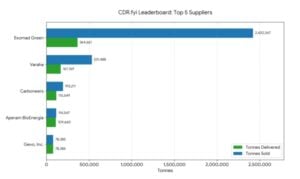
The wider carbon removal market is growing, but it remains relatively young. CDR.fyi currently tracks 50.5 million tonnes of durable carbon removal contracted globally, compared with only about 1.7 million tonnes delivered. Its current weighted-average price across publicly disclosed purchases is around $196 per tonne.
The large gap between contracted and delivered tonnes shows why operational projects can have an advantage.
Gevo’s North Dakota facility is already operating and has generated hundreds of thousands of certified removal credits. That gives the company an existing supply base while many newer CDR projects are still being developed.
However, Gevo’s future carbon revenue will still depend on credit prices, buyer demand, and the amount of CO2 that can be captured and certified.
Can Carbon Management Change the Economics of Renewable Fuel?
Gevo’s updated more-than-$60 million 2026 adjusted EBITDA outlook reflects a business model that goes beyond selling ethanol. The company produced $47 million in revenue in the second quarter of 2026 and generated $11 million of adjusted EBITDA. For the first six months, revenue reached about $89.4 million, while adjusted EBITDA was $19.6 million.
The full-year target is therefore a significant step up from first-half results.
Gevo has said the stronger outlook is supported by 45Z monetization, the Canada CFR pathway, low-carbon fuel sales, operational improvements and its carbon business. The broader market lesson is that carbon value can materially change the economics of renewable fuel production.
For Gevo, ethanol provides the core commodity product. CCS creates carbon removal value. 45Z creates a federal clean fuel incentive. Canada’s CFR creates another compliance market. The challenge now is turning those different revenue streams into durable cash flow.
If Gevo can continue producing low-carbon fuel, monetizing eligible incentives and delivering certified carbon removals, its North Dakota facility could serve as a model for how fuel production and carbon management can operate as one integrated business.