

Europe’s small modular reactor (SMR) market is nearing commercial deployment. Governments and energy firms seek reliable low-carbon power to boost renewable energy.
SGE, GE Vernova, Hitachi, and Samsung C&T signed a Memorandum of Understanding (MoU) to explore market opportunities for GE Vernova Hitachi’s BWRX-300 SMR in Central and Eastern Europe and the UK.
The agreement was signed on September 22 in New York during the Atlantic Council Nuclear Energy Policy Summit, coinciding with the United Nations General Assembly. The U.S. Department of State recognizes this partnership as part of wider U.S., Japanese, and South Korean cooperation on SMR deployment.
The four companies will evaluate potential markets, develop deployment strategies, and pursue commercial opportunities. This partnership combines reactor technology, nuclear engineering, construction, and European project development.
Europe Nuclear Generation Capacity
Nuclear power already plays a significant role in Europe’s electricity supply. France accounts for the largest share of nuclear capacity and generation.
- The World Nuclear Association (WNA) reports 96 GWe of operating nuclear capacity across the European Union, with 98 reactors operating in 12 EU countries.
- In 2025, nuclear plants generated about 650 TWh, making up 23.2% of EU electricity production, according to Eurostat and WNA. Renewables led at 47.2%.
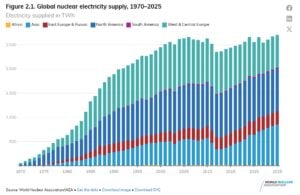
Beyond the EU, several European countries also operate nuclear reactors. The United Kingdom, Russia, Ukraine, Belarus and Switzerland add significant nuclear capacity and generation. Their 2025 generation totaled about 323 TWh, while their operating capacity was about 55 GWe.
The European Commission estimates that around €241 billion will be needed for EU nuclear energy through 2050. This includes extending the life of existing reactors and building new large-scale facilities. Additional investment will be required for SMRs, advanced modular reactors, and fusion.
This creates a growing market for smaller nuclear units, which can be deployed in fleets rather than single large reactors.
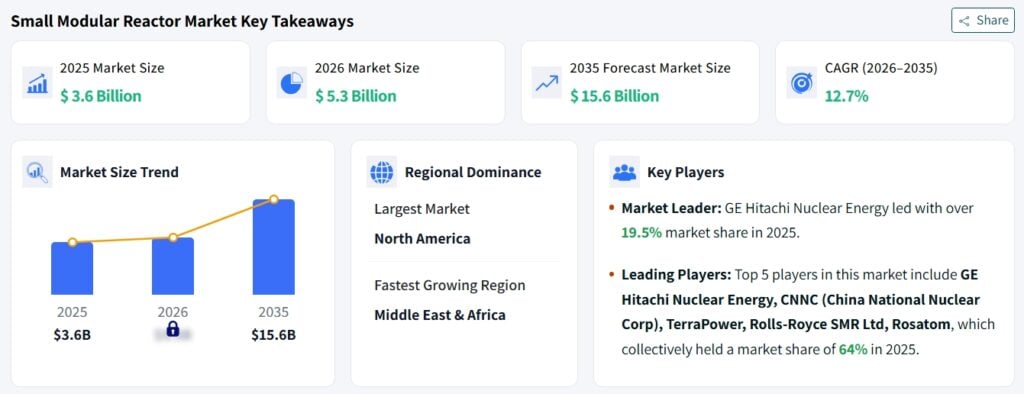
The global SMR market is attracting more investment, although estimates vary widely. A July 2026 report from Heimdall Insights valued the market at $6.5 billion in 2025, predicting $10.7 billion by 2030. Global Market Insights predicts a $3.6 billion market in 2025, with growth to $15.6 billion by 2035.
However, installed capacity is much smaller than these market estimates suggest. Mordor Intelligence estimates global SMR capacity at 312.5 MW in 2025, rising to 912.5 MW by 2030.
- Now focusing on Europe, the EU launched its first dedicated SMR strategy in March 2026 and aims for the first SMRs to operate in the early 2030s. Its Nuclear Illustrative Programme predicts EU SMR capacity could reach between 17 GW and 53 GW by 2050.
SGE Builds a BWRX-300 Pipeline
In Poland, Decisions in Principle have been issued for 26 BWRX-300 reactors. SGE is focusing on three sites for the first 14 units, with the first Polish unit expected to be operational by 2032.
SGE and GE Vernova Hitachi are also creating a Polish reference design for the reactor, aiming for a repeatable model for future projects.
The UK is another key target.
Rafał Kasprów, CEO of SGE, noted:
“Europe is entering a new strategic era in which energy independence, security of supply and industrial resilience are becoming core elements of national and regional security.
This agreement brings together state-of-the-art American nuclear technology from GE Vernova Hitachi, the industrial and technological capabilities of Hitachi and Samsung, and SGE’s European BWRX-300 development platform. Our objective is to establish a standardized, cross-border BWRX-300 fleet across the European Union and the United Kingdom, creating a new layer of secure, reliable and low-carbon generation capacity.
By combining American technology, Japanese and Korean industrial strength, and European development capabilities and supply chains, we are building the foundations of a long-term nuclear strategic program designed to strengthen Europe’s energy security, strategic autonomy and industrial competitiveness.”
Shaping the UK SMR Fleet
In July, SGE announced plans for 14 BWRX-300 reactors across three UK sites, totaling about 4.2 GW of capacity. This fleet could supply around 11% of the UK’s electricity demand.
SGE’s proposal is now in the Preliminary Regulatory Assessment Deep Dive led by Great British Energy – Nuclear. The first site will host six reactors, with commercial operation aimed for 2034.
The UK is exploring several SMR options. In September, Reuters reported that EDF plans to develop 10 small nuclear plants in the EU by 2035 using its NUWARD technology, with projects in France, Italy, Poland, Belgium, and Finland.
This competition means technology developers must show more than reactor performance. Licensing, financing, construction timelines, supply chains, and the ability to replicate projects will all be critical.
The Key Advantages of BWRX-300
The BWRX-300 is a 300 MW-class boiling water reactor from GE Vernova Hitachi Nuclear Energy. It features a simplified design based on established boiling water reactor technology, supporting standardized deployment.
Key characteristics include:
- 300 MW-class output: A single unit provides a smaller block of firm electricity than traditional gigawatt-scale reactors.
- Standardized design: Projects can use common engineering, manufacturing, and construction processes.
- Modular construction: The design supports more factory-made components and repeatable construction.
- Existing reactor experience: The BWRX-300 builds on decades of boiling water reactor operations.
- Fleet deployment: Developers can add multiple units or deploy standardized units across locations.
Additionally, the BWRX-300 is gaining insights from a project in Canada.
Ontario Power Generation received a license in April 2025 to build one BWRX-300 at the Darlington New Nuclear Project. In March 2026, the Canadian Nuclear Safety Commission confirmed that the first regulatory hold point was cleared. OPG also applied for a 20-year operating license in March.
This Canadian project provides a reference as European developers navigate their own regulatory processes.
Four Companies, One European Fleet Strategy
The new partnership assigns distinct roles to each company.
GE Vernova Hitachi Nuclear Energy manages the BWRX-300 design and technology. Hitachi offers nuclear and industrial capabilities, while Samsung C&T provides engineering, procurement, and construction expertise. SGE leads European project development and market expansion.
This structure reflects a broader shift in the SMR industry. Developers are increasingly focusing on fleets rather than single reactors. Repeating designs could minimize engineering work, strengthen supply chains, and create economies of scale.
Jung Wook Kim, Executive Vice President and Head of Global Business Unit and Global Operation, Samsung C&T, expressed himself by saying:
“Samsung C&T is honored to open a new chapter in Europe’s SMR business together with GE Vernova, Hitachi and SGE. Building on Samsung C&T’s proven EPC capabilities, we will fully leverage the synergy created by this four-way partnership to strengthen Europe’s energy security and contribute to the realization of carbon neutrality.”
The SMR Race Is Heating Up
The BWRX-300 enters a European market with several competing reactor designs.
The European Commission’s SMR strategy supports fleet-based deployment, standardized industrial processes, stronger supply chains, and closer cooperation among regulators. It also aims for the first European SMRs to start deploying in the early 2030s.
For developers, the opportunity is vast, but execution remains a challenge.
The new MoU does not guarantee the construction of the proposed BWRX-300 fleet. Each project still needs regulatory approvals, financing, site development, and commercial agreements.
However, the partnership combines reactor technology, nuclear expertise, construction capability, and European project development at a time when the region is preparing for renewed nuclear investment.
If successful, BWRX-300 fleets could boost demand for reactors, engineering, construction, nuclear components, fuel services, and long-term operations in Europe.