

Gevo, Inc. (NASDAQ: GEVO) has signed a three-year carbon removal credit supply agreement with CEEZER, adding another corporate buyer to its growing carbon business. The deal will supply durable carbon dioxide removal (CDR) credits from Gevo’s North Dakota ethanol facility through 2029.
Announced on October 14, the agreement marks Gevo’s first multi-year carbon removal contract with CEEZER. The company expects the growing business to generate more than $30 million in annual carbon revenue from its existing operations.
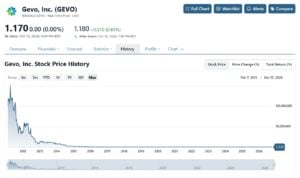
However, GEVO stock fell 9.3% on October 14, closing at $1.17, compared with $1.29 a day earlier. Shares remained at $1.17 at the close on October 15. The decline coincided with the announcement, although the available data does not establish that the deal caused the drop.
Nonetheless, the agreement strengthens Gevo’s carbon credit sales pipeline as companies seek long-term supplies of durable removals. However, investors will need more information about contract pricing, delivery volumes, and revenue recognition to assess its direct financial impact.
Gevo Signs Three-Year Carbon Removal Deal With CEEZER
- Under the agreement, Gevo will supply a five-figure volume of carbon removal credits to CEEZER through 2029. CEEZER will procure and manage the portfolio for an unnamed Fortune 500 enterprise software company.
The companies have not disclosed the exact number of tonnes covered by the contract or its financial value.
Gevo will generate the credits at its North Dakota facility, where the company captures biogenic carbon dioxide released during ethanol fermentation and stores it in deep geological formations.
According to Gevo, the facility stores CO₂ more than a mile underground, with expected permanence exceeding 1,000 years. The project also operates without a dedicated CO₂ pipeline.
The process uses bioenergy with carbon capture and storage (BECCS), which combines biomass-based production with carbon capture and permanent storage. When projects account for emissions across the production process, this approach can remove more carbon dioxide from the atmosphere than it releases.

Gevo says its North Dakota project is among the first commercial-scale U.S. BECCS facilities delivering verified carbon removal credits to the voluntary carbon market.
The company has also supplied credits to organizations including Nasdaq and Whirlpool. Its carbon removal certificates have appeared in the Puro.earth registry through purchases involving other buyers and intermediaries.
The CEEZER agreement gives Gevo another route to corporate customers and extends its contracted sales pipeline through 2029.
CEEZER Senior Vice President of Sourcing & Delivery Stephan Fuechtenhans, said:
“Companies building carbon removal portfolios increasingly need certainty of supply, price and quality over several years, not just individual purchases. Seeing Gevo’s operation, including on-site storage and supply chain, during our team’s recent site visit confirmed the kind of traceability our clients look for. Long-term offtakes with suppliers that combine an operating project with a proven delivery record are becoming central to how companies meet their long-term climate goals.”
Durable Carbon Removal Demand Grows, but Deliveries Lag
Gevo’s latest agreement comes as the durable carbon removal market expands. However, the gap between contracted purchases and delivered credits remains a major industry challenge.
- According to CDR.fyi’s first-quarter 2026 market update, buyers contracted 2.3 million tonnes of durable carbon removal during the quarter, approximately 5.6 times the volume contracted in the first quarter of 2025.
Suppliers delivered 145,000 tonnes during the quarter, up 67% year over year. Buyers retired just over 100,000 tonnes. Biochar carbon removal accounted for 93% of newly contracted volume, while biomass-based carbon removal methods dominated deliveries.
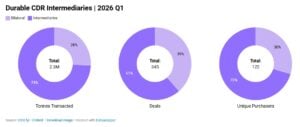
The figures show that market demand is growing, but suppliers still need to turn contracts into verified deliveries. Long-term agreements can help developers plan production and give buyers greater confidence about future credit availability.
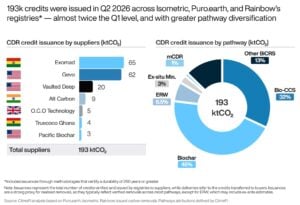
According to ClimeFi’s Q2 2026 CDR Market Review, buyer commitments increased by 83% from the first quarter. Purchases from buyers other than Microsoft also reached a record high, with non-Microsoft commitments rising 136% year over year. These trends suggest that demand is broadening beyond the market’s largest corporate buyer.
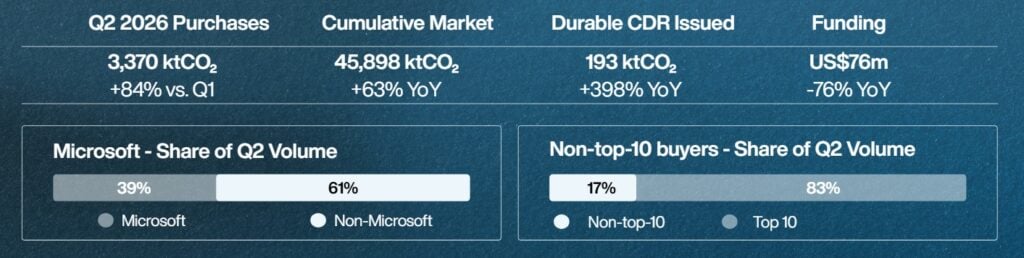
The quarter also marked a shift in purchasing patterns. Bioenergy with carbon capture and storage (Bio-CCS) overtook biochar to become the largest contributor to quarterly purchase volumes for the first time in more than a year. Credit issuances nearly doubled from the first quarter, according to ClimeFi.
For Gevo, existing ethanol production and carbon storage infrastructure provide a potential advantage because the company can generate removal credits alongside its core operations. However, future sales will depend on available credit volumes, buyer demand and the project’s ability to maintain verification standards.
Gevo Targets More Than $30 Million in Annual Carbon Revenue
The company is building its carbon business alongside its renewable fuels operations. In a June 2026 update, the company said first-half carbon removal sales had already surpassed its total 2025 sales, with deliveries on schedule.
Gevo also reported that its North Dakota facility had issued more than 500,000 carbon dioxide removal certificates since carbon capture and storage activities began in June 2022. The company sells these certificates under the Puro.earth standard.
It expects its carbon business to generate more than $30 million in annual revenue from existing operations. The CEEZER agreement supports that objective, although the undisclosed contract value makes it difficult to estimate how much revenue the deal will contribute.
Section 45Z Tax Credit Revenue
Gevo is also monetizing government incentives tied to low-carbon fuel production. On October 1, it announced that it had sold substantially all the Section 45Z tax credits it expected to generate in 2026, representing $70 million. The company had received more than $30 million in cash from those sales through September 30 and expected the remaining proceeds over the following six months.
It also forecast more than $77 million in Section 45Z credits for 2027. Planned improvements at its North Dakota facility could increase production capacity and carbon capture volumes by 10% to 15%, supporting additional credit generation.
Section 45Z credits are separate from carbon removal credits. The government incentive supports qualifying low-emission transportation fuel production, while CDR credits are sold to buyers seeking verified carbon removals.
What the CEEZER Deal Means for GEVO Stock
The agreement adds another potential source of recurring revenue for Gevo and supports its strategy of generating additional value from existing infrastructure.
For investors, the key question is whether carbon credit sales can become a material and predictable contributor to the company’s financial performance. The $30 million annual revenue target provides a benchmark, but Gevo has not disclosed the CEEZER contract’s pricing or enough detail to quantify its contribution.
GEVO shares’ decline on October 14 also highlights why investors should distinguish a commercial milestone from its immediate stock-market impact. One session’s price movement does not establish how the market values the contract or whether the announcement influenced trading.
Going forward, investors will be watching carbon credit deliveries, realized prices, additional long-term agreements and progress toward the company’s revenue target. Gevo’s ability to turn growing demand for durable carbon removals into consistent cash-generating sales will be central to the investment case.