

Verra has released new templates for carbon projects that seek certification for both their climate benefits and their impacts on communities and biodiversity. The updated documents bring together requirements under two of Verra’s standards programs and reflect changes to its Verified Carbon Standard (VCS) Version 5.
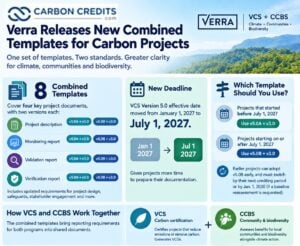
Announced on October 27, 2026, the templates are designed for projects registered, or seeking registration, under both the VCS and the Climate, Community & Biodiversity Standards (CCBS). The release gives project developers and auditors updated documents to prepare for the new VCS rules. Verra has also moved the effective date for Version 5 from January 1 to July 1, 2027, giving projects more time to prepare their documentation.
Eight Templates Cover Key Carbon Project Reports
The new package includes eight combined templates. They cover four main types of project documents, with two versions of each:
- Project description: Explains the project, its activities, and its expected results.
- Monitoring report: Tracks project activities and results over time.
- Validation report: Records an independent assessment of the project design.
- Verification report: Records an independent check of reported results.
Each document is available in versions VCS v5.0A + CCBS v3.0 and VCS v5.0B + CCBS v3.0.
Project developers and validation and verification bodies must select the version that applies to their project under Verra’s transition rules. The templates include new and revised reporting requirements related to project design, safeguards, stakeholder engagement, and other VCS Version 5 updates.
How Verra’s VCS and CCBS Standards Work Together
The VCS Program is one of the main standards used to certify projects that reduce greenhouse gas emissions or remove carbon dioxide from the atmosphere. Projects that meet its requirements can generate Verified Carbon Units, or VCUs.
The CCBS Program focuses on a project’s wider benefits. It assesses whether a project addresses climate change while supporting local communities and smallholders and protecting biodiversity.
For example, a forest project may seek to generate carbon credits by protecting or restoring trees. It may also aim to support local jobs, improve community livelihoods, or protect wildlife habitats. The VCS and CCBS programs assess different aspects of such work.
The combined templates bring the reporting requirements for both programs into shared documents. This gives developers and auditors a common set of forms to use when preparing and reviewing projects under the two standards.
Which Template Should Projects Use?
The version required depends on the project’s start date.
- Projects that started before July 1, 2027, must use the combined VCS v5.0A + CCBS v3.0 templates under the stated transition rules.
- Projects starting on or after that date must use the VCS v5.0B + CCBS v3.0 templates.
Earlier projects may choose to adopt the v5.0B templates before they are required to do so. Projects must switch to v5.0B either at their next crediting period renewal or when they submit a baseline reassessment request after January 1, 2030.
These rules mean project developers need to check both their project start dates and the timing of their submissions before preparing documents. Using the wrong version could lead to extra work or delays during review.
Why Verra Extended the Version 5 Deadline
The combined templates are part of Verra’s wider move to update its VCS Program. Verra announced on October 27 that it has extended the effective date of Version 5. This decision came after requests from project developers, auditors, and other market participants.
Many projects were trying to finish audits and submit documents under the previous rules before the original January 1, 2027 deadline. Verra said this workload also put pressure on the capacity of validation and verification bodies.
The extension is intended to give project teams more time to prepare accurate documents and avoid having to redesign projects or convert paperwork in the middle of an audit. Verra also said it would not provide additional implementation exemptions beyond those already set out in its effective-date guidance.
What This Means for Carbon Projects
The updated templates give developers a clearer set of documents for reporting under both the VCS and CCBS programs. They also help projects prepare for the reporting changes introduced by VCS Version 5.
The transition will still require work. Project teams and auditors need to understand the revised requirements, choose the correct template, and ensure that their project documents meet the applicable rules. Projects already deep into an audit may need to consider the timing of their submissions carefully.
Verra has encouraged projects that are still early in development to start preparing their documents under Version 5 as soon as possible. This could help reduce the risk of having to revise documents or repeat audit work if the process extends beyond the new deadline.
Why the Update Matters for Carbon Markets
Clear and consistent reporting matters to carbon markets because buyers need reliable information about the credits they purchase. Standardized templates help project developers and auditors show results consistently. This makes it easier to review climate benefits and the broader effects on communities and biodiversity.
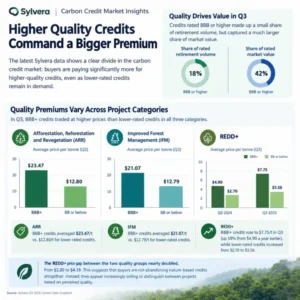
The update comes as carbon buyers become more selective about the credits they purchase. Data from Sylvera shows that credits rated BBB or higher made up just 18% of rated retirements in Q3 2026 but generated 42% of the market value. This gap suggests that buyers are paying more for credits with stronger quality ratings rather than focusing only on volume.
Environmental and social benefits can also influence credit prices. An Ecosystem Marketplace study found that credits with at least one co-benefit certification received a 78% price premium over credits without one. Credits linked to the UN Sustainable Development Goals (SDGs) had an even higher premium of 86%.
These figures show why clear reporting of both carbon reductions and wider project benefits matters to the market. By combining VCS and CCBS requirements in shared templates, Verra aims to make it easier for project developers and auditors to document and assess these outcomes.
However, the templates alone do not guarantee better outcomes. Their value will depend on how well projects follow the requirements and how carefully independent auditors check the reported results.
A Step in Verra’s Wider Standards Update
The release of the combined templates is part of a broader update to the VCS Program, rather than a new carbon-crediting program in itself.
For projects seeking both carbon certification and recognition of community and biodiversity benefits, the new documents set out how to prepare reports under the updated rules. The July 2027 deadline also gives developers and auditors a defined period to prepare for the transition.
The impact will depend on how smoothly projects adopt the new templates and meet the revised requirements. For now, developers working under both programs should review Verra’s official guidance, confirm which template applies to their project, and prepare their documentation ahead of the deadline.