

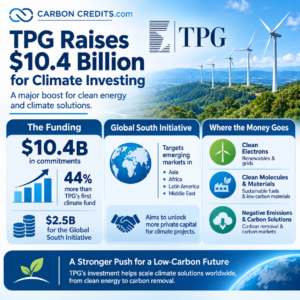
Global investment firm TPG has raised $10.4 billion in commitments for its climate-focused funds and related investment vehicles, including $2.5 billion for its Global South Initiative. The funding will support investments in climate solutions such as clean energy, sustainable fuels, industrial emissions cuts, and carbon removal.
TPG announced the final close of its second Rise Climate fund and the Global South Initiative on October 30, 2026. Together, the funds raised 44% more than TPG’s first Rise Climate fund, which closed at $7.3 billion in 2022.
The Global South Initiative aims to bring more private investment into emerging markets. Many projects in these regions face high borrowing costs and limited access to funding. TPG hopes to attract large investors to climate projects and businesses in these markets.
The fundraising comes as countries seek more money to expand clean energy, cut industrial emissions, and prepare for climate risks. However, raising capital is only the first step. The real test will be how the money is invested and whether it delivers measurable climate benefits.
TPG Closes $10.4 Billion Climate Fundraising Round
TPG confirmed the final close in its third-quarter 2026 earnings update. The $10.4 billion covers commitments across TPG Rise Climate II, the Global South Initiative, and related investment vehicles.
Jon Winkelried, Chief Executive Officer, TPG, said during the earnings call:
“We held a final close for our second Rise Climate fund and the Global South Initiative, bringing aggregate commitments to $10.4 billion across the two funds and related vehicles. This highly successful outcome represents a 44% increase over our inaugural fund and further validates TPG’s leadership in the climate sector.”
He added that 31% of the commitments came from investors new to TPG. This shows continued interest in its climate investment strategies.
TPG launched its first Rise Climate fund in 2021 and closed it in 2022 with $7.3 billion. It launched its second fund in 2023, along with plans to expand climate investment in emerging markets. The latest funds will support companies and projects working on climate solutions. The company focuses on areas such as:
- clean electricity,
- electrification,
- sustainable fuels,
- low-carbon materials, and
- carbon removal.
Notably, the $10.4 billion does not represent money already spent on projects. These are investment commitments that TPG can deploy over time, based on each fund’s terms and strategy.
Global South Initiative Reaches Its $2.5 Billion Target
The Global South Initiative seeks to boost private investment in climate projects. It focuses on emerging markets in Asia, Africa, the Middle East, and Latin America.
TPG announced the initiative with UAE-backed climate investment platform ALTÉRRA at the COP28 climate conference in December 2023. Its goal is to attract large investors by making climate projects in emerging markets more appealing.
ALTÉRRA initially committed up to $500 million in catalytic capital through its Transformation Fund. This type of funding can help lower investment risks and encourage other investors to provide capital. TPG also planned to invest about $1 billion from Rise Climate II in projects alongside the initiative.
The Global South Initiative has now reached its $2.5 billion target in commitments. This is crucial because climate projects in emerging markets often face financial barriers. High borrowing costs, policy uncertainty, currency risks, and project development costs can make investors more cautious.
Catalytic capital can help address some of these problems. It can take on a different level of risk or offer different returns from other investments, making it easier to attract more private funding. However, this approach does not remove all risks. Projects still need strong business plans, reliable developers, and clear evidence of their expected climate benefits.
Where Will the Climate Investment Go?
TPG Rise Climate focuses on three main areas: clean electrons, clean molecules and materials, and negative emissions.
- Clean electrons include renewable power, electricity grids, and the shift from fossil fuels to electric systems. Investments in these areas can help expand clean power and reduce emissions from businesses and industries.
- Clean molecules and materials include sustainable fuels and lower-carbon building materials. These solutions can cut emissions in areas where using electricity is tough or where fossil fuels are still a big part of production.
- Negative emissions and carbon solutions include carbon markets, environmental commodities, and carbon removal. These investments may support projects and technologies that remove carbon dioxide from the atmosphere or help build markets for climate-related assets.
All three areas matter because the shift to a lower-carbon economy requires more than renewable energy. Heavy industry, transport, buildings, and other sectors also need ways to cut emissions.
However, not all climate investments deliver the same results. Some projects may reduce emissions directly, while others support technologies or infrastructure that may deliver benefits later. Tracking these results is important when measuring the funds’ climate impact.
Why the Global South Needs More Climate Investment
Emerging markets need large investments to expand energy access, improve infrastructure, and prepare for climate change. Yet, many projects struggle to attract private investors. High financing costs and concerns about risk can slow the growth of renewable energy, cleaner industrial systems, and climate-resilient infrastructure.
Private investment can help fill part of this funding gap. Initiatives such as TPG’s Global South fund aim to connect large investors with companies and projects that support climate goals.
The initiative’s structure is also designed to attract more capital beyond its original backers. ALTÉRRA aimed to boost private investment, not cover the whole strategy.
Still, private funds cannot meet every climate-finance need. Public funding, development banks, grants, and low-cost loans are still key. They are crucial for projects that benefit the public, even if they don’t promise high profits.
Climate finance will therefore depend on how well public and private funding work together and whether the money reaches projects that need it most.
Carbon Markets and Carbon Removal Could Benefit
TPG’s investment strategy includes environmental commodities, carbon markets, and carbon removal. These areas could create opportunities for companies that measure, reduce, or remove greenhouse gas emissions.
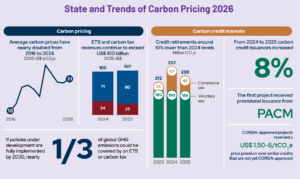
Carbon markets are growing. The World Bank’s State and Trends of Carbon Pricing 2026 report found that 87 carbon-pricing policies covered 29% of global greenhouse gas emissions. Governments raised more than $107 billion from carbon taxes and emissions trading systems in 2025.
- The report also found that carbon credit issuance increased by 8% from 2024 to 2025. These figures show the growing role of carbon pricing and crediting in climate policy and finance.
Carbon removal projects take carbon dioxide out of the atmosphere and store it. They can use natural methods, engineered technologies, or both.
Private investment can help these projects grow from early development to larger operations. It can also support companies that provide the technology and services needed to build carbon markets.
However, the value of carbon credits depends on their quality. Buyers and investors need reliable proof that claimed emissions reductions or removals are real, measurable, and properly recorded. For carbon removal projects, how long the carbon stays stored is also important.
TPG’s interest in carbon markets does not mean it will invest in every type of project or generate a specific volume of carbon credits. Its actual investments and the results of those projects will show how much the funds contribute to the market.
Turning Investment Commitments Into Climate Results
TPG’s $10.4 billion fundraising result shows the role private investment can play in growing climate solutions. The $2.5 billion Global South Initiative aims to boost funding for emerging markets, which often face barriers that slow down climate projects.
To assess the funds’ results, investors will need information on where the money goes and what those investments achieve. Useful measures include emissions avoided, renewable power added, industrial emissions reduced, and carbon removed and stored.
For emerging markets, another important question is whether these investments help build local skills and attract more funding over time. Projects need to make financial sense while also delivering clear environmental benefits.
TPG’s latest fundraising provides more capital for climate-focused investments. The next test is whether that money reaches the right projects and helps deliver measurable climate results.