

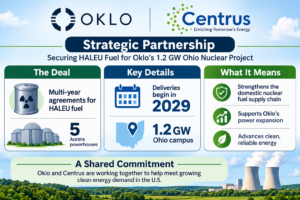
Oklo Inc. (NYSE: OKLO) has signed multi-year agreements with Centrus Energy Corp. (NYSE: LEU) to secure nuclear fuel for its planned advanced reactor deployment in Ohio. The deal will provide high-assay low-enriched uranium (HALEU) to support up to five Aurora powerhouses as Oklo advances its proposed 1.2-gigawatt (GW) power campus.
The agreements also support the development of America’s domestic nuclear fuel supply chain. Oklo will make advance payments to Centrus for future fuel deliveries, helping the company expand its uranium enrichment capacity. Deliveries are expected to begin in 2029 from Centrus’ American Centrifuge Plant in Piketon, Ohio.
The announcement formalizes a letter of intent signed by both companies in June 2026. It also advances their efforts to secure fuel for Oklo’s planned commercial reactor deployments.
Oklo and Centrus Move Ahead With Ohio Nuclear Project
Under the agreements, Centrus will supply enough HALEU to support up to five Aurora powerhouses over multiple years. The fuel will serve the first phase of Oklo’s planned Ohio campus, future Aurora deployments, and additional refueling needs for the Aurora-INL project in Idaho.
The proposed Ohio campus will have a total capacity of 1.2 GW and is linked to Oklo’s partnership with Meta. The tech company has agreed to make advance payments for future electricity production, supporting Oklo’s project development and fuel procurement plans.
This partnership connects growing electricity demand with investment in nuclear infrastructure. Meta gains a potential long-term source of reliable electricity, while Oklo secures financial support for its planned power generation capacity.
The project could also benefit Ohio’s economy. The companies expect the wider development to support thousands of direct and indirect jobs at full buildout. It could create opportunities for local businesses, expand the skilled workforce, and increase tax revenues for state and local governments.
Why HALEU Matters for Advanced Nuclear Energy
Access to HALEU remains a major challenge for companies developing next-generation nuclear reactors.
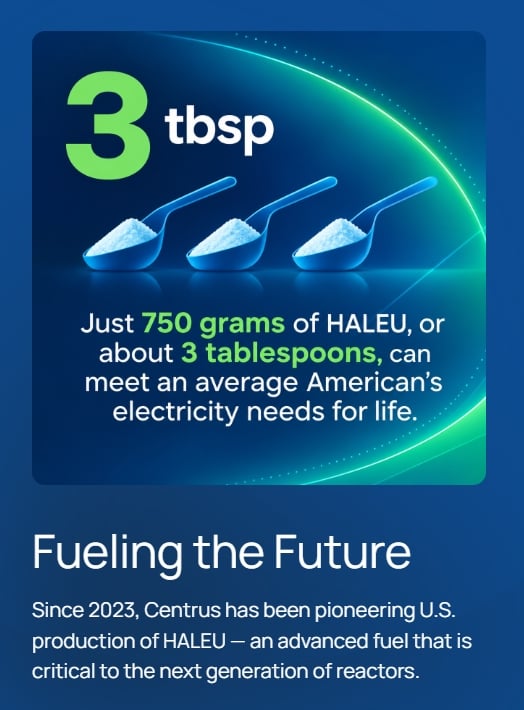
HALEU contains uranium enriched to more than 5% but less than 20% of the uranium-235 isotope. Conventional commercial nuclear reactors generally use uranium enriched to between 3% and 5%.
The higher enrichment allows certain advanced reactor designs to operate with smaller cores and potentially longer refueling cycles. It can also improve fuel efficiency and reduce fuel requirements. As a result, HALEU has become an important fuel for several advanced nuclear technologies under development in the United States.
However, domestic production remains limited. The country needs more enrichment capacity to support advanced reactor projects and reduce its reliance on foreign nuclear fuel suppliers. Without reliable access to HALEU, developers could face delays in reactor testing, construction, and commercial deployment.
The Oklo-Centrus agreement helps address this challenge by connecting future fuel demand with investment in domestic production.
US Nuclear Energy Demand Creates New Opportunities
The agreement comes as nuclear power maintains an important position in the US electricity mix. At the same time, electricity demand is rising because of data centers, artificial intelligence (AI), and industrial expansion.
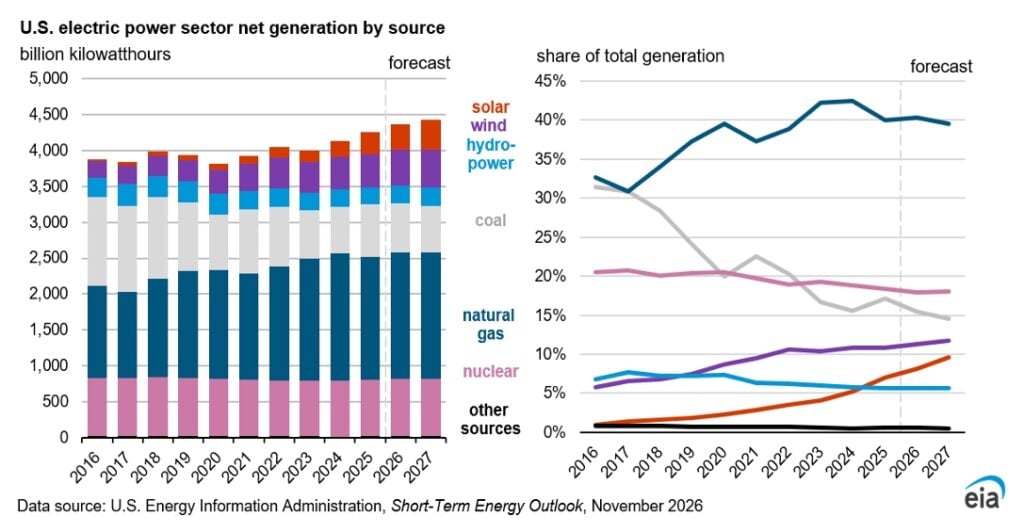
According to the US Energy Information Administration (EIA), nuclear power generated approximately 18% of US utility-scale electricity in 2025. It remains one of the country’s largest sources of low-carbon electricity.
The EIA’s November 2026 Short-Term Energy Outlook projects that nuclear power will continue to supply around 18% of US electricity generation in 2026 and 2027. Total US electricity generation is expected to reach approximately 4,368 billion kilowatt-hours in 2026, up 2.2% from 2025.
The United States currently has 94 operating commercial nuclear reactors across 54 power plants in 28 states, according to EIA data from March 2026. Together, these reactors have approximately 98.4 GW of net summer generating capacity.
The existing nuclear fleet also recorded an average capacity factor of 91% in 2025. This means reactors operated close to their maximum generating capacity for most of the year, highlighting their ability to provide consistent electricity.
As electricity consumption grows, advanced nuclear technologies could add more reliable power to the grid. They could also serve large industrial facilities and data centers that require electricity around the clock. However, expanding reactor capacity will require both new generating technologies and a dependable fuel supply.
Centrus Energy Expands America’s Nuclear Fuel Supply Chain
Centrus Energy plays an important role in the US nuclear fuel market. The company provides uranium enrichment services and nuclear fuel to commercial power producers and government customers.
Its American Centrifuge technology can enrich uranium for conventional reactors and advanced nuclear systems that require HALEU. Centrus operates its enrichment facility in Piketon, Ohio, and manufactures centrifuge equipment at its facility in Oak Ridge, Tennessee.
The company began producing HALEU at its Piketon facility in late 2023 under a contract with the US Department of Energy (DOE). It is now working to expand production and strengthen domestic enrichment capabilities.
In October 2026, Centrus completed and began shipping its first new centrifuge from its Oak Ridge manufacturing facility to support the expansion of uranium enrichment capacity in Ohio. This development marks progress toward scaling up its production infrastructure.
Centrus has also secured $5.4 billion in customer contracts and commitments to purchase low-enriched uranium (LEU) and HALEU from its planned new capacity, according to the company’s announcement. These commitments reflect growing interest in securing domestic nuclear fuel supplies.
What the Agreement Means for Oklo’s Expansion
The agreement strengthens Oklo’s plans to expand beyond its initial Aurora deployment in Idaho. Securing fuel well ahead of expected deliveries could help the company address one of the major challenges facing advanced reactor developers.
Meta’s involvement also highlights how technology companies are exploring nuclear energy to meet their growing electricity needs.
However, the fuel agreement alone does not guarantee that Oklo’s planned powerhouses will enter commercial operation on schedule. The company must still advance project development, construction, licensing, and other regulatory requirements.
For now, the deal gives Oklo a clearer path to securing fuel for its Ohio campus while supporting Centrus’ domestic enrichment expansion. It also highlights the importance of building both advanced reactors and the fuel infrastructure needed to operate them.