

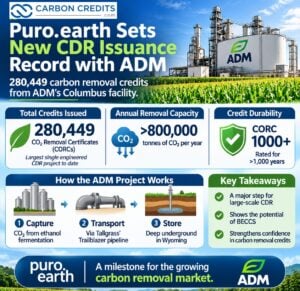
Puro.earth has certified and issued 280,449 carbon removal credits from an industrial carbon capture project at Archer Daniels Midland’s (ADM) ethanol facility in Columbus, Nebraska. The issuance is the largest ever recorded for a single engineered carbon dioxide removal (CDR) project, marking a major step for large-scale carbon removal.
The project uses bioenergy with carbon capture and storage (BECCS) to capture carbon dioxide (CO₂) released during ethanol production. It then transports the gas to an underground storage site in Wyoming for permanent storage.
The carbon credits were issued under Puro.earth‘s Geologically Stored Carbon methodology after an independent third-party audit. The project also has an estimated annual removal capacity of more than 800,000 tonnes of CO₂, giving it room to supply more credits in the years ahead.
The milestone highlights how existing industrial facilities could become a source of durable carbon removal. It also brings attention to the role of certification and verification in building trust in the growing carbon removal market.
Puro.earth Sets New CDR Issuance Record with ADM
Puro.earth announced the issuance on November 25, 2026, for ADM’s Columbus CCS Project. The public Puro Registry records 280,449 CO₂ Removal Certificates (CORCs) issued on November 24.
The certificates were issued under the Puro Standard’s Geologically Stored Carbon methodology, Edition 2024. The project underwent an audit by an independent validation and verification body before the credits entered the registry.
Puro.earth classifies the credits as CORC 1000+, which represents a carbon storage durability rating of more than 1,000 years. This category applies to carbon removal projects that store CO₂ in geological formations or other qualifying long-term storage systems.
The issuance is a significant milestone for ADM and the engineered carbon removal market. It shows that a large industrial facility can generate verified removal credits through carbon capture and geological storage.
However, issuance does not mean the credits have already been sold or used by companies to offset emissions. The Puro Registry currently lists all 280,449 credits as issued, with zero retired. Retirement is the step that removes a credit from circulation after a buyer claims its environmental benefit.
From Corn to Carbon Removal: How ADM Captures CO₂
ADM’s Columbus project captures biogenic CO₂ released during ethanol fermentation at its corn processing complex. The site includes both wet-mill and dry-mill facilities that process corn into food ingredients, fuel, and animal feed.
The project works through these main stages:
- First, the facility captures CO₂ produced during fermentation. Ethanol production releases a relatively concentrated stream of biogenic CO₂, making it suitable for capture.
- Second, the captured gas is purified and compressed. It is then transported through Tallgrass’ Trailblazer pipeline to the Eastern Wyoming Sequestration Hub.
- Finally, the CO₂ is injected deep underground through carbon storage wells in Laramie County, Wyoming. The wells operate under a Class VI permit regulated by the Wyoming Department of Environmental Quality.
Capture operations at the Columbus facility began in November 2025, in partnership with energy infrastructure company Tallgrass. This process allows ADM to capture carbon from an existing ethanol plant rather than build an entirely new facility.
Puro.earth also noted that the project does not use solvent- or amine-based capture technology. It offers a different way to capture fermentation emissions. Benno Fuchs, COO, Puro.earth, said:
“What we are seeing at the Columbus project is engineered CDR at true industrial scale – something that is only possible when you combine one of the largest bioethanol carbon capture facilities with an investment-grade certification infrastructure. This project sets the benchmark for what BECCS can deliver and a replicable pathway for the ethanol sector worldwide. We are excited to support ADM as it continues with its strategic drive into low-carbon markets while meeting rigorous scientific standards.”
800,000-Tonne Capacity Could Fuel Future CDR Credit Supply
The Columbus facility has an estimated annual carbon removal capacity of more than 800,000 tonnes of CO₂. This makes it one of the largest bioethanol carbon capture operations of its kind.
However, this figure represents potential annual capacity, not the volume of credits already issued. The first issuance totals 280,449 CORCs. Future issuance will depend on actual project performance, verified removals, and the completion of further audits.
The Puro Registry lists the project’s crediting period as January 1, 2026, to December 31, 2040. This gives the project a 15-year period in which it can generate eligible carbon removal credits, subject to the standard’s requirements.
ADM first announced its planned entry into the voluntary carbon removal market in September 2026. At the time, the company said credits from the Columbus facility would be certified by Puro.earth after the verification process.
The November issuance confirms that the first batch has passed that process. It also gives ADM a route to offer durable carbon removal credits to buyers in sectors such as technology, finance, aviation, and pharmaceuticals.
Why BECCS Could Scale Long-Term Carbon Removal
Bioenergy with carbon capture and storage combines biomass-based energy or fuel production with the capture and permanent storage of CO₂. In ADM’s case, the carbon comes from corn used to produce ethanol. The plants absorb CO₂ as they grow. During fermentation, some of that carbon is released as biogenic CO₂ and captured before it reaches the atmosphere.
When the captured CO₂ is stored underground, the process can result in net carbon removal. This depends on the project’s emissions over its full lifecycle. These include emissions from growing and processing corn, transporting materials, running capture equipment, and moving and storing CO₂.
Fermentation can be a useful source for BECCS because it produces a concentrated stream of biogenic CO₂. This can make capture more straightforward than capturing diluted CO₂ from some industrial exhaust gases.
The Columbus project also shows how ethanol producers could add carbon capture systems to existing facilities. This could help expand BECCS without requiring every project to build a new bioenergy plant.
Puro.earth‘s Registry Shows a Growing CDR Market
The ADM issuance comes as the market for engineered carbon removal continues to expand. Puro.earth reported that its registry had passed 2 million CORCs issued across more than 130 certified suppliers and projects. It also issued over 1 million CORCs.
Its platform supports several carbon removal methods, including biochar, enhanced rock weathering, and geologically stored carbon.
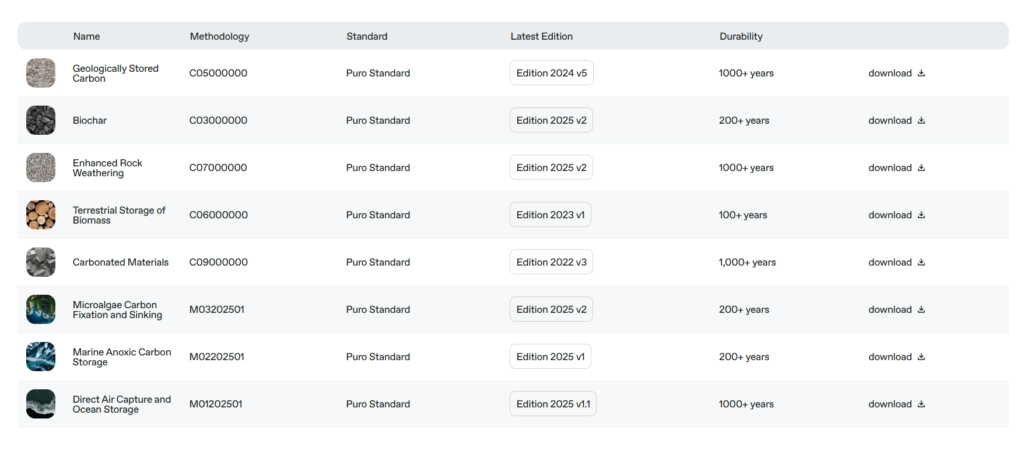
The standard provides a framework for measuring, verifying, and certifying carbon removal. Independent auditors assess project evidence before Puro.earth issues CORCs through its public registry.
Each CORC represents one metric tonne of CO₂ removed and stored under the relevant methodology. The registry also records credit transactions, allowing users to track issuance, transfers, and retirements.
This tracking matters as companies look for carbon removal credits to address emissions that remain after direct reduction efforts. Buyers need to know where removals come from, how they are measured, and how long the carbon is expected to remain stored.
The ADM project adds a large industrial BECCS facility to this growing supply base. Its issuance also shows how carbon removal standards can turn industrial capture and storage into credits. Companies can then purchase them.
Beyond Capture: Proving the Climate Value of BECCS
ADM’s record issuance shows that durable carbon removal can reach industrial scale through existing bioethanol infrastructure. The project captures CO₂ through fermentation and transports it by pipeline. It then stores the CO₂ underground and creates credits rated to last more than 1,000 years.
However, the long-term value of the project will depend on more than its first issuance. Future credit supply must be backed by continued operation, accurate monitoring, and verified net removals.
For Puro.earth, the certification marks a major issuance milestone. For ADM, it opens a new route into the voluntary carbon removal market. And for the wider industry, it offers an example of how established industrial facilities could help increase the supply of durable carbon removal credits.
As demand for high-quality CDR grows, projects will need to prove not only how much CO₂ they capture, but how much they remove from the atmosphere and keep out of it over the long term.