


Meta Platforms and Amazon.com just announced their latest quarterly earnings. Both showed strong financial results despite a tough global economy. Both companies are investing in clean energy, carbon reduction, and sustainability. They aim to meet the rising energy demand from artificial intelligence (AI) and data centers. However, while Amazon’s stock soars after the announcement, Meta’s stock dips.
The results show a big shift in tech companies. They are connecting financial growth to climate responsibility and long-term resilience. Let’s examine how these tech giants perform financially and sustainably.
Amazon’s Revenue and Cloud Strength Push Q3 Growth
Amazon reported $180.2 billion in revenue for the third quarter of 2025, up 13% year over year. The company’s net income surged to $21.2 billion, or $1.95 per diluted share, compared to $9.9 billion a year earlier.
The strongest gains came from Amazon Web Services (AWS), which grew 20% year over year to $33.0 billion in revenue. Amazon’s cloud division is its most profitable part. It supports thousands of companies around the globe and helps boost AI and digital tools.

Amazon’s retail business did better than expected. Prime Day sales and rising advertising revenue helped. Advertising revenue climbed 28% to US $14.7 billion.
With its strong quarter, Amazon’s stock increased about 12% in after-hours trading. Analysts say the company’s long-term plan is key to growth. It focuses on cloud computing, renewable energy, and automation.

Meta Reports Higher Profits but Faces Market Pressure
Meta Platforms, which owns Facebook, Instagram, and WhatsApp, reported $51.2 billion in revenue for Q3 2025. This is a 26% increase compared to last year. Net income reached $2.7 billion, or $1.05 per share.

The company noted higher ad spending, strong engagement on its apps, and early gains from its AI-driven recommendation systems. Despite these strong results, Meta’s stock dropped more than 11% after the results came out. Investors were concerned about the company’s rising costs for infrastructure and AI chips.

CEO Mark Zuckerberg stated that Meta will keep “building responsibly for the long term.” He emphasized that AI systems and the metaverse will be key investment areas until 2026.
Big Tech’s Race to Power AI With Clean Energy
AI development is driving record electricity demand. Data centers already consume around 415 terawatt-hours (TWh) of power globally each year, or about 1.5% of total electricity use. By 2030, consumption could more than double to 945 TWh, according to the International Energy Agency (IEA).
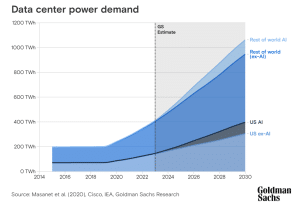
Both Meta and Amazon are addressing this surge by pairing AI growth with clean energy expansion.
- Amazon is the largest corporate buyer of renewable energy in the world. It has over 550 wind and solar projects. Together, these projects generate more than 33 gigawatts (GW) of capacity as of 2025. They supply power to AWS data centers, logistics hubs, and fulfillment sites across 27 countries.
- Meta sources 100% renewable energy for its global operations and data centers. It has added 10 GW of clean energy capacity since 2020 and continues to invest in solar and wind farms in the U.S., Spain, and Singapore.
These efforts are part of a larger trend in tech: replacing fossil fuel power with firm, clean sources such as nuclear, geothermal, and long-duration storage, to ensure 24/7 reliability.
Amazon’s Net-Zero Roadmap
Amazon aims to reach net-zero carbon emissions by 2040, a decade ahead of the Paris Agreement target. To get there, it is cutting emissions across transportation, operations, and packaging.
Key steps include:
- Deploying over 145,000 electric delivery vans by 2030.
- Using sustainable aviation fuel for Amazon Air.
- Reducing plastic packaging and promoting circular economy programs.
- Investing in carbon removal projects, including reforestation and direct air capture systems.
In 2024, Amazon reduced its carbon intensity — emissions per dollar of revenue — by 16% from its 2021 baseline. The company is testing green hydrogen and battery storage. This will help stabilize renewable energy supplies for its warehouses and data centers.
Meta’s Net-Zero and Carbon Removal Efforts
Meta reached net-zero emissions for its operations (Scope 1 and 2) in 2020. Now, it’s focusing on Scope 3 emissions, which come from suppliers and user activity.
By 2030, Meta aims to reach full net-zero emissions across its value chain. It is buying more renewable energy and improving server designs for better efficiency. It is also investing in carbon removal projects, like reforestation and biochar.
The company’s circular-hardware program reuses old data-center servers. This effort recycles materials and cuts electronic waste by almost 60% since 2022. Its new data centers in Texas and Denmark will run entirely on wind and solar power, helping to balance AI’s growing energy demand.
Meta also launched a “climate science hub” across Facebook and Instagram to share verified climate information and encourage community-level sustainability actions.
Investor Takeaway: Profits Up, Pressures High, Climate Still Central
Amazon’s strong revenue and cloud success show its resilience. However, the company is dealing with rising costs from its AI expansion and logistics network. Analysts expect AWS growth to remain steady as enterprise clients expand AI workloads.
Meta’s profits were better than expected. However, the company’s high capital spending raised worries about short-term margins. Reality Labs, which works on AR/VR and metaverse products, had a $3.7 billion operating loss in Q3. However, executives noted that AI integration is boosting user engagement and ad performance.
Both companies play key roles in the AI economy and clean energy transition, even with short-term ups and downs.
Clean Energy and Tech: A Shared Future

Amazon and Meta are boosting their clean energy efforts. This shows a big change in the industry. As AI and data grow, having reliable low-carbon electricity is now a key advantage.
- By 2030, Amazon’s projects might create enough renewable energy to offset 30 million metric tons of CO₂ each year. This is about the same as the emissions from 8 million cars.
- Meta’s ongoing efficiency programs have cut data center energy use by 30% per computing task compared to 2020, even as total workloads grow.
Both companies are exploring new power sources. They are looking into small modular reactors (SMRs) and advanced geothermal systems. This aims to provide clean energy for their global networks without interruption.
For Amazon and Meta, the latest earnings reports tell a story of growth tied to responsibility. Their revenues are up, AI investment continues, and sustainability remains at the center of their long-term strategies.
Short-term market swings show investor caution. Still, both companies are building the digital and environmental infrastructure for the next decade of tech growth.
In the race to power AI with clean energy, they show that profitability and sustainability can grow together if backed by the right investments, partnerships, and long-term visions.