

Analysts said that a total of 1.2 billion metric tons of carbon credits surplus could flood the market at short notice.
A Trove Research consultant indicated that there’s a market surplus of 600 million MT of carbon credits. These credits have been issued but not retired and enough to meet market demand for about 3.5 years.
There are also another 600 million MT credits that sit in project developers’ accounts. They’re created but lack verification yet from accrediting bodies. And so, these credits are “ghosts” – they’re not in emissions registries but could flood the voluntary market if prices rise.
Guy Turner, Trove Research CEO and founder, said that
“There is 1.2 billion Mt of credits that can be issued today and be provided by existing projects…That can weigh on the market at certain points in time… this could lead to volatility.”
Why Is There A Carbon Credits Surplus?
The excess credit supplies are likely old and may lead to price discounts in voluntary markets. Why is there a surplus?
Trading carbon credits started way back after the ratification of the UN Kyoto Protocol. It’s the first international pact to cut down emissions.
While the trading volume via the regulated market is huge, sizable trading is also happening in the voluntary carbon market (VCM). The momentum behind the VCMs has been strong and trading volume jumped high last year.
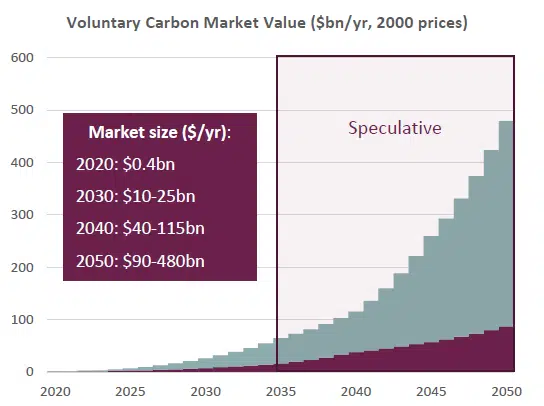
In fact, it’s expected to grow from $0.4 billion a year in 2020 to up to $25 billion in 2030 and as much as $480 billion in 2050. The world targets to reach net-zero emissions by 2050.
In 2021, carbon credits for almost one billion tons of CO2 were for sale to would-be carbon offsetters on the VCM. But there have been more sellers than buyers.
Hence, there’s a surplus from old carbon credits. This excess in supply is equal to about 7 to 8 times the present annual demand.
Plus, there are also credits not verified by certifying bodies. They emerge when some project developers didn’t pay their verification fees before issuing the credits. It happens when carbon credit prices are too low.
Turner from Trove Research predicts that spending on carbon credits will jump 20-fold in the next decade.
But there’s a fear that the surplus stocks of ghost carbon credits will meet much of that credit demand.
So What Should Happen?
Some governments review their current carbon credit schemes to weed out the junk. While new rules are being written to ensure the quality and reliability of the credits.
Better yet, investors have to assess first the credits they’re going to buy using a set of criteria. This is important to prevent double-counting for the same credits or buying credits that can’t provide real offsets.
Despite some doubts about the role of carbon credits in offsetting footprint, there are many projects that need them to take off and cut emissions.
The big trend right now is putting huge credits in projects that deliver carbon removal. Tech giants have been pooling money in portfolios that fund carbon capture and store it for good.
The recent XPRIZE carbon removal winners are a list of innovators in this space.
Best of all, a lot of companies are committing to report their GHG emissions based on the Science Based Targets initiative’s (SBTi) approach. It’s the go-to standard for corporate emissions reporting.
In the last quarter, over 400 businesses signed up with SBTi. This corresponds to around 370 million metric tons of GHG emissions.
Thus, we can still expect that the reported carbon credits surplus will be actual reductions if more firms and individuals seek to offset their footprint.
Original source: Quantum, Trove Intelligence,|Yale School of the Environment