Gulf Countries Bet Big: $100B for Renewables to Slash Emissions by 20%

The Gulf Cooperation Council (GCC) nations, also called Gulf countries excluding Iraq, have announced a historic $100 billion investment in renewable energy by 2030. This initiative aims to reduce carbon emissions by up to 20% while transitioning toward sustainable energy sources.

With the regionโ€™s heavy dependence on fossil fuels, this bold move signals a major shift in energy priorities. But can the GCC truly lead the charge toward a greener future?

The $100 Billion Bet: Why It Matters

The announcement was made at the 43rd meeting on “Future Climate Change Management and Economic Development in the Gulf States” in Muscat. It marks a big step in the region’s energy change.

The GCC countries account for about 25% of the worldโ€™s oil production. They contribute around 1.5 billion tons of CO2 annuallyโ€”roughly 4% of global emissions.

They also face serious climate risks. These include rising temperatures, water shortages, and higher sea levels. Projections show that Gulf temperatures could rise by as much as 2.5ยฐC by the century’s end. This will make current environmental problems even worse.

Dr. Khalid bin Saeed Al Amri, Chairman of the Omani Economic Association, warned that ignoring climate issues could harm the economy. He noted that

โ€œGlobal economic losses from climate-related disasters reached nearly $270 billion in 2022. In the Gulf region, failure to adopt effective climate measures could result in losses of up to 5% of GDP by 2050.โ€

Breaking the Oil Habit: GCCโ€™s Energy Transition Strategy

The $100 billion investment will speed up the use of clean energy. This includes renewables, nuclear energy, and hydrogen. This aligns with global climate commitments such as the Paris Agreement and the objectives discussed at the COP summits.

The initiative marks a shift for the region, which has long depended on oil and gas revenues. GCC nations have a lot of fossil fuels, but they see the need to diversify their energy sources. They also want to improve sustainability urgently.

The Omani Economic Association and the Gulf Development Forum discussed climate strategies, energy policies, and necessary technologies. Experts looked at how behavioral science can aid climate action and the changing global climate framework.

Emissions Hotspots: The GCCโ€™s Carbon Challenge

The six GCC nations – Bahrain, Kuwait, Oman, Qatar, Saudi Arabia, and the UAE – share similar economic structures and environmental challenges.

GCC countries rank among the highest in global CO2 emissions per capita. Qatar currently tops the list, with other GCC nations also among the top emitters, per a study of CO2 emissions of GCC households.

GCC countries carbon emissions per capita 2021
Chart from the study of Ahmed et al., 2024.

Additionally, electricity consumption per capita is extremely high. Four of the top 10 countries for electricity consumption per capita are from the GCC. High living standards, economic growth, and extreme climate conditions drive this. These factors need energy-intensive cooling systems.

Turning Sunlight into Power: GCCโ€™s Renewable Push

The GCC region has a lot of renewable energy potential, particularly in solar and wind. However, only 0.6% of its electricity is generated from renewables. However, there are ambitious plans to expand renewable capacity as shown below:

GCC countries renewable energy targets 2030
Source: Ahmed et al., 2024.

Additionally, green building codes, energy efficiency programs, and conservation policies have been introduced.

In 2014, the UAE banned incandescent light bulbs. This decision saved an estimated $182 million each year. It also cuts carbon emissions, which is like taking 165,000 cars off the road. In contrast, Saudi Arabia still relies on incandescent bulbs, with LED adoption at only 30% in some regions.

Solar and Wind Energy: The GCCโ€™s Untapped Goldmine

The GCC region is well-suited for renewable energy, especially solar power. Oman has the highest annual solar radiation of up to 2,500 kWh/mยฒ, followed by the UAE at 2,285 kWh/mยฒ. Saudi Arabia and Kuwait both record around 2,200 kWh/mยฒ. Additionally, Oman, Saudi Arabia, and Kuwait have promising wind resources, with wind speeds above 7.5 m/s.

Renewable energy has many benefits, but its growth is slow. This is mainly because the government keeps electricity prices low through subsidies. This discourages private investment in solar power for households. However, large-scale government-led projects are expected to change this dynamic.

GCC Nationsโ€™ Net Zero Commitments

The push for renewables is crucial for the region’s climate and net zero goals. Here’s what each of the GCC nations aims for:

  • UAE was the first Middle Eastern country to commit to net zero by 2050, aiming to reduce carbon emissions by 23.5% (70 million tonnes) by 2030. Abu Dhabi is investing in solar and nuclear energy projects. Meanwhile, Dubai’s Future Council of Energy has outlined a plan for a carbon-free economy. The Abu Dhabi Fund for Development has pledged $400 million. This funding will support renewable energy projects in developing countries.

  • Saudi Arabia aims for net zero by 2060 and has pledged $1 billion in climate initiatives under the Saudi Green Initiative. Plans include a regional carbon capture and storage center, an early storm warning system, and cloud seeding programs to support sustainability efforts.

  • Qatar has the highest carbon intensity per person. To tackle this, the country has started a climate change action plan. It aims to cut greenhouse gas emissions by 25% by 2030. Qatar also plans to reduce the carbon intensity of its LNG facilities by 25% in that time.

  • Bahrain has committed to net zero emissions by 2060 and aims to reduce emissions by 30% by 2035. The country is putting money into renewable energy. It is also focusing on carbon removal and planting trees to meet its climate goals.

  • Oman is targeting net zero by 2050 and aims for zero routine flaring by 2030, along with a 7% emissions reduction by the same year. The country is boosting investments in renewable energy and efficiency. It aims to produce 20% of its electricity from renewable sources by 2027.

Key Measures for a Sustainable Future

To reduce emissions and enhance energy efficiency, experts have proposed several strategies:

  1. Solar PV and Hybrid Energy Systems: Switching household lighting to solar PV or hybrid systems (solar + wind) can reduce emissions from electricity use by 8% to 30%.

  2. Energy-Efficient Appliances: Encouraging the use of LED lighting and efficient air conditioning systems could significantly lower energy demand.

  3. Consumer Behavior Change: Awareness campaigns and incentives for energy conservation can reduce household energy consumption.

The GCC can shift to cleaner renewable energy and still grow its economy. Their $100 billion pledge is a key step to tackle environmental and economic issues.

The coming years will be critical as these countries implement their energy transition plans. The success of this initiative relies on ongoing investments, solid policies, and teamwork among governments, businesses, and international organizations.

BYD to Partner with European Automakers to Offset Emissions Through Carbon Credit Pooling

Chinese EV giant BYD is in talks with European automakers to create a carbon credit pool. This effort helps traditional carmakers meet strict EU emissions standards. It also helps them avoid large fines starting in 2025.

Reuters reported that BYD’s special adviser for Europe, Alfredo Altavilla, confirmed the talks at an event in Italy. However, he did not provide specific details.

EU Tightening Grip on Light-Duty Vehicle Emissions

The EU aims to cut CO2 emissions from light-duty vehicles. This goal is part of their plan to fight climate change. Automakers are required to cut emissions significantly by 2025 compared to 2021 levels. The ultimate goal is 100% zero-emission vehicle sales by 2035.

  • In March 2023, the EU raised the bar further, mandating a 55% emissions reduction for cars and 50% for vans by 2030.

These tough policies urge automakers to boost EV production. They also force a big cut in emissions from ICE vehicles. This further keeps the industry moving toward a sustainable future. Study the breakdown from the figure here:

Challenges for European Automakers

To meet new regulations, battery electric vehicle (BEV) adoption will have to rise significantly. Automakers have to increase their BEV share from 16% in 2023 to about 28% by 2025. Each manufacturer, however, faces unique challenges. The latest report from ICCT shows:

  • Volkswagen and Ford must reduce emissions by 21%, the highest among automakers.
  • Hyundai, Mercedes-Benz, and Toyota face reductions exceeding the industry average of 12%.
  • BMW, Kia, and Stellantis are closer to their targets, with required cuts ranging from 9% to 11%.

These differences show how ready the industry is for EVs and how advanced the technology is.

EU automobile CO2 target
Source: ICCT
Note: Note: The 2025 targets are adjusted for expected changes in plug-in hybrid CO2 emissions. Data (sorted alphabetically) is shown for the 10 largest, leaving aside Tesla, a manufacturer that solely sells BEVs.

Carbon Credit Pooling: A Lifeline for Automakers?

Carbon credit pooling has emerged as a practical solution for automakers with limited EV sales. Manufacturers can team up with companies like BYD, Tesla, and Polestar. So how do they help automakers avoid the EU’s hefty cut?

  • Helps offset their fleet’s emissions and meet strict EU regulations.
  • Help them sell internal combustion engine (ICE) vehicles. They can do this while still meeting emissions limits.

Pooling agreements are reported to the European Commission by December 31 each year. This strategy gives European automakers a financial safeguard and vehicle manufacturers can avoid hefty penalties by getting closer to compliance.

Boosting Green Mobility with Emission Credits

We have seen and read how important emission credits are for the EUโ€™s sustainability framework. In short, automakers earn these credits by producing vehicles with CO2 emissions below regulated limits. Companies like Tesla and BYD, which consistently outperform these standards, generate surplus credits.

They can sell these extra credits to traditional automakers. This helps others meet regulatory goals and generate revenue for themselves.

Additionally, this system encourages the production of low-emission vehicles. It fosters innovation and speeds up the industry’s move toward greener mobility.

BYDโ€™s Advantage in Carbon Credit Pooling

BYD is a global leader in EVs. This makes it an excellent partner for carbon credit pooling. The wide variety of EVs and cutting-edge battery tech match the EU’s aim for zero-emission cars. By teaming up with BYD, traditional automakers can offset their emissions. This helps them meet regulatory targets and avoid fines.

Partnering with BYD boosts an automakerโ€™s credibility in the EV market and attracts eco-friendly consumers. It also shows a commitment to lowering emissions.

ย A Short-Term Fix for a Long-Term Challenge?

The increasing adoption of carbon credit pooling reflects a significant shift in the automotive industry. While EVs gain traction, many automakers continue to depend on internal combustion engine (ICE) vehicles for revenue.

Pooling agreements offer a temporary solution, allowing manufacturers to transition to electrification without immediate financial strain.

However, this strategy comes with challenges. Relying too heavily on pooling could stall critical investments in EV production and infrastructure. Automakers that fail to prioritize innovation risk losing competitiveness as emissions regulations become more stringent.

The EUโ€™s tough climate policies are reshaping the industry. Carbon credit pooling provides short-term relief, but automakers must accelerate battery electric vehicle (BEV) production to remain viable and meet future emissions targets.

BYDโ€™s entry into the European carbon credit market underscores the importance of global partnerships. Collaborating with EV pioneers and traditional carmakers can help drive the industry toward a more sustainable future. Success will depend on how quickly automakers adapt and innovate.

BYDโ€™s Emissions Reduction Vision: Cooling the Earth by 1ยฐC

BYD stated that in the last century, Earthโ€™s temperature increased by 1.1ยฐC. This rise has caused major environmental issues. To address this, BYD Auto and Mega Motor Company launched new green mobility solutions. These solutions focus on reducing carbon emissions and decreasing fossil fuel usage. They aim to lower Earthโ€™s temperature by 1ยฐC and create a healthier planet for future generations.

As of September 2024, the company’s efforts have:

  • Prevented 58 billion kg of carbon emissions, equivalent to planting 967 million trees.
  • Championed eco-friendly initiatives that reduce both operational energy use and pollution.

Driving Sustainability Through Green Operations

BYD’s 2022 CSR report emphasized its dedication to environmental protection through proactive measures. The company audits and verifies its greenhouse gas emissions. This ensures transparency and accountability. It also improves energy efficiency by making energy-saving upgrades throughout its operations.
The company has embraced electrification to make its operations eco-friendly. For example fully electric forklifts, trucks, and cleaning equipment power its production processes.

Its Zero-Carbon Campus uses 100% new energy-powered vehicles and innovative green solutions. The campus has solar panels and energy storage systems. It also offers SkyRail and SkyShuttle for green transport. By 2022, these efforts had successfully reduced 245,681 tons of CO2 emissions.

BYD emission
Source: BYD

BYDโ€™s discussions with European automakers highlight the shifts in the automotive sector, propelling the EV giant’s sustainability goals. However, long-term success needs strong investments in EV technology and infrastructure.

Nickel Prices Plunge in 2025: Can Demand Revive the Market by 2030?

Nickelโ€”a vital component for stainless steel and electric vehicle (EV) batteriesโ€”is facing a challenging period in 2025. Supply-demand imbalances, shifting policies, and economic uncertainty are shaping the market, which is further impacting its price.

Notably, Indonesia holds significant influence over prices and supply, being the worldโ€™s largest nickel producer. Letโ€™s explore the current state of the nickel market, the forces shaping it, and what lies ahead in the pricing trend.

Key Factors Behind the Ongoing Nickel Price Slump

Nickel prices have been falling steadily for two years. In 2024, the London Metal Exchange (LME) recorded an average price of $15,328 per metric ton, down 7.7% from 2023. By early 2025, prices dipped even further to $15,078 per metric tonโ€”the lowest since 2020.

  • However, analysts predict average prices are expected to be around $15,700 per metric tonโ€”a level insufficient to attract significant new investments.

Several factors are driving the price slump, and some of them are starkly evident.

Strong US Dollar

A stronger US dollar has made nickel more expensive for international buyers, reducing demand. When the dollar strengthens, commodities like nickel become less affordable for those using other currencies.

Robust US labor market data in early 2025 also impacted prices, pushing nickel to its lowest levels in five years.

US-China Tariff War

Additionally, ongoing geopolitical tensions, like US-China trade disputes post-Trump took over the presidency, have created uncertainty.

For instance, in January 2025, the announcement of potential 10% tariffs on Chinese goods added more pressure on base metals, including nickel.

Persisting Oversupply

At the same time, nickel production has consistently outpaced demand. Indonesiaโ€™s aggressive output expansion is a significant factor. With the country accounting for nearly half of the worldโ€™s nickel supply, its policies directly influence market dynamics.

Market experts predict that Indonesia’s nickel output will continue to grow at a strong pace this year.

  • As a result, the global primary nickel market is expected to remain oversupplied in 2025.

Nickel Prices in 2025: Where Are They Headed?

While nickel prices briefly surged to $16,168 per metric ton in December 2024 due to speculation about output cuts in Indonesia, it was short-lived. Prices quickly fell back to $15,113 per metric ton, highlighting the marketโ€™s fragility.

Despite this, Russian producer Norilsk Nickel (Nornickel) expressed confidence, announcing plans to sell all its metal production in 2025. However, market experts believe Indonesiaโ€™s policies and global environmental regulations will continue to dictate price movements.

Additionally, environmental concerns will continue to reshape the nickel industry. Stricter regulations could limit production, creating uncertainty for producers and investors.

For instance, companies failing to meet green standards might face production cuts. This has prompted some producers to look for alternative sources of nickel ore.

In the short term, price recoveries seem unlikely. Still, nickelโ€™s role in key industries like EVs and renewable energy keeps it significant. Companies need to innovate, prioritize sustainability, and adjust to new dynamics to thrive in this changing market.

Indonesiaโ€™s Nickel Power: A Market Shaper

Indonesia controls almost half of the world’s nickel production. This solidifies its role as a major market influencer. Therefore, its policies and strategies can shape the global nickel landscape.

In late 2024, optimism grew when talks of cutting mining quotas emerged.

Credible media agencies reported that the Indonesian Nickel Miners Association (APNI) shared data in a recent hearing with the House of Representatives. It revealed Indonesia’s nickel production is set at 298.5 million wet metric tons, exceeding 2024โ€™s 272 million tons.

This move shows a strong commitment to high output, keeping the market once again oversupplied.

Indonesia nickel

Despite being the top nickel producer Indonesia faces a tough balancing act. The government wants to boost economic gains from nickel exports. At the same time, it needs to tackle rising environmental issues. Producers failing to meet sustainability standards could face stricter regulations or production cuts.

Some Indonesian companies are looking to import nickel ore from the Philippines. This unusual step shows the tough regulations producers will have to deal with.

China’s Grip on Refining Raises Concerns

Chinaโ€™s dominance in nickel refining further complicates the scenario. Chinese firms control 75% of Indonesiaโ€™s refining capacity. This gives them a major hold on this key part of the supply chain. By 2030, Indonesia will likely produce 44% of the worldโ€™s refined nickel.

This could increase supply chain risks for EV makers that depend on this resource.

This dependency has raised concerns. Disruptions in Indonesia’s nickel output or China’s refining could impact global EV production. Automakers and battery makers might need to change their supply chains soon.

READ MORE: China and Indonesia Bolster Ties with $10B Deal in Strategic Sectors. How will it Impact Indonesiaโ€™s Nickel Industry?ย 

Nickel Price Forecast 2030 and Beyond

The analysis for the supply vs. demand chart emphasizes that demand is growing at a faster rate than supply. Over the period from 2023 to 2035, the compound annual growth rate (CAGR) for supply is 4.6%, while demand is projected to grow at 5.1%.

nickel supply and demand

Building on the supply and demand forecast, the current nickel oversupply and low-price environment are expected to shift. With a declining market balance and reduced oversupply, nickel prices are forecasted to rise. By 2030 and beyond, demand is projected to exceed supply, leading to a further price increase.

Nickel price 2025 forecast

In conclusion, the nickel market is currently facing persistent challenges of oversupply, slower demand growth, and stricter environmental regulations. These factors consistently drive prices downward. However nickel prices for 2030 and beyond show optimism for industry growth and mining.

Microsoft Leads as Carbon Removal Credits Hit 8 Million Tonnes in 2024

Carbon removal credits are becoming a key tool for tackling climate change. The report from CDR.fyi shows that the carbon dioxide removal (CDR) market grew significantly in 2024. Carbon removal credits rose 78% to 8 million tonnes. This big rise shows more interest in carbon removal solutions for global climate action.

Carbon removal credits are different from regular carbon offsets. Instead of balancing emissions, they help fund projects that take COโ‚‚ out of the air. This article explores the key trends, challenges, and outlook for the CDR market based on the latest findings from CDR.fyi.ย 

Big Tech Fuels CDR Market Boomย 

Total CDR purchases reached nearly 8 million tonnes in 2024, a 78% increase over 2023, per CDR.fyi analysis. However, the number of unique purchasing companies grew by only 7%, from 202 to 216.ย 

Durable carbon removal credits CDR purchases 2024
Source: CDR.fyi report

The growth was primarily driven by repeat buyers such as Microsoft, Google, and Stripe. These big tech companies, along with other Frontier buyers accounted for about 80% of 2024 purchases. Their purchases highlight a high concentration of CDR demand.ย 

These companies lead in carbon removal investments, backing projects that grow new technologies. Their ongoing support is crucial. However, the few new players in the market raise worries about long-term stability.

  • Microsoft led the market with 5.1 million tonnes, making up 63% of the total volume. This is a small drop from its 70% share in 2023.
Top 20 CDR purchasers 2024
Source: CDR.fyi report

Microsoft, Google, Meta, and Salesforce created the Symbiosis Coalition. They promised to purchase 20 million tonnes of nature-based CDR by 2030.

CDR Supply Struggles to Keep Up

While the market is growing, demand remains insufficient to support the increasing number of suppliers. Only 36% of CDR suppliers listed on CDR.fyi registered a sale in 2024. Many suppliers might struggle to get funding without new buyers. This could lead to consolidations and bankruptcies in 2025 and 2026.

A few buyers dominate the market. If their priorities or financial plans change, progress could slow. Getting more industries on board is key for future growth. This includes manufacturing, transportation, and retail.

Microsoft and Frontier accounted for 12 of the top 20 purchases in 2024. Google increased its direct purchases, totaling 500,000 tonnes. Meta pledged to buy $35 million in carbon credits over the next year. The tech giant is still unsure how much to allocate to durable CDR or nature-based solutions.

top 10 CDR buyers 2024
Source: CDR.fyi report

Among suppliers, Stockholm Exergi’s 3.3 million-tonne sale to Microsoft set a new record. ร˜rsted expanded its relationship with Microsoft with an additional 1 million-tonne sale. Meanwhile, CO280, Terradot, and Gigablue made significant market entries with first-time sales.

top 10 CDR suppliers 2024
Source: CDR.fyi report

Meanwhile, venture investments in the CDR sector dropped 30% year-over-year in 2024 as investors exercised caution. Many are waiting to see which suppliers secure sales before committing additional funding. Suppliers who canโ€™t make enough money might struggle financially. This can slow down innovation and reduce market variety.

Price Wars: Cheap vs. Costly CDR

The price of CDR credits remains a critical factor influencing market growth. The weighted average price per tonne decreased from $490 in 2023 to $320 in 2024.ย 

Remarkably, credit prices varied significantly based on removal technology. Biochar-based removal credits were cheaper. In contrast, direct air capture (DAC) credits stayed costly because of high tech and operation expenses.

Biochar, which converts waste into carbon that can be stored in soil, has prices ranging from $50 – $150 per tonne. In contrast, DAC, which extracts COโ‚‚ from the air and stores it underground, remains costly, with prices going beyond $600 per tonne.ย 

The big cost difference slows down the use of DAC. It’s a great option for permanent carbon removal, but itโ€™s still not widely adopted.

CDR pricing change 2023 to 2024
Source: CDR.fyi report

Biochar and Mineralization saw price increases, while other methods experienced declines. Most notably, mineralization saw a whopping 123% price increase, from $370 to $827 per tonne.ย 

The cost reductions indicate a narrowing gap between supplier and purchaser expectations. However, high-cost durable CDR methods may struggle to compete without additional buyer incentives.

The high price of high-quality CDR solutions continues to be a barrier to wider corporate adoption. To make CDR more accessible, costs must come down. This can be done through technological advances and economies of scale. This will help a wider range of companies and industries use CDR in their climate goals.

Durable CDR deliveries hit 318.6K tonnes in 2024. This is a 120% rise from 2023. However, the delivery-to-booked volume ratio was just 4.4%. Many companies are still increasing production. Biochar accounted for 86% of total deliveries. As other methods mature, the overall delivery rate is expected to rise.

CDR credits deliveries 2024
Source: CDR.fyi report

Policy Push and Tech Breakthroughs

Government policies and incentives are critical to sustaining growth in the CDR market. Some governments have taken proactive steps to integrate CDR into their climate strategies. The United States has increased funding for CDR projects with initiatives like the US 45Q tax credit. Meanwhile, the European Union is creating a certification framework for carbon removal.ย 

Denmark and Sweden’s BECCS subsidies have helped build expensive facilities. But, the absence of global standards makes it hard for companies to deal with regulations.

Better policy clarity and uniform regulations may enhance corporate confidence and promote broader adoption.ย 

Technology is also making carbon removal solutions more efficient and affordable. In 2024, DAC cut costs. Biochar and ocean-based CDR projects also gained traction.ย 

In addition, ocean-based carbon removal has gained interest due to its potential for large-scale impact. Techniques like ocean alkalinity enhancement boost the ocean’s ability to absorb COโ‚‚. They’re currently being explored.ย 

However, scalability remains an issue. Deploying these technologies on a large scale needs a big investment. Many companies hesitate to invest without better financial incentives. If costs keep falling because of new technology, more companies may invest in CDR solutions. This could speed up market growth.

Whatโ€™s Next for CDR? Challenges and Opportunities

Despite strong growth, the CDR market faces key challenges:

  • Dependence on a Few Buyers: The market needs new participants to ensure long-term stability.
  • High Costs: Prices must come down for broader adoption.
  • Regulatory Uncertainty: Standardized policies could provide clearer incentives for companies to invest.
  • Technological Barriers: Further advancements are needed to improve scalability and affordability.

However, there are also opportunities, namely:

  • Government Support: Increased funding and policy incentives could drive growth.
  • Innovation: Technological improvements could lower costs and enhance effectiveness.
  • New Market Entrants: Demand could expand significantly if more companies commit to CDR.

The carbon removal credits market in 2024 saw impressive growth, but it still faces hurdles. More companies should enter the market; costs must fall, and rules must change. With continued investment, innovation, and policy support, CDR could become a key component of global climate action, helping meet net-zero goals more effectively.

Carbon Markets in 2025: A New Era of Accountability, Quality, and Transparency

This year, companies are improving their climate strategies by integrating carbon offsets. The focus is on projects that create real environmental benefits. With public scrutiny increasing, transparency and quality are top priorities. Top market analysts predict that in 2025, the carbon market will shift. It will emphasize credible, high-integrity solutions. This change will create a stronger, more reliable system for achieving climate goals.

Clearer Rules for Offset Use in 2025

As per Wood Mackenzie, in 2024, independent standards updated 15 offset methods to align with best practices. These changes involve new methods for carbon removal and regional programs.

  • For example, the Science-Based Targets initiative (SBTi) requires companies to cut emissions by 90% across their value chains.

In 2025, SBTi will decide if offsets can apply to Scope 3 emissions or if they will encourage early investments in carbon removal. This decision will provide much-needed clarity for corporate climate plans.

As the year progresses, we can expect more advancements in these methods. They will boost the market’s credibility and reliability.

VCMs Embrace the Shift to Higher-Quality Carbon Credits

MSCI’s latest report on sustainability and climate trends shows big improvements in the quality of voluntary carbon market projects over the past year. Based on their carbon project ratings by mid-2024:

  • Nearly 50% of retired credits were rated B or lower, while only 8% were rated A or AA.

  • Although no projects achieved the highest AAA rating, the progress was evident.

Between Q2 2022 and Q2 2024, the share of the lowest-rated credits (CCC) dropped from 29% to 15%. The use of A or AA credits doubled. This shows a clear shift toward higher integrity and quality in carbon credits.

They analyzed 8,844 firms in the MSCI ACWI Investable Market Index (IMI) and found that firms using carbon credits reported their Scope 1, 2, and 3 emissions more transparently. Those firms were also more likely to set and achieve emission reduction targets more efficiently.

This analysis shows that carbon credits are usually part of larger climate strategies. They are not a replacement for cutting emissions.

Carbon Market

Core Carbon Principles Boost Credibility

In 2024, the ICVCM launched Core Carbon Principles (CCPs) to enhance the quality of carbon credits. These principles set strict standards, helping buyers choose reliable offsets. The ICVCM also labeled high-quality projects, guiding businesses toward credible options.

By January 2025, it planned to evaluate 90% of the market, ensuring informed decisions and better-quality credits.

Compliance Markets Go Global

India and Japan have launched hybrid emissions trading systems. Also, ICAO approved six offset standards for aviation under CORSIA. However, a shortage of carbon offsets has pushed prices higher.

Wood Mackenzie revealed,

  • Airlines need over 135 MtCO2e of offsets to keep emissions below 85% of 2019 levels, which highlights more need and demand for solutions.

Clearer guidelines, stricter standards, and rising demand are key for this yearโ€™s carbon markets. To achieve carbon reductions, businesses must be proactive and stay focused on their climate goals.

corsia CARBON MARKET

Carbon removal methods are gaining popularity. Two key methods are Direct Air Capture (DACCS) and Bioenergy with Carbon Capture and Storage (BECCS). They are known for their strong impact. These methods can be costly, but better techniques are making them more practical. Still, financing is a major barrier to scaling these technologies.

The graph shows how average prices and the share of carbon offset retirements have changed from 2015 to 2024. Removal offsets saw a sharp rise in prices starting in 2020, reaching about $11 per tCO2e by 2024.

This spike suggests a growing demand for removal offsets, driven by a stronger focus on long-term sustainability and effective carbon reduction solutions.

carbon offset price

Carbon Border Taxes: Expanding Beyond the EU

In 2025, the EU is set to provide updates on expanding its Carbon Border Adjustment Mechanism (CBAM). Key areas to watch include:

  • Coverage of indirect emissions in steel, aluminum, and hydrogen sectors.

  • Inclusion of transportation emissions and other materials like organic chemicals.

  • Timeline for adding other sectors under the EU Emissions Trading System (ETS) by 2030.

Importers will soon face financial obligations under CBAM, making carbon accounting essential. The EU will provide flexibility for emissions data, possibly exempting small and medium enterprises. The CBAM Registry will open for non-EU operators in 2025, encouraging companies to work closely with their suppliers.

Beyond the EU, other nations are also adopting carbon border taxes. The UK and Australia are moving forward with their CBAM plans in 2024. Meanwhile, Chile and Taiwan are adding carbon border mechanisms to their pricing systems.

In the US, support is growing for a carbon levy like the Foreign Pollution Fee Act. This is happening alongside a rise in protectionism.

COP29: A Boost for Global Carbon Markets

Last yearโ€™s COP29 is driving major growth in global carbon markets by advancing Article 6. It allows governments to buy offsets to meet their climate targets (NDCs). By February 2025, countries will update their NDCs. This will clarify how carbon offsets fit into their plans.

Article 6.2

Article 6.2 enables nations to trade Internationally Transferred Mitigation Outcomes (ITMOs). While some agreements are already in place, low-quality carbon projects remain a concern.

A better collaboration of governments, UN bodies, and voluntary carbon market (VCM) initiatives will be crucial to set clear standards and enhance transparency in carbon trading.

Paris Agreement Carbon Market (PACM)

The Paris Agreement Carbon Market (PACM) helps developing countries build strong carbon trading systems. At COP29, leaders agreed on high standards for project methodologies and social impacts.

Both MSCI and Wood Mackenzie expect detailed rules by 2025. They predict PACM credits will likely enter the market by late 2025. This will offer businesses new opportunities to align with the Paris Agreement.

Subsequently, companies must choose between adopting Article 6’s stricter standards or improving VCM systems. Investors might also face a similar dilemmaโ€”wait for Article 6 rules or utilize the current VCM. As Article 6 is expected to boost market credibility, it will also raise future demand by providing clearer guidelines and higher standards.

Governments to Tighten Reins on Carbon Markets

In 2025 and beyond, governments will play a bigger role in carbon markets. They aim to ensure transparency and accountability. For example, the EU plans to launch a Carbon Removal and Carbon Farming (CRCF) framework in 2025. This will include new methodologies. Meanwhile, the US and UK have introduced guiding principles for voluntary carbon markets.

The EU’s Green Claims Directive also bans offset-only claims. Now, European Sustainability Reporting Standards (ESRS) and International Financial Reporting Standards (IFRS) require detailed carbon offset disclosures. Yet, companies will need to adapt to meet these rising transparency standards.

The Carbon Credit Market Beyond 2025

By 2030, the carbon credit market might grow to between $7 and $35 billion, says MSCI. Looking ahead to 2050, the forecast is even brighter, with estimates of $45 to $250 billion. Key trends fueling this growth include:

  1. Corporate Climate Goals

  2. Rising Demand for Carbon Removal Credits

  3. Higher-Quality Credits

carbon market

As carbon markets continue to evolve, 2025 could be a pivotal year. Companies will likely adopt higher standards and clearer rules. They will also use innovative carbon removal technologies. With stronger government involvement and improved benchmarks, the market is poised for growth. This growth will ensure greater integrity and reliability.

Lithiumโ€™s Comeback in 2025: Will Surging EV Demand Fuel the Next Price Boom?

In 2025, the lithium market is showing signs of recovery after a period of uncertainty. Lithium is key for electric vehicle (EV) batteries and consumer electronics. It is vital for the clean energy transition.ย 

The global lithium market is shaped by factors like EV growth, supply changes, and geopolitical issues. Here’s a closer look at what to expect for lithium this year and the near future.

EV Sales Surge: Can Lithium Keep Up?

A major factor boosting lithium demand is the rise in sales of plug-in electric vehicles (PEVs). This includes both battery electric vehicles (BEVs) and plug-in hybrid electric vehicles (PHEVs).ย 

In 2024, global PEV sales reached 16.5 million units, a 28.5% increase from the previous year, per S&P Global data. A significant portion of this growth came from China, which accounted for 86% of the global increase in PEV sales.ย 

The US also played a role, contributing 5.9%, while the European Union experienced a slight decline in sales due to policy changes.

In particular, Chinaโ€™s EV market has been bolstered by competitive pricing, government incentives, and a growing variety of models. As more consumers switch to EVs, the demand for lithium, a key component in EV batteries, continues to rise.ย 

This shift is crucial for cutting global carbon emissions. Electric vehicles are a cleaner option than traditional internal combustion engine (ICE) vehicles.

Lithium Prices on a Rollercoaster

Lithium prices have been volatile, with a rebound seen in early 2025. The price of lithium carbonate, used in batteries, rose by 4.5% in January 2025. This increase came from higher demand for restocking before the Lunar New Year holidays. Maintenance at many lithium refineries has also added to supply issues.

Despite this, the overall outlook for lithium prices remains cautious. In the face of a growing supply surplus, prices are expected to stabilize between $10,000 and $11,300 per ton through 2029.ย 

Supply growth may outpace demand for now, but market conditions could change by the decadeโ€™s end. A possible supply deficit might drive prices up.

The Lithium Power Struggle: US vs. China

Geopolitics plays a significant role in the lithium market. The US and China are competing for control in EV and battery tech. To protect their industries, both countries are imposing trade restrictions.ย 

In January 2025, China suggested restricting lithium extraction and refining technologies. This step helps the worldโ€™s largest carbon emitter gain more control over the global lithium supply chain. This is important for lithium-iron-phosphate (LFP) batteries.

China’s soaring demand for electric vehicles (EVs) has fueled a sharp increase in its lithium reserves.ย It is theย largest EVย market in the world and so itย needsย a lotย of lithium forย batteries. This demand isย pushing the country toย speed upย exploration and resource development.

annual raw material demand China
Chart from ICCT

China’s lithium reserves have nearly tripled, making the country the second-largest holder worldwide. Demand is set to increase by 2025. This expansion shows China’s drive for more self-reliance in the electric vehicle supply chain.

The US, in response, is focusing on strengthening its domestic mining and refining capabilities.ย US President Donald Trump’s “Unleashing American Energy” order seeks to simplify permits for mining. This change may boost lithium production in the country.

However, the process of developing new lithium mines in the US is slow. On average, it takes around 16 years for a mine to go from discovery to production. This long timeline could limit the USโ€™s ability to meet its domestic demand for lithium in the short term.

Surprise Lithium Giants: Whoโ€™s Joining the Race?

New lithium producers are joining traditional ones like Australia and Chile. For example, Saudi Arabia is investing heavily in lithium projects.ย 

In December 2024, Ma’aden, Saudi Arabia’s state-owned mining company, teamed up with the local startup Lithium Infinity. They will extract lithium from brine. This partnership helps Saudi Arabia diversify its economy and boost its role in the EV and battery markets.

This investment signals the growing global interest in securing reliable sources of lithium. Other countries want to boost their lithium production. Several African and European nations are making deals to develop lithium resources.

Challenges Ahead: Economic Uncertainty

The EV market is growing quickly, but the lithium industry faces challenges. Economic issues like inflation and changing government policies may lower consumer spending and demand for lithium.ย 

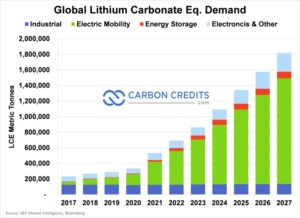
global lithium carbonate equivalent demand 2017-2027

For instance, in the US, President Trumpโ€™s policies might slow EV adoption by reversing climate goals. If the federal government cuts the $7,500 tax credit for EV buyers, electric vehicles may become more expensive. This change could hurt lithium demand.

In Europe, the situation is equally uncertain. The upcoming election in Germany could influence the future of the EV market.ย 

Germany plays a key role in Europe’s car industry. The election results could impact its push for electric mobility. The uncertainty around policy shifts in key markets like the US and Germany could result in fluctuating demand for lithium.

Lithiumโ€™s Next Chapter: Boom or Bust?

It is expected that the lithium market will face a surplus in 2025, as supply growth continues to outpace demand. However, the situation could change in the latter part of the decade, with a potential supply deficit driving prices higher.ย 

In 2025, the lithium market is navigating a period of uncertainty and opportunity. Prices should stabilize soon, but the long-term outlook looks bright. Strong demand from the electric vehicle industry drives this positivity. As companies and countries work to tackle climate-related issues, lithium becomes vital for the clean energy shift.

Amazon’s Q4 Triumph: Revenue Rises, Sustainability Shines

Amazon ended 2024 with strong sales, record-breaking revenue, and impressive profits. However, the stock market reacted cautiously due to a less optimistic forecast for early 2025. However, the retail giant focused on financial performance and made key strides in sustainability and innovation.

Amazon’s Holiday Sales Hit New Highs

The 2024 holiday season proved to be a major win for Amazon. The company reported $187.8 billion in sales for the fourth quarter, up 10% from 2023 and profits doubled to $20 billion or $1.86 per share. It exceeded analysts’ expectations of $1.49 per share.

Andy Jassy, President and CEO of Amazon, also affirmed by saying,

“The holiday shopping season was the most successful yet for Amazon and we appreciate the support of our customers, selling partners, and employees who helped make it so.”

Early Discounts, More Spending

This strategic approach to holiday sales contributed massively to its success. By offering deals as early as October, the company attracted early shoppers. It also helped maintain momentum through key events like Black Friday and Cyber Monday. This strategy made Amazon a top shopping spot for the holidays.

AWS Stands Out

Notably, Amazon Web Services (AWS), the companyโ€™s cloud computing arm, was a standout performer. AWS generated $10.6 billion in operating income, a rise from $7.2 billion in 2023. This growth highlighted the increasing demand for cloud and AI technologies.

For the entire year, Amazon recorded $638 billion in revenue, an 11% increase from 2023. Despite challenges like fluctuating exchange rates, the company maintained a consistent growth trajectory.

Andy Jassy further expressed himself by saying,

“When we look back on this quarter several years from now, I suspect what weโ€™ll most remember is the remarkable innovation delivered across all of our businesses, none more so than in AWS where we introduced our new Trainium2 AI chip, our own foundation models in Amazon Nova, a plethora of new models and features in Amazon Bedrock that give customers flexibility and cost savings, liberating transformations in Amazon Q to migrate from old platforms, and the next edition of Amazon SageMaker to pull data, analytics, and AI together more concertedly. These benefits are often realized by customers (and the business) several months down the road, but these are substantial enablers in this emerging technology environment and weโ€™re excited to see what customers build.”

Amazon revenue
Source: Amazon

2025 Forecast

Amazon expects first-quarter sales in 2025 to range from $151 billion to $155.5 billion. This shows a growth rate of 5% to 9% from last year. However, this outlook is below analystsโ€™ expectations of $158.56 billion in revenue.

Amazon’s Commitment to Carbon Neutrality

Amazon is equally focused on sustainability. Its sustainability report revealed that in 2023, the company cut its carbon emissions by 3%. It reduced its carbon footprint to 68.82 MMT CO2e from 70.74 MMT CO2e in 2022. This was driven by an 11% drop in Scope 2 emissions and a 5% decline in Scope 3 emissions. However, Scope 1 emissions rose by 7% due to increased transportation fuel use.

Amazon also slashed its carbon intensity for the fifth year in a row. This means a 13% drop from 2022 levels. This progress shows its dedication to minimizing its environmental impact.

Amazon emissions
Source: Amazon

Renewable Energy Milestone

Additionally, Amazon is growing its renewable energy portfolio. This includes wind, solar, and new tech like small modular reactors. Its AWS is playing a crucial role in meeting growing energy demands.

Energy efficiency is a key focus for AWS data centers. Amazon collects data and designs systems to boost energy efficiency. This helps lower its carbon footprint. The company is also increasing battery storage capacity to stabilize energy grids and speed up the shift to clean energy.

It also invests in green tariffs and utility contracts to launch new renewable projects.

amazon renewable energy
Source: Amazon

Electrifying Transportation

Transportation is a critical area for Amazonโ€™s emissions reduction strategy. The company plans to deploy 100,000 electric delivery vans by 2030. These vans will come from Rivian and other manufacturers. These efforts are transforming Amazonโ€™s logistics network while cutting transportation-related emissions.

Investing in Carbon-Neutral Solutions

Amazonโ€™s commitment to sustainability goes beyond emissions reduction. The company invests in new technologies through its $2 billion Climate Pledge Fund. This fund helps reduce the cost of decarbonization in various industries.

This initiative also supports startups developing solutions for hard-to-transform sectors and unavoidable emissions. Such strategies include:

  • Nature-Based Solutions: The company supports projects to reduce deforestation and restore ecosystems. These initiatives capture carbon, protect biodiversity, and benefit local communities.

  • Carbon Removal Technologies: Amazon is developing scalable solutions. These include direct air capture, bioenergy with carbon capture and storage (BECCS), and mineralization. These technologies remove CO2 from the air and address difficult emissions.

Amazon’s strong performance in 2024 shows its ability to balance growth and sustainability. It sets benchmarks for innovation and environmental responsibility. Despite challenges, its focus on efficiency, renewable energy, and decarbonization makes it a leader in creating a sustainable future.

Amazon-backed X-Energy Raises $700M: A Game-Changer for Small Modular Reactors (SMRs)

X-Energy, a leading company in advanced nuclear reactor and fuel technology, closed a $700 million Series C-1 financing round. This increase follows a $500 million raise in October 2024. The new funds will speed up the growth of their Small Modular Reactor (SMR) technology. The companyโ€™s Xe-100 reactor, which could transform the future of clean energy, is at the center of this push.

X-Energy: Powering the Future with Next-Gen Reactors

Founded in 2009, X-Energy is located in Rockville, Maryland. The company leads in nuclear technology, creating reactors and fuel systems for clean energy.ย 

Amazon-backed X-Energy raised $700 million from various investors, such as Segra Capital Management, Jane Street, Ares Management, Emerson Collective, and Amazonโ€™s Climate Pledge Fund. This funding is key for the companyโ€™s goals, including the following:

  • complete reactor designs,ย 
  • obtain licenses, andย 
  • build the TRISO-X fuel facility in Oak Ridge, Tennessee.

Kam Ghaffarian, Ph.D., Founder and Executive Chairman of X-Energy, emphasized the importance of the raise, stating,ย 

โ€œWe are proud to have gained the additional support from our industry, government, and investment community… We look forward to continuing to advance and scale our technology and realize our vision of fulfilling the growing energy needs of future generations.โ€

X-Energyโ€™s TRISO-X fuel is a key component of its SMR technology. This innovative fuel uses uranium particles with a tough shell. It can handle high temperatures without melting. This makes the Xe-100 reactor safer and more efficient than old reactors. It removes the need for large containment systems. Plus, the reactor can run continuously for up to 60 years.

Xe-100 Reactor: Revolutionizing the SMR Landscape

The Xe-100 reactor, which is powered by the TRISO-X fuel, is one of the most advanced Small Modular Reactors in development today.ย 

  • Each unit produces 80 megawatts of electricity, with plants typically consisting of multiple units to generate between 320 MW to 960 MW.

The modular design of the Xe-100 reactor is particularly attractive because it allows for easier transportation, faster construction, and more predictable costs. The technology also supports high-temperature steam production, ideal for both power generation and industrial uses, such as in chemical plants and data centers.

X-Energy is deploying its first Xe-100 plant at Dowโ€™s UCC Seadrift Operations in Texas. This will be the first grid-scale advanced nuclear reactor in North America. The U.S. Department of Energyโ€™s Advanced Reactor Demonstration Program supports it. The plant will deliver zero-carbon electricity and high-temperature steam for industrial use.

The company teams up with Amazon to add over 5 gigawatts of clean power by 2039. This partnership is vital for making SMRs a common energy source. Amazon’s investment supports its goal of reaching net-zero carbon emissions by 2040. This shows a rising interest in SMRs as a dependable, low-carbon energy option.

Why SMRs Are the Future of Nuclear Energy

Small Modular Reactors are poised to change the nuclear energy landscape. With a smaller footprint than traditional nuclear plants, SMRs can be deployed more quickly and at lower costs. This modular approach speeds up deployment. Itโ€™s faster than the multi-year timelines of larger reactors.

The flexibility of SMRs makes them an attractive option for a variety of applications. SMRs can power remote locations and industrial sites. They also boost renewable energy like solar and wind. As energy demand rises, especially in cloud computing, SMRs are viewed as a solution. Large data centers need stable and high energy output.

X-Energyโ€™s Xe-100 reactor exemplifies the potential of SMRs. The modular design speeds up deployment and cuts down on construction risks and costs. This makes SMRs appealing to utilities and companies like Amazon. They need to meet rising energy demands while sticking to budgets and reducing environmental impact.

Billions Flow into SMRs as Demand Soars

The $700 million raised by X-Energy is part of a broader trend in the nuclear industry toward smaller, more affordable nuclear solutions. Interest in SMRs is rising worldwide.ย 

Governments and businesses want energy security and lower carbon emissions. Estimates suggest we could see up to 25 gigawatts of SMR capacity by 2030. By 2050, this could grow to 40 gigawatts if current policies stay in place.

SMRs are expected to play a crucial role in meeting the worldโ€™s energy needs while addressing climate change. They provide a low-carbon choice instead of fossil fuels. Their small size suits smaller grids or industrial sites.ย 

The International Atomic Energy Agency (IAEA) sees SMRs as a key technology for clean energy production. They can help produce reliable electricity to meet global energy needs.

In fact, a significant investment jump is anticipated in the coming years. From the current $5 billion market today, SMR investments could grow to $25 billion by 2030, totaling $670 billion by 2050.ย 

nuclear energy investment outlook by type 2050
Chart from the IEA

If SMR construction costs go down as expected, total capacity may reach 190 gigawatts by mid-century. This could lead to $900 billion in global investment.

The Road Ahead for SMRs

While SMRs offer immense potential, challenges remain. To unlock the full potential of SMRs, thereโ€™s a need to streamline regulations and cut construction costs. With ongoing investments from firms like X-Energy and rising support from governments and private sectors, SMRs will likely be vital in the future of nuclear energy.

X-Energyโ€™s $700 million funding raise is just the beginning. As the company continues to develop and deploy its Xe-100 reactor technology, it will help pave the way for a new era in nuclear energyโ€”one that is clean, safe, and reliable.ย 

Fordโ€™s Q4 Success Overshadowed by EV Lossesโ€” What About its Carbon Reduction Goals?

Ford Motor Company ended 2024 with strong fourth-quarter results. This shows its growth and financial strength. However, the performance of its EV segment fell short of expectations.

Given that electric vehicles are central to Fordโ€™s net-zero strategy, this raises an important question: Is Ford falling behind in its sustainability goals? Let’s study the revenue report and its sustainability outlook in detail.

Ford Closes 2024 with Strong Fourth-Quarter Performance

Revenue surged to $48.2 billion, marking a $2.2 billion increase from the same quarter in 2023. The company reported a net income of $1.8 billion, with adjusted EBIT reaching $2.1 billion. Operating cash flow came in at $3.0 billion, while adjusted free cash flow stood at $0.7 billion, highlighting its steady financial footing.

For the full year, Ford’s revenue rose by 5% to $185 billion.

The company finished the year with over $28 billion in cash and nearly $47 billion in liquidity. This gives them flexibility in an unpredictable market. However, there was disappointment in the stock market as shares fell after the Q4 earnings release.

Ford’s President and CEO Jim Farley said,

โ€œFord is becoming a fundamentally stronger company. We finished 2024 with a solid fourth quarter, capping the highest revenue year in Fordโ€™s history. Our product portfolio offers the broadest powertrain choice. And Ford Pro, with its mid-teen margins, leading market position, and growing service and repair revenue, provides unique advantages for continued growth.โ€

Ford revenue
Source: Ford

Ford Pro Excels, Ford EV Disappoints

Ford Pro performed well, with revenue increasing by 15% to $66.9 billion. It earned $9.0 billion in profits, achieving a solid 13.5% margin. Software subscriptions increased by 27%, hitting close to 650,000 users. Also, telematics usage nearly doubled.

In 2024, Ford Blueโ€™s revenue stayed the same at $101.9 billion. Higher prices made up for a 2% drop in sales after cutting low-profit products. The segment earned $5.3 billion in profits.

Fordโ€™s EV segment struggled, losing $1.4 billion in the fourth quarter and $5.1 billion for the year. Despite selling about 105,000 EVs, generating $3.9 billion in revenue, losses exceeded sales.

Ford
Source: Ford

Fordโ€™s 2025 Outlook: Modest Earnings and Cash Flow

Ford is expecting adjusted EBIT for 2025 to be between $7.0 billion and $8.5 billion, with adjusted free cash flow ranging from $3.5 billion to $4.5 billion. Capital spending is forecasted to be between $8.0 billion and $9.0 billion.

However, the company is preparing for some challenges due to market conditions. In the first quarter, Ford expects its adjusted EBIT to be nearly zero. This is because of lower sales, a less favorable product range, and ongoing launches at key U.S. plants like Kentucky Truck and Michigan Assembly.

Farley further added,

“In 2025, we expect to make significantly more progress on our two biggest areas of opportunity โ€“ quality and cost โ€“ as we enter the heart of our Ford+ transformation. We control those key profit drivers, and I am confident that we are on the right path to create long-term value for all our stakeholders.โ€

Ford’s Carbon Reduction Strategy for a Sustainable Future

Ford aims to cut greenhouse gas (GHG) emissions by boosting operational efficiency. Its Carbon Reduction Strategy aims to cut Scope 1 and 2 emissions by 76% by 2035, compared to 2017 levels.

  • To track progress, Ford also set a shorter-term goal to reduce these emissions by 18% from 2017 levels by 2023, focusing on its manufacturing operations.
Ford emissions
Source: Ford

In 2023, Ford exceeded its target, achieving a 49% reduction in manufacturing emissions, and a total of 47% across all facilities. These efforts are helping Ford stay on track to meet its 2035 target.

  • Additionally, its carbon-free electricity now accounts for 70.5% of its global manufacturing operations.
Ford carbon reduction
Source: Ford

Fuel Efficiency and Emission Cuts in Fordโ€™s Vehicle Portfolio

Fordโ€™s vehicle portfolio is increasingly focused on models with the greatest potential for reducing emissions. The company is working on improving fuel efficiency for its light- and medium-duty trucks while also offering fully electric and hybrid versions of popular models. Simply put EV adoption is an important element of its long-term decarbonization strategy

  • Data from the U.S. EPA shows that the real-world CO2 intensity of Ford’s light-duty vehicles in the U.S. improved by 21% for cars and 10% for trucks from 2017 to 2022.

One of Fordโ€™s major projects includes developing hydrogen fuel cell technology for its medium- and heavy-duty vehicles. The company had partnered with the U.S. Department of Energy, to develop hydrogen fuel cell-powered Class-5 Super Duty trucks as part of the SuperTruck 3 program.

Ford fuel cell
Source: Ford

Ramping Up EV Production for Bigger Emissions Wins

Despite facing a drop in EV revenue, Ford would continue focusing on boosting its EV fleet. The plan includes battery-electric vehicles, hybrids, and fuel-efficient internal combustion engine (ICE) models. These options will help in areas where EV infrastructure is still growing.

  • Ford highlights that driving a Ford EV, using average U.S. grid power can cut GHG emissions by up to 62% when compared to a similar ICE vehicle.

This reduction occurs for two main reasons: the energy used to charge the vehicle and the lower emissions than regular gasoline cars.

In 2023, Ford sold nearly 280,000 hybrid vehicles, marking a 20% increase from the previous year. This growth shows that hybrids are becoming more popular. They are a lower-carbon choice compared to traditional vehicles.

Looking ahead, the shift toward EVs is expected to lead to even greater GHG savings as the electric grid becomes cleaner. As EVs become more affordable compared to traditional vehicles, it will also boost Ford’s market share in the low-emissions automobile domain.

Chinaโ€™s Renewable Energy Boom: A Record-Breaking Shift or Still Chained to Coal?

China is making record-breaking progress in renewable energy. The country has already achieved its 2030 clean energy goal six years early. With massive investments and policy support, China is set to remain the global leader in renewable energy expansion. But can it sustain this rapid momentum while balancing energy security and economic growth?

Beating the Clock on Clean Energy: Surpassing Renewable Energy Targets

In 2020, China set a goal to install at least 1,200 gigawatts (GW) of solar and wind power by 2030. By the end of 2024, China had already surpassed this target, reaching this milestone 6 years ahead of schedule. This was made possible by aggressive investments, government policies, and a surge in solar and wind installations.

Chinaโ€™s solar capacity grew by an incredible 45.2% in 2024, adding 277 GW. Wind capacity also saw a strong increase of 18%, with an additional 80 GW installed. Overall, total power generation capacity rose by 14.6% in 2024, driven mainly by renewables.

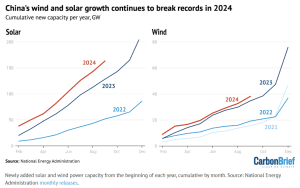
China renewable growth, wind and solar Q3 2024

One major milestone was the completion of the Ruoqiang photovoltaic (PV) project. This massive 4-GW solar farm in the Taklamakan Desert is one of the worldโ€™s largest solar power projects. It is part of Chinaโ€™s broader strategy to peak emissions before 2030 and transition toward cleaner energy sources.

This rapid progress is due to strong government support, record investments, and local manufacturers producing affordable solar and wind components.

Leading the World in Renewable Investments

China is the worldโ€™s largest market for low-carbon energy investment. In 2024, the country attracted $818 billion in clean energy investmentsโ€”more than the combined total of the U.S., the European Union, and the UK. This accounted for โ…” of the global increase in clean energy investments that year.

The world’s biggest carbon emitterโ€™s commitment to renewables is reshaping its energy mix. In June 2024, wind and solar power combined surpassed coal in installed capacity for the first time.ย 

China’s 14th Five-Year Plan set a goal for renewables to supply 33% of its electricity by 2025. By 2026, solar capacity alone is projected to overtake coal as Chinaโ€™s leading energy source, with 1.38 terawatts (TW) of solar power expectedโ€”150 GW more than coal.

China forecast renewable power generation 2050.jpg

Remi Eriksen, CEO of energy consultancy DNV, once remarked that:

“Intense policy focus and technological innovation are transforming China into a green energy powerhouse.”

And one of these innovations is in the field of nuclear power.

Nuclear Power and SMRs: A Game-Changer for Chinaโ€™s Energy Future?

China is also investing heavily in nuclear power, with 29 reactors under construction, totaling 33 GW of capacity. This makes up nearly half of all new nuclear projects worldwide. By 2030, China will surpass the U.S. as the largest nuclear power producer, with a projected capacity reaching up to 320 GW by 2050.

China nuclear power capacity under construction

Small Modular Reactors (SMRs) are a key part of China’s nuclear strategy. The countryโ€™s first SMR, a high-temperature gas-cooled reactor (HTR-PM), began operations in 2023. Other SMR designs, including the ACP100 and NHR200, are under development.ย 

These compact reactors will support industrial heating, electricity supply, and district heating. By 2050, Chinaโ€™s SMR capacity is expected to reach 35 GW, making it the leading global market for this next-generation nuclear technology.

number of SMRs announced China

China is quickly growing its renewable energy and advancing nuclear power. This makes it a leader in clean energy worldwide. Even though it still uses coal, the focus on renewables and nuclear is cutting carbon emissions a lot.

The Road to Net Zero: Can China Meet its 2060 Goal?

China has set ambitious climate goals. The country aims to peak its carbon emissions by 2030 and reach net zero by 2060. A key driver of this transition is energy independence, as China seeks to reduce reliance on imported fossil fuels.

A recent report from DNV highlights Chinaโ€™s rapid progress. The country had 1.45 TW of renewable energy capacity online by the end of 2024 and is on track to increase its clean energy capacity fivefold by 2050.

  • By that time, renewables are expected to supply 60% of Chinaโ€™s energy needs, although fossil fuels will still account for around 40% of the mix.

Challenges and the Role of Coal

Despite this rapid progress, coal remains a significant part of Chinaโ€™s energy system. The country still consumes over 50% of the worldโ€™s coal and continues to build new coal-fired power plants. In 2022, China approved 6x more new coal capacity than the rest of the world combined.

The heavy reliance on coal is partly due to energy security concerns. Events like Russiaโ€™s invasion of Ukraine and reduced rainfall affecting hydropower have made alternatives like gas and hydroelectric power more expensive.

  • Coal remains a backup energy source to support the countryโ€™s rising electricity demand, which increased by 6.8% in 2024.

However, Chinaโ€™s long-term goal is to reduce this dependence. The government is implementing policies to phase out fossil fuels gradually while ensuring energy stability. By 2050, Chinaโ€™s emissions are expected to drop by 70% compared to current levels, marking significant progress in its clean energy transition.

Future Outlook: A Renewable Superpower

Chinaโ€™s energy transition is at a critical turning point. The countryโ€™s investments and policy shifts indicate a strong commitment to clean energy. By 2030, Chinaโ€™s total energy consumption is expected to peak and then decline by 20% in 2050 due to increased efficiency and electrification.

China aims for net zero by 2060, which is ten years later than the UN’s 2050 target to keep global warming under 1.5ยฐC. So, while progress is strong, more efforts are needed to speed up the shift from fossil fuels.

Overall, China is leading the world in renewable energy expansion, breaking records in solar and wind installations. The countryโ€™s rapid growth in clean energy capacity is reshaping its power mix and reducing its reliance on coal.ย