

Disseminated on behalf of Alaska Energy Metals Corporation
Nickel’s importance stems from its role in enhancing battery energy density, improving EV range, and enabling a shift away from fossil fuels. To support this energy transition there has been a meteoric rise of nickel as a key material, particularly for batteries. But Nickel’s high demand has consequently sparked a supply strain.
Let’s study the demand and supply dynamics of nickel and its impact on this metal’s future.
Why Nickel is Indispensable?
Nickel’s role in enhancing battery energy density makes it indispensable for long-range EVs and larger vehicles like trucks. For instance, in this nickel revolution, high-nickel cathodes, such as those in NMC 811 batteries are taking the lead. These batteries offer higher energy density, reduced weight, and extended driving ranges which are vital consumer needs.
Thus, as global EV adoption surges, the demand for nickel is set to increase, requiring simultaneous expansion in supply to prevent shortages that might stall the energy transition.
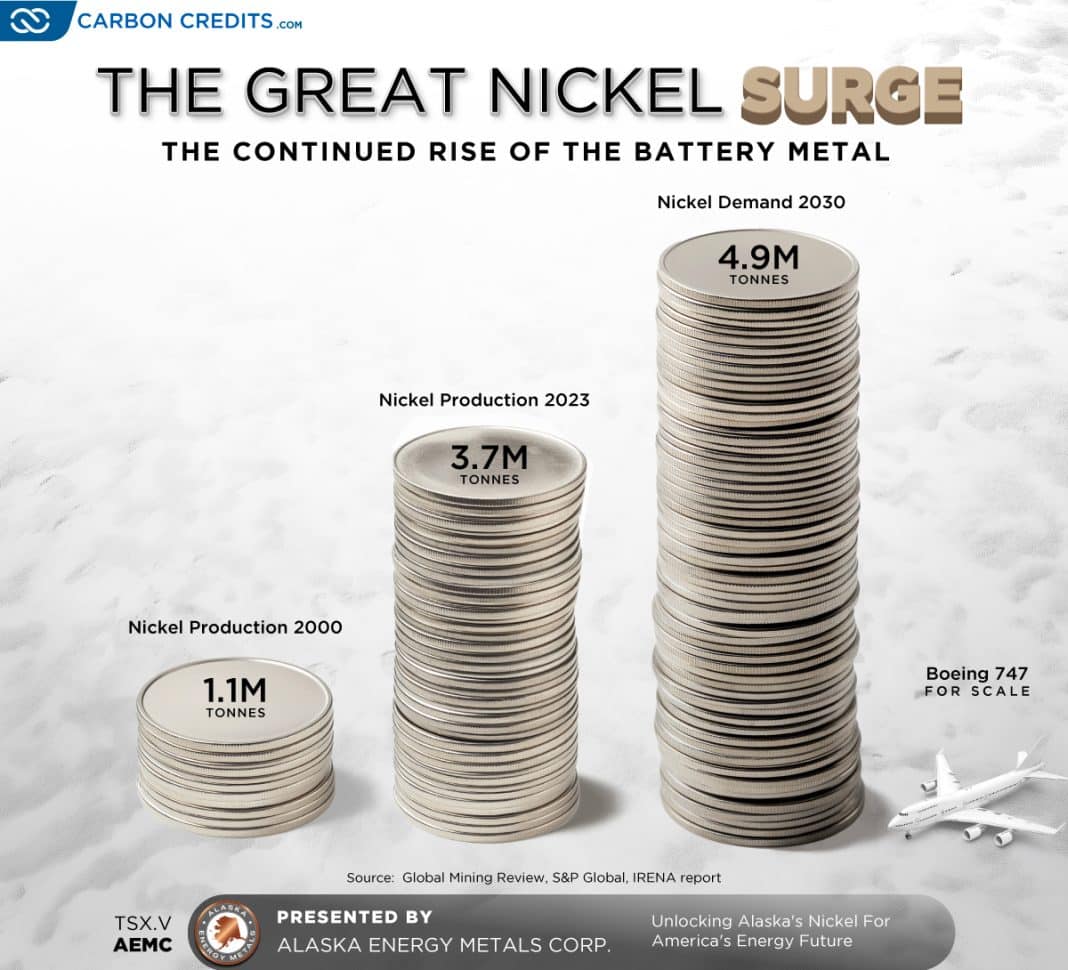
As you can see in the infographic, global nickel production has surged over the past two decades, increasing from 1.1 million tons in 2000 to 3.7 million tons in 2023. However, this growth may not be enough to meet future demand.
- By 2030, nickel demand will reach 4.9 million tonnes, driven by the electric vehicle (EV) market and renewable energy storage needs.
Navigating the Nickel Supply Chain
IRENA projects a positive outlook for nickel supply, but challenges remain in meeting the rising demand. However, the demand surge is expected to face fewer supply shortages compared to other critical materials.
- By 2030, nickel production is projected to range between 4.6 and 5.6 million tonnes, reflecting a relatively stable outlook for this essential resource.
Nonetheless, the potential for supply-demand imbalances persists due to the wide variation in production forecasts. For instance, the gap between the highest and lowest projections is nearly 60% of the current supply, underscoring uncertainties in meeting future needs.
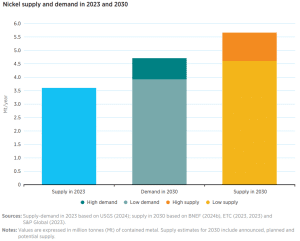
Source: IRENA
Alaska Energy Metals: Redefining Nickel’s Future
Now achieving this supply level will require significant investments in sustainable nickel mining and refining infrastructure across various regions. This means nickel miners must ramp up exploration efforts to bridge the supply-demand gap.
Additionally, factors such as market dynamics, regulatory policies, mining advancements, and processing technology will be crucial for meeting supply targets.
Notably, Alaska Energy Metals Corp. is one of the nickel juniors playing a significant role in shaping nickel’s future by tapping into Alaska’s rich nickel resources. The company is putting serious efforts into bolstering the nickel supply and building a reliable, low-carbon supply chain essential for the growing EV and renewable energy markets.
MUST READ: Nickel Could Be the Key to U.S. Energy Independence: Alaska Energy Metals’ Strategic Role
FEATURED: Live Nickel Prices
Disclosure: Owners, members, directors, and employees of carboncredits.com have/may have stock or option positions in any of the companies mentioned: AEMC.
Carboncredits.com receives compensation for this publication and has a business relationship with any company whose stock(s) is/are mentioned in this article.
Additional disclosure: This communication serves the sole purpose of adding value to the research process and is for information only. Please do your own due diligence. Every investment in securities mentioned in publications of carboncredits.com involves risks that could lead to a total loss of the invested capital.