Lenovo Unveils 2050 Net Zero Goal, Enters Carbon Credits Deal

Lenovo has revealed its goal to reach net zero greenhouse gas (GHG) emissions by 2050, which the Science Based Targets initiative (SBTi) approves, and entered a carbon credits deal with K+N.ย 

With this commitment, Lenovo becomes the first PC and smartphone maker with an SBTi-approved net zero target. The tech firm is also one of only 139 companies in the world that has a climate goal validated by the Net Zero Standard.ย 

Lenovoโ€™s emissions reduction measurements will contribute to a wider body of data to better understand and tackle climate change.

The SBTi Net Zero Standard

Lenovo Chairman Yuanqing Yang remarked:

โ€œIn the fight against climate change, we believe collaboration and accountability are the two critical elements needed for collective success. We remain dedicated to following climate science, standardizing our measurements, and seeking ongoing validation for our targets and progress.โ€ย 

Aligning net zero goals to the SBTi helps Lenovo to take a scientific, collaborative, and accountable means to cut emissions. Without doing so will make it hard to know when a net zero target is met.ย 

SBTi is the first international body to standardize net zero and what it means as it relates to limiting global warming to 1.5ยฐC. This net zero standard is also dynamic and responsive to firmsโ€™ collective efforts to decarbonize.ย 

More importantly, SBTi holds companies accountable for their emissions reduction targets.ย 

More than 4,000 companies worldwide are in the process of aligning their emissions reduction goals to SBTiโ€™s methodology and validation processes.ย 

CEO of the SBTi Luiz Amaral noted that the world needs rapid and deep emissions cuts to meet global net zero targets to avoid the most damaging effects of climate change. He further said:

โ€œLenovoโ€™s net zero targets match the urgency of the climate crisis and set a clear example that their peers must follow.โ€ย 

How Lenovo Will Hit Its 2050 Net Zero Goal

Lenovo commits to reaching net zero emissions across its value chain by 2050. Its long-term target is to cut absolute GHG emissions across all three scopes – 1, 2, and 3 – by 90% by 2050 from a 2019 base year.ย 

Hitting such an ambitious decarbonization goal requires the tech company to achieve the following reduction goals.

SBTi-Validated Near-Term Targets

  • Reduce scope 1 and scope 2 GHG emissions by 50% by 2030, compared to 2019 levels
  • Reduce emissions from the use of sold products by 35% on average for comparable products by 2030
  • Cut scope 3 emissions from purchased goods and services by 66.5% per million US$ gross profit by 2030
  • Cut scope 3 emissions from upstream transportation and distribution by 25% per tonne-km of transported product by 2030

The key strategies that Lenovo will adopt to reduce its GHG emissions are:

  1. Slashing the environmental impact of its products
  2. Applying innovation to increase the sustainability of its manufacturing
  3. Reducing emissions across its operations and value chain

These plans are outlined in Lenovoโ€™s Journey to Net-Zero video series. It shows how the companyโ€™s experts are modifying business processes to hit net zero targets.ย 

In addition to those emission reduction strategies, Lenovo is also working with other firms to further cut its carbon footprint. Its recent carbon credits collaboration with Kuehne+Nagel (K+N) perfectly shows this.ย 

Lenovo and K+N Carbon Credits Deal

Lenovo works with Kuehne+Nagel to develop a green logistics service that allows its customers to buy carbon credits that fund the use of Sustainable Aviation Fuel (SAF).

  • SAF is a fuel from sustainable inputs that reduces carbon emissions.

Via a purchase add-on service, customers can buy credits to cut the footprint of shipping the IT equipment and devices they purchase. They can then use those credits to fund the use of SAF that K+N provides.

There’s a specific amount of liters of SAF assigned to a purchased device. That figure equals the amount of reduction that the customer can claim under Scope 3.1. – emissions for purchased goods and services.ย 

If this service is chosen, Kuehne+Nagel will issue the carbon credit or certificate to Lenovo and its customers. This certificate indicates the amount of SAF liters per purchased device for any logistics company.

Through K+Nโ€™s SAF concept, Lenovo finds a way to address carbon emissions across supply chains, which is in line with its SBTi targets. This further allows Lenovo customers to avoid emissions in product shipment regardless of the lane or airline.ย 

This forged carbon credit deal with K+N enables Lenovo to pursue its net zero commitment – by โ€œdelivering sustainable products and solutionsโ€, the head of global logistics at Lenovo, Gareth Davies said.

Lenovo is an early adopter of the science-based emissions reduction approach. It has received SBTi approval for its near-term 2030 goals in 2020. This has allowed the firm to road-test the first-of-its-kind Net Zero Standard.ย 

DevvStream Files Provisional Patents to Improve Efficiencies in Carbon Credit Generation

DevvStream Holdings Inc. (โ€œDevvStreamโ€ or the โ€œCompanyโ€) (NEO:DESG), a leading carbon credit investment firm specializing in technology solutions, today announced the filing of provisional patent applications surrounding its innovative programmatic approach to green project management and carbon credit generation.

These initial filings establish concrete definitions for, and stake boundaries around, the Companyโ€™s exclusive processes and methodologies.

The provisional patents are primarily focused on the establishment of a proprietary umbrella approach to program implementation across the scope of the Companyโ€™s operations.

This umbrella approach will allow the Company to aggregate multiple green technology projects together under a single designated program, resulting in several anticipated efficiency improvements.

Implementation costs are expected to be reduced, current barriers to participation are expected to be eliminated, and the process for generating carbon credits is expected to accelerate.

Sunny Trinh, CEO of DevvStream stated:

โ€œThe current rate of greenhouse gas emissions underscores the importance of creating carbon credit programs that are robust and far-reaching, yet nimble and efficiently operated,โ€ย 

โ€œBy combining relevant green technology projects under the auspices of a common program, we can, for example, plug and seal a greater number of leaky wellbores more quickly under our methane abatement programs, including oil wells that might otherwise fail to qualify due to size or location. We anticipate that our proprietary approach will broaden our client reach, and by extension, broaden our overall environmental impact as a company.โ€

Click here to Get DevvStream’s Latest Investor Deck


Disclosure: Owners, members, directors, and employees of carboncredits.com have/may have stock or option positions in any of the companies mentioned: DESG.

Carboncredits.com receives compensation for this publication and has a business relationship with any company whose stock(s) is/are mentioned in this article.

Additional disclosure: This communication serves the sole purpose of adding value to the research process and is for information only. Please do your own due diligence. Every investment in securities mentioned in publications of carboncredits.com involves risks that could lead to a total loss of the invested capital.

Please read our Full RISKS and DISCLOSURE here.

Voluntary Carbon Credits Market Can Be Worth $1 Trillion in 2037

The total value of carbon credits traded in the market to help entities achieve their net zero goals can be worth $1 trillion as early as 2037, according to a recent report by BloombergNEF.

Verified emission reduction credits or carbon credits are traded in the voluntary carbon market (VCM), equivalent to 1 ton of carbon reduced or removed. Under its current structure, the VCM is โ€œnot built for successโ€, BloombergNEF said. But the research provider also noted that:

โ€œMore rigorous definitions of quality and greater emphasis on carbon removal could solidify market confidence, lift prices and drive demand.โ€

The VCM Growth (2021 – 2022)

Investments in VCM projects grew to $10 billion in 2022, up from $7 billion in 2021, a new report has found. Yet the market failed to grow last year as BNEF reported in its Long-Term Carbon Offsets Outlook.ย 

  • Firms bought only 155 million carbon credits as offsets, down 4% from 2021. The major reason being is the fear of reputational risk from buying low-quality credits.ย 

But carbon credits supply jumped by 2%, with a total of 255 million carbon offsets generated globally. Remarkably, the supply of credits from โ€œavoided deforestationโ€ fell by a third from 2021 to 2022.ย 

There were accusations of greenwashing in buying carbon credits from nature-based projects that had questionable environmental impact. REDD+ projects, in particular, are still under criticism after analysis claiming they produce โ€œghost creditsโ€.

In a different market analysis by AlliedOffsets, the lack of growth in the VCM is due to a slowdown in retirements of carbon credits. 2022 has seen slowing growth in retirements after last yearโ€™s explosion as seen in the chart below.

Voluntary Carbon Credits Retirement

carbon credits retirement
Source: AlliedOffsets

In particular, retirements of renewable energy and forestry credits declined in two consecutive quarters as shown below. This is the first time that it has happened in VCM history.

changes in carbon credits retired 2022


BNEF VCM Projections Under 3 Scenarios

  1. The Voluntary Credit Market Scenario

The BNEF modeled supply, demand, and prices for carbon offset credits under three different scenarios by 2050. Under each scenario, demand grows at various rates, and so do the prices.ย 

carbon prices VCM and removal scenarios

In the first scenario, entities can buy any type of carbon credits to meet their decarbonization goals. In this case, theyโ€™ll need about 5.4 billion credits each year in 2050. Thereโ€™s oversupply of credits and 8 billion of them will be produced annually, mostly from avoided deforestation.ย 

As shown in the graph above, carbon prices in the VCM scenario will go up to only $12/ton in 2030 and $35/ton in 2050. The total market value would only be $15 billion each year in 2030. Still, thatโ€™s a 650% increase from the $2 billion valuation in 2022.

2. The Removal Scenario

Under this second scenario, carbon credits from projects that actually remove carbon from the air only count. Those from avoided deforestation or clean energy projects are not part of the supply.ย 

As such, supplies will be short in 2037 as carbon removal technologies, e.g. direct air capture (DAC), are still expensive to scale up. Carbon prices for removals are far way higher than in the VCM scenario at ~ $250/ton. Annual market value will be as high as $1 trillion.ย 

But as DAC and other carbon removal tech receive more investments, costs will go down below $100/ton by 2050.ย 

Yet, high prices may prompt some firms to put their money in other net zero strategies over carbon offsetting. Or worse, it may force them to neglect their climate goals entirely if carbon removal credits remain too costly for them to offset emissions.

3. The Bifurcation (Two Market Branches) Scenario

The debate on what makes a carbon credit high-quality continues to this day. Stakeholders – investors, companies, and non-profits – believe that defining quality involves a set of criteria. The major ones include additionality, permanence, and co-benefits (benefits apart from reducing emissions).

  • In effect, the third BNEFโ€™s scenario emerges from this debate – the bifurcation or splitting of the market into two branches.ย 

carbon prices bifurcation scenario

In a smaller branch lies the less liquid market for high-quality carbon credits. These include credits from carbon removal technology projects and nature-based solutions in Oceania, Africa, and North America.ย ย 

Demand for high-quality carbon credits peaks at 433 million only in 2030 and 1.3 billion in 2050. And buyers will also have a smaller supply compared to other scenarios, at 1.4 billion and 3.2 billion in the same periods. Carbon prices reach $38/ton in 2039 before falling to $32/ton in 2050.

In another branch is the larger market for low-quality credits from energy generation and nature-based solutions in Latin America and Asia. Prices will be at only $12/ton in 2025 and peak at only $22/ton in 2050.ย 

  • Entities relying in this market for offsetting their emissions may have to deal with greater reputational risks.ย 

Overall, the outcomes of this third market scenario may change depending on what constitutes low- and high-quality offset credits. What will help clarify quality tiers are simplifying and standardizing carbon credit buying.

Standardization in Carbon Credits Marketย 

Standardization can drive more market liquidity and help stakeholders better decide on their offsetting strategies. Carbon exchanges, technology providers, and private sector initiatives are working hard to achieve this.ย 

But buyers may become more confused if many groups are addressing the issue separately.ย 

Kyle Harrison, Head of Sustainability Research at BNEF and the reportโ€™s lead author remarked:

โ€œBuyers need transparency, clear definitions around quality and easy access to premium supply, or future years will resemble what we saw in 2022. These changes will send demand signals to the projects making the greatest decarbonization impact and in need of the most investment.โ€

He further added that standardization is the carbon credit marketโ€™s space race. Only by resolving this matter can the carbon market grow by several orders of magnitude.

Abandoned Oil Wells and Carbon Credits

Youโ€™ve probably seen dozens of pictures before that look exactly like the one above.

An active oil field littered with pumpjacks, all churning out oil by the barrelsโ€ฆ

But have you ever stopped to think of what happens to these oil wells when the oil is gone? When the oil and gas companies pack up and leave for greener pastures?

If you havenโ€™tโ€ฆ then youโ€™re not alone.

Because as it turns out, most oil companies havenโ€™t, either.

Abandoned oil wells have rapidly become one of the major headline issues in the world’s fight against climate change.

The Original Pump and Dump

When oil wells on land are drilled, holes are bored into the ground that often go miles down. These holes are cased in cement to prevent leakage, all the way down to the bottom of the well where the oil is.

As you can probably imagine, oil wells can be pretty expensive to drill.

However, itโ€™s even more expensive to clean up afterward when theyโ€™re no longer profitable.

Hereโ€™s the thing: oil wells donโ€™t produce a constant amount of oil. Itโ€™s not like a faucet you can turn on and off.

  • Oil well flow rates vary depending on a number of factors, including how much oil is left in the reservoir.

Generally speaking, an oil well produces the most oil when itโ€™s first drilled.

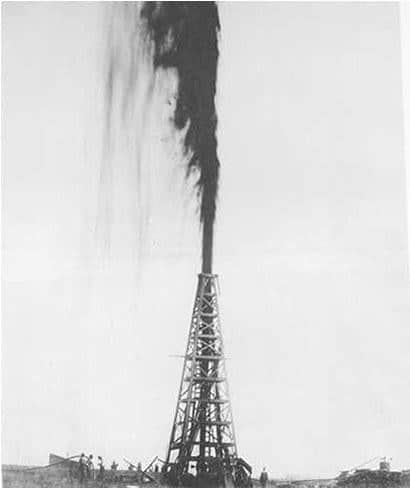
Lucas Gusher well pumping oil

The Lucas Gusher in Texas. Taken by John Trost in 1901

If youโ€™ve seen any old photos like the one aboveโ€ฆ

Pictures like these were usually taken when a new oil well had just breached a new oil reservoir under high pressure.

Over time, however, as more and more oil and gas is pumped away, flow rates will continuously decrease.

  • At some point, there wonโ€™t be enough oil coming out anymore to offset the costs of keeping the well running. This is known as a wellโ€™s โ€œeconomic limitโ€.

Now, this oil well isnโ€™t empty. Thereโ€™s still plenty of oil and gas left down there. Itโ€™s just not coming up fast enough for the oil company to make any money off it. So, at this point the well is usually shut down โ€“ or โ€œpluggedโ€.

Quite often, oil companies will do this simply when oil prices are unfavorable, as opposed to only when flow rates have fallen too low. Temporary plugs are placed in these wells so that they can be reactivated at a later date.

However, sometimes these wells are forgotten afterwards. The owners may have gone bankrupt, lost their drilling rightsโ€ฆ Or they may simply have walked away from the well, leaving them neglected. Abandoned.

But just because theyโ€™ve been abandoned doesnโ€™t mean theyโ€™re out of sight, out of mind. Many of these abandoned wells leak, potentially contaminating the surrounding groundwater or soil.

And one of the most concerning things these wells leak is methane โ€“ a deadly greenhouse gas thatโ€™s the second-largest contributor to climate change, right behind carbon dioxide.

Methane gas is up to 86 times better than CO2 at trapping heat in the atmosphere in the first 20 years after itโ€™s been released. So, targeting methane emissions is an important part of the fight against climate change.

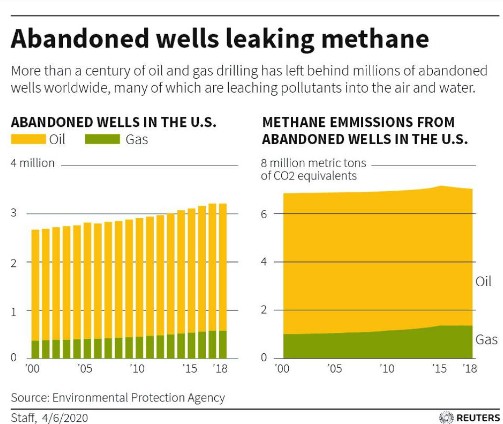
abandoned oil wells leaking methane in US

There are over 3 million abandoned oil and gas wells in the U.S. They collectively emit the equivalent amount of putting an extra 1.5 million cars on the road every day.

Reuters estimates that, when taking into account major oil-producing nations with a poor track record like Russia or Saudi Arabia, there may be as many as 29 million oil wells abandoned internationally.

Thatโ€™s why these abandoned oil wells โ€“ also known as orphan wells โ€“ have turned into a major problem in the fight against climate change.

One Manโ€™s Trashโ€ฆ

Now youโ€™re probably thinking: why do these oil companies get to just walk away from oil wells like that? Why even do it in the first place?

Well, as it turns outโ€ฆ

  • Cleaning up an oil well is expensive. Potentially more expensive, in fact, than drilling the well in the first place.

The process of plugging a well begins with dismantling the pumpjack, alongside any other equipment that may still be left on the surface.

Then โ€“ and this is the hard part โ€“ they have to inspect the casing of the well for leaks and other defects.

A casing is a series of hollow steel pipes surrounded by a cement shell. It supports the well hole and protects against leakage. It keeps the oil thatโ€™s being pumped up from getting out and contaminating the surroundings.

So, as you might guess, the casing needs to go all the way down to the bottom of the well.

In the years that a well has been abandoned, the casing will have been deteriorating, as cement will over time. Especially since the impurities found in crude oil are often corrosive.

Any defects in the casing need to be repaired first, to ensure that no more oil or gas leaks out. This is generally accomplished by cleaning out any oil or gas that could cause corrosion, and then pouring more cement.

When the condition of the casing is deemed satisfactory, the well is then filled with water or another non-corrosive liquid. The well casing is then cut, typically one meter below the surface, and then topped with a vented cap.

The cost of plugging an abandoned oil well can run anywhere from $20,000-$40,000 all the way up to $1,000,000. That depends on how deep the well goes and what condition itโ€™s in.

Oil wells for fracking, for instance, are expected to run closer to $300,000 on average to plug. That’s because their long horizontal nature makes them harder to deal with than traditional oil wells.ย 

The problem is, while oil and gas companies are required by law to set aside a chunk of money for each well they drill to plug it later, this amount of money is based on the cost to plug a traditional oil well. This required amount is as low as $10,000 per well in some areas. But on federal land, caps at a maximum of $150,000 for all wells drilled nationwide.

And for many of these abandoned oil and gas wells, the owners lack enough money to cover the actual costs of plugging each wellโ€ฆ or worse, thereโ€™s no more owners left to chase down for the money.

Which is why the governmentโ€™s been stuck with the bill.

โ€ฆ Is Another Manโ€™s Treasure

Theyโ€™re a major environmental disasterโ€ฆ but at the same time, theyโ€™re also an opportunity for some.

In November of 2021, the Biden administration launched a $4.7 billion program to plug abandoned wells as part of the Infrastructure, Investment and Jobs Act.

Through this program, qualifying states can receive federal grant money to find and plug abandoned wells, as well as reclaim the land surrounding them.

Phase one of the program is already under way. $560 million was awarded last August to 24 different states, with more on the way.

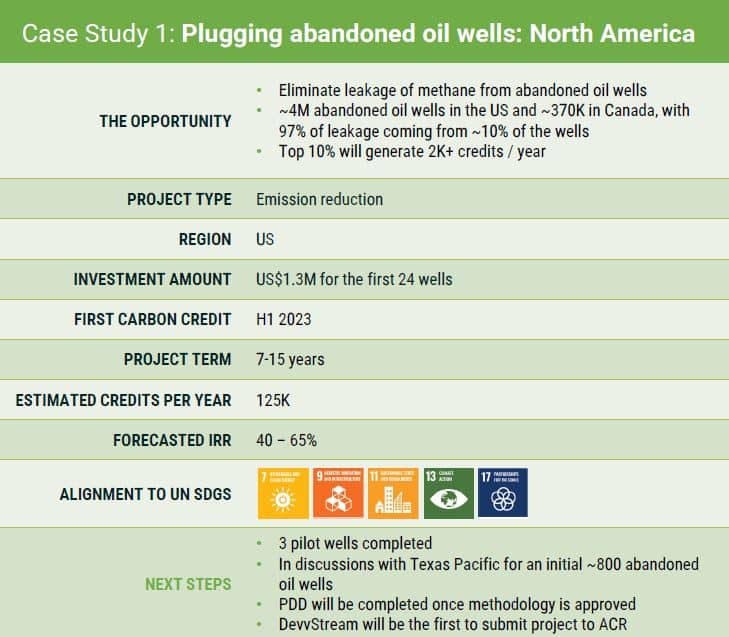
In addition to this, since plugging abandoned wells eliminates methane emissions, any abandoned wells not already covered under a government program are a potential source of carbon credits for companies willing to take on the burden of plugging them.

The Biden administration may be willing to take the fight to abandoned oil wells in the U.S., but what about the other 29 million scattered around the world? Some of them are even very close to home, such as right across the border in Alberta, Canada.

Thereโ€™s a big opportunity here for the right companies in the right places to make a ton of money.

Canadian-based DevvStream (DESG) last year announced an agreement with TS-Nano to plug abandoned wells and generate a stream of carbon credits.

Plugging abandoned oil wells Methane Carbon Credits


Disclosure: Owners, members, directors, and employees of carboncredits.com have/may have stock or option positions in any of the companies mentioned: DESG.

Carboncredits.com receives compensation for this publication and has a business relationship with any company whose stock(s) is/are mentioned in this article.

Additional disclosure: This communication serves the sole purpose of adding value to the research process and is for information only. Please do your own due diligence. Every investment in securities mentioned in publications of carboncredits.com involves risks that could lead to a total loss of the invested capital.

Please read our Full RISKS and DISCLOSURE here.

Amazon to Start Trading Renewable Energy in India

0

Amazon received the green light from Indian authorities to start trading renewable energy sources in the country.

After securing a category-III energy trading license, the e-commerce giant is building up a series of wind and solar energy projects in India. A category III license allows the company to trade electricity of up to 4,000 million units annually.ย 

Amazon has signed a total of 720 MW worth of energy purchasing agreements in India. It has also signed agreements with partners such as Vibrant Energy, ReNew Power Global, Amp Energy India and Brookfield Renewable. Amazon will handle all its energy trading through its new subsidiary, AEI New Energy Trading Pvt. Ltd.ย 

In September last year, ReNew Power signed a deal with Amazon to supply 210 MW of solar power. The 210 MW solar farm will be located in the northern state of Rajasthan. By operational capacity, ReNew Energy is one of Indiaโ€™s largest renewable energy companies.

  • The solar farm is one of Amazonโ€™s three solar renewable energy projects in India. The second one is a 100 MW project in partnership with Amp Energy. The third project is a 110 MW project with Brookfield Renewable.ย 

These three solar farms can produce a total of 1,076,000 megawatt hours (MWh) of clean energy annually. This would be enough to cover the electricity consumption for around 360,000 medium homes in Delhi.ย 

Additionally, at the end of last year Amazon announced two more utility-scale renewable energy projects. Partnering with Vibrant Energy, Amazon will develop two hybrid solar-wind projects in Karnataka and Madhya Pradesh.

These projects have a total capacity of 300 MW. The company now has a total of five utility-scale renewable energy projects in progress in India.ย 

Indiaโ€™s Net Zero Goals

In recent years, India has set ambitious net zero goals and ramped up efforts to decarbonize different sectors. In November 2022, India submitted its Long-Term Low Emission Development Strategy to the United Nations Framework Convention on Climate Change (UNFCCC) at COP27.ย 

India has committed to reaching net zero carbon emissions by 2070 and increase its renewable energy capacity to 500 MW by 2030. In addition to developing renewable energy projects

Amazonโ€™s Renewable Projects Across Asia

As the largest corporate purchaser of renewable energy in the world, Amazon has a strong commitment towards decarbonizing the planet. Besides India, Amazon has also invested in green and renewable energy projects in Indonesia, Japan, Singapore and Australia.ย 

In the Asia-Pacific region, the company has over 50 renewable energy projects in the works. Amazonโ€™s portfolio of renewable energy projects across Asia have a total capacity of 1.6 GW.ย 

In 2021, Amazon launched its first renewable energy project in Singapore. It is a 62 MW solar plant that would have the potential to generate 80,000 megawatt hours (MWh) of clean energy annually. This would be enough to cover the electricity consumption of over 10,000 homes in Singapore.ย 

Last year, Amazon also announced its first renewable energy projects in China. They are a wind and solar farm that have a total energy capacity of 200 MW, and can generate 496,000 MWh annually. This would cover the energy needs of over 250,000 homes in China.

Amazonโ€™s Decarbonization Strategies

Beyond developing renewable energy projects, Amazon Web Services (AWS) has also invested in massive climate-based data collection efforts around the world. AWS set up the Amazon Sustainability Data Initiative (ASDI), providing greater access to large climate-based datasets to help researchers and scientists.ย 

The company also partnered with Verra to introduce a new carbon credit label called ABAQUS. The new label aims improves on additionality and durability considerations of long-term decarbonizing initiatives.

  • Verra is a non-profit company that has been a leader in creating and upholding environmental standards, especially with regards to carbon emissions.

This is in the midst of reports that Amazonโ€™s carbon footprint grew in 2021, with a 40% increase since 2019. In 2021, the retailer had emitted a total of 71 million metric tons of carbon emissions.

In 2019, the company founded The Climate Pledge, to lay out its net zero commitments. The goal is to reach net zero by 2040, 10 years ahead of the 2050 goal set by the Paris Agreement.ย 

The pledge, signed by over 300 businesses, covers three key aspects of decarbonizing:

  • Eliminating carbon using decarbonizing projects (e.g. renewable energy)
  • Carbon emissions reporting, with better regularity and accuracy (e.g. via initiatives like ASDI)
  • Using credible carbon offsets (e.g. ABAQUS)

UK Considers ยฃ300M Climate Bailout of British Steel

0

The UK government is considering a plan to channel a ยฃ300 million ($372 million) climate package to help British Steel reduce its carbon emissions and save it from collapsing.ย 

Once a giant UK steel manufacturer, British Steel has been hit hard in recent years. Three years ago, the Chinese Jingye Group bought the steelmaker, making it the 3rd owner in four years.ย 

A final decision has not been made to date and is set to be announced in the coming days.

Saving UK British Steel

The investment deal will help the Chinese-owned steelmaker to become more eco-friendly by transitioning from blast furnaces to electric arc furnaces. The companyโ€™s site is in Scunthorpe, northern England.ย ย 

The government aid will also help protect jobs at the Chinese-owned steelmaker, employing about 4,000 people directly.ย 

The Department for Business, Energy, and Industrial Strategy said in a statement:

โ€œThe government recognizes the vital role that steel plays within the UK economy, supporting local jobs and economic growth and is committed to securing a sustainable and competitive future for the UK steel sectorโ€ฆโ€

Negotiations about the deal are ongoing so the business secretary canโ€™t comment yet about it. But the official considers โ€œthe success of the steel sector a priority and continues to work closely with industry to achieve this.โ€ย 

British Steel has been seeking urgent financial support after it was heavily affected by soaring energy and carbon prices. UK public officials have been urging the Chancellor to come into rescue.ย 

Theyโ€™re saying that the fall of the steelmaker will also impact the government. It can lead to alarming decommissioning liabilities and may undermine steel production in the UK.ย 

The decision comes after the UK steel industryโ€™s struggles were revealed. Another steelmaker, Liberty Steel, decided to cut its production in Britain and stop operations in some sites. All thatโ€™s due to the high energy costs threatening lay-offs.ย 

Add to that the decrease in demand last year over the fear of recession taking on the region. Consumption from major customers such as construction companies and manufacturers also fell.ย 

And so the need for intervention from the government.ย 

Shifting Away from Coal to Electric

But there are some strings attached to the British Steel package deal.ย 

One is to protect jobs at the company. Another condition is that Jingye Group has to invest at least ยฃ1 billion in British Steel by the start of the next decade.ย 

But the general goal is to help the company reduce its carbon emissions by shifting away from coal.

The traditional way of producing steel using coal represents about 70% of the worldโ€™s steel production. This produces about 2 tons of carbon for every ton of steel produced.ย 

Electric arc furnaces (EAFs) produce the remaining 30% of the steel. EAFs emit lower levels of carbon than blast furnaces as they can run on renewable power. They are best used on recycled steel.ย 

Report shows the need to act now to bring the steel industry to net zero emissions. And according to the analysis, the biggest factor for the industry to be successful in its climate goals is to switch to EAFs.

Another option is producing steel using green pig iron. Itโ€™s iron ore thatโ€™s processed using low emission technologies and inputs such as biomass called biochar.

Using biochar for green pig iron eliminates the need for sintering and coking. The technology is also 10% – 15% less cost-intensive than traditional blast furnace systems.

But these alternatives call for about over one trillion investment opportunities in the industry. And the UK steel industry must shift away from coal and embrace low carbon alternatives to stay competitive.ย 

JBS “Green Bonds” and GHG Emissions Under Investigation

Brazilian meat giant JBS is under investigation by a watchdog group that questions the company’s GHG emissions disclosure and the integrity of its โ€œgreen bondsโ€.

The worldโ€™s biggest meat company, JBS, was founded in 1953 in Western Brazil. It expanded into Argentina, to the U.S. and beyond.

It has made plenty of acquisitions, too, including the beef business of Smithfield Foods, pork business of Cargill, and most of Pilgrimโ€™s Pride chicken production.ย 

The food-processing firm has sold ~$3 billion worth of green bonds tied to its sustainability goals in 2021. It said that should it fail to achieve its GHG emissions targets, it will pay bondholders a โ€œpremium or step up amountโ€.ย 

But according to an activist group, Mighty Earth, JBS is already missing out on meeting its climate goals.ย 

JBS Green Bonds Issue

The group said that the meat giant contributed to or ignored deforestation done by its suppliers, and filed a complaint about it with the Securities and Exchange Commission (SEC).ย 

Mighty Earth calls for the agency to impose appropriate penalties and injunctions on JBS. the organizationโ€™s CEO and founder Glenn Hurowitz remarked:

โ€œWe see JBS as one of the three linchpin companies for changing the whole meat industryโ€ฆ It has by far the highest emissions of any company in agriculture.โ€ย 

The group noted that JBS methane emissions are far more than the total sum of four large countries – Germany, France, Canada, and New Zealand. And so, theyโ€™re taking on the company over whether its โ€œgreenโ€ bonds deserve to be called as such.

JBS disagrees with the groupโ€™s accusations, saying that it will channel $7 billion to sustainability efforts. For instance, it aims to adopt solar power for all of its Swift & Company stores. It also works with European health and nutrition company DSM to cut its cattle methane emissions.ย 

Moreover, the food giant is also planning to invest another $1 billion over the next decade to slash its emissions intensity by 30%.ย 

ESG Disclosure: Scope 3 Emissions

Specifically, JBS said the firm seeks to reduce its Scope 3 emissions. This refers to the indirect emissions from sources that an entity doesnโ€™t own or control, e.g., suppliers.ย 

The company stated in a filing:ย ย 

โ€œWhile we acknowledge the importance of measuring and ultimately reducing scope 3 emissions, a widely-accepted method for measuring scope 3 emissions does not currently exist for our industry.โ€

Investors are becoming more concerned about the environmental impact of the firms they invest in. Thus, many demand more transparency and disclosure.ย 

The complaint against JBS comes as the SEC will be revealing its new rules on GHG emissions disclosures. Climate activist groups believe that this will improve transparency in disclosure if businesses report them.ย ย 

The SEC had dealt with this concern in some cases. For example, the agency prompted Goldman Sachs Asset Management to pay the penalty amounting to $4 million last November. Itโ€™s a charge for misrepresenting its mutual funds and ESG investment accounts.ย 

Still, the regulator has to deal with how entities measure emissions coming from sources they donโ€™t control. The bulk of JBSโ€™ emissions (90%) comes from its supply chain or Scope 3.ย 

The company doesnโ€™t argue against corporationsโ€™ role to mitigate climate change. In fact, it pledges to reach net zero emissions by 2040.ย 

In a framework it published for bond investors, JBS acknowledges that climate change โ€œposes significant risks to our business, our producer partners, customers, and consumers.โ€

JBS GHG Emissions Disclosure

Regardless, Mighty Earth still seeks more disclosure. The group claimed that JBS is not disclosing correctly the total number of animal slaughter it has had since 2017. That figure is a significant part of the firmโ€™s total GHG emissions as a meat processor.ย ย 

Thatโ€™s a larger footprint than all of Italy and almost as large as that of the UK.

JBS GHG emissions vs. countries 2021

The food company, however, responded that it hasnโ€™t misled its investors. Thatโ€™s why its green bonds are not tied to Scope 3, only to Scope 1 and 2 emissions.ย 

JBS spokesperson said the bonds were not for โ€œfunding its entire decarbonization processโ€. Rather, they were โ€œclearly designed and structuredโ€ to address the facilities under the firmโ€™s control.

  • The company also stated that it will eliminate illegal Amazon deforestation from its supply chain by 2025. But it will not completely stop deforestation globally across its supply chains until 2035.

Behind that pledges are a series of investigations into JBS operations.ย 

In November last year, the meat processor claimed it was a victim of fraud in buying thousands of cattle from illegal farms in the Amazon.

Before that, the firm was the subject of various financing and bribery investigations. And for the past five years, it has paid millions for violating the Foreign Corrupt Practices Act and settling price-fixing cases.ย 

Mighty Earth thinks that JBS has the freedom in disclosing its GHG emissions, as to what and to whom.ย 

The group also said that the meat giant is considering getting into capital markets in the U.S. for a public offering. However, without addressing the dispute over its GHG emissions disclosure, it might be hard for JBS to achieve that, says Mighty Earth.

From Plants to Plastics and Carbon Credits

Plastic pollution has become one of the most pressing environmental concerns but scientists discovered a new alternative – PET-like recyclable plastics made from plants.

A lot of studies are shedding light on the impact of plastics on human health and marine ecosystems. But discussions around plasticsโ€™ impact on climate change have been scarce so far.ย 

The recent COP27 high level event changes that, bringing more awareness to plastic pollution and its contribution to global warming.

A 2050 net zero emissions scenario requires plastic alternatives that are biodegradable, affordable, scalable, and have lower energy use and carbon footprint.ย 

Researchers have created a plastic from biomass with PET-like properties and meets the criteria as an eco-friendly alternative to the existing plastics.ย 

Plastics and Their Carbon Footprint

Plastics are made from fossil fuel and produce greenhouse gases throughout their lifecycle. They are also projected to represent 20% of oil consumption and 15% of the global annual carbon budget by 2050.ย 

  • Single-use plastics, in particular, have a high carbon footprint and loss of energy resources as theyโ€™re discarded after only a short, one-time use.

Unfortunately, only 9% of plastic has ever been recycled. And according to the International Union for Conservation of Nature (IUCN), at least 14 million tons of plastic go to the ocean every year. Without action, plastic in the oceans could triple by 2040.

Thus, new materials made from other sources than oil are emerging to address emissions across segments in the plastics industry. Bioplastics or biopolymers are from natural, biological sources. Both alternatives are meeting the demand for plastic substitutes.

But one critical factor thatโ€™s often overlooked when it comes to plastic alternatives is their carbon footprint.ย And so, scientists and companies around the world are finding ways how to address this.ย 

Carbon capture and utilization (CCU) companies are developing technologies to make plastics from carbon emissions.

For instance, the US-based company LanzaTech is using microbes to convert captured carbon into polymer precursors like ethanol.ย This is part of their ESG strategy to make business operations become sustainable.

Meanwhile, some scientists are working on degradable or recyclable polymers made from non-edible plant material called โ€œlignocellulosic biomassโ€. However, the research surrounding this natural plastic source is complex.ย 

Plastics Made From Plants

But teams of scientists from Switzerland and Austria, led by Jeremy Luterbacher at Federal Institute of Technology Lausanne or EPFL and the University of Natural Resources and Life Sciences in Vienna believe they offer an ideal solution.

They have created a new PET-like recyclable plastics that can be easily made from the non-edible parts of plants. This plastic alternative offers a promising tough and heat-resistant plastic ideal for food packaging.ย 

Here’s a quick overview about this new discovery.

Jeremy Luterbacher noted:

โ€œWe essentially just โ€˜cookโ€™ wood or other non-edible plant material, such as agricultural wastes, in inexpensive chemicals to produce the plastic precursor in one stepโ€ฆ By keeping the sugar structure intact within the molecular structure of the plastic, the chemistry is much simpler than current alternatives.โ€

Such a technique is after Luterbacherโ€™s and his colleaguesโ€™ discovery in a previous study in 2016. The team discovered that adding an aldehyde, an organic compound, stabilized certain parts of plant material and prevented their destruction.

The scientists use a different aldehyde – glyoxylic acid instead of formaldehyde. This chemical allows the sugar molecules from biomass waste to act as plastic building blocks.ย 

  • Using that technique, the team was able to convert about 25% of the weight of plant waste (95% of purified sugar) into plastic.ย 

The new plastic material can have various uses, the researchers said. It works for packaging, making textiles, and creating electronics and medicinal items.ย 

In fact, the team has made some of them already as shown in the picture below. E.g. packaging films (H), fibers for clothing and other textiles (E), and filaments for 3D-printing (G, J).ย ย 

plastics made from plants or biomass wastes

Luterbacher says that the plastic has very exciting properties, making it great for food packaging. He also added that:

โ€œAnd what makes the plastic unique is the presence of the intact sugar structure. This makes it incredibly easy to make because you donโ€™t have to modify what nature gives you, and simple to degrade because it can go back to a molecule that is already abundant in nature.โ€

If businesses opted to use the plastics from plants for packaging or other purposes, they may enjoy a potential revenue stream from carbon credits. They can earn the corresponding credits from the amount of carbon saved from not using fossil fuel.ย 

Do Deforestation Projects Really Reduce Carbon?

An investigation claimed that over 90% of its forest carbon credits likely donโ€™t represent real emission reductions, but Verra said that this is incorrect because the studies miscalculate the impact of its REDD+ projects.ย 

Verra is the worldโ€™s leading carbon standard for carbon credits that support global climate action. To date, it has issued over 1 billion carbon credits since 2009.

The credits enabled billions of dollars invested into urgent climate action, sustainable development, and the protection and restoration of ecosystems, Verra stated.ย 

Findings on Verraโ€™s REDD+ Projects

An analysis of some forest projects, also called REDD+, that Verra verifies says that the carbon credits those projects generate are “largely worthless” and areย โ€œphantom creditsโ€.

The 9-month investigation was done by the Guardian, the German weekly Die Zeit, and SourceMaterial, a non-profit investigative journalism organization.ย 

Their findings are based on an analysis of scientific studies of Verraโ€™s rainforest schemes. These studies used satellite images to check the results of the REDD+ projects under investigation.

  • REDD+ means “reducing emissions from deforestation and forest degradation, plus the conservation, sustainable management of forests and enhancement of forest carbon stocks in developing countries”.

Example of a Verra REDD+ Project

Example of Verra REDD+ project generating carbon credits
Guardian graphic. Source: High-Resolution Global Maps of 21st-Century Forest Cover Change by Hansen et al. 2013. Referenced area sourced from project documents

A team of journalists that performed the investigation concluded these key findings:

No climate benefit:

According to two studies, only a handful of Verraโ€™s rainforest projects showed evidence of deforestation reductions. Further analysis also shows that 94% of the carbon credits bring no benefit to the climate.ย 

Overstatement of forest threats:

A study by the University of Cambridge in 2022 revealed that the threat to forests was overstated by about 400% on average for Verra REDD+ projects.ย 

Carbon credits buyers:

Big corporations are the major buyers of carbon offset credits approved by Verra for climate and environmental benefits. They include Shell, BHP, EasyJet,ย Pearl Jam, Salesforce, Gucci, and Disneyย among many others.

Human rights issues:

At least one of the projects involves a serious concern with human rights issues. Residents in a project site (in Peru) said that they were forced to leave their homes that were cut down by park authorities.ย 

The studies that journalists based their analysis on used different methods and time periods. They also looked at various ranges of Verra REDD+ projects.

The researchers noted that their studies have limitations and that no modelling approach is ever perfect.ย Still, the data spoke of broad agreement on the lack of effectiveness of the projects compared with the Verra-approved predictions, the analysts said.ย 

Verra strongly disputed the findings, saying the methods the studies use cannot capture the projectsโ€™ real impact on the ground. This is where the difference in calculating the carbon credits Verra approves and the reductions the scientists estimate lies.ย 

Verraโ€™s Response: Incorrect Conclusions

Verra worked closely with the publication to explain why their findings are not true. The carbon standard responded that it is:

“…disappointed to see the publication of an article in the Guardian, developed with Die Zeit and SourceMaterial, incorrectly claiming that REDD+ projects are consistently and substantively over-issuing carbon credits.”

Verra further said that the claims in the article are based on studies using โ€œsynthetic controlsโ€ that don’t account for project-specific factors that cause deforestation. Thus, they greatly miscalculated the impact of Verra’s REDD+ projects.

The carbon credits verifier develops and improves its methodologies through rigorous consultations with academics and experts.

This is to make sure that project baselines used to calculate carbon credits are robust. Only then that they can serve as a credible benchmark against which to assess the impact of the projects.

Verra certifies projects that avoid, reduce, or remove emissions measured in tonnes of CO2 or its equivalent (CO2e).ย 

The Claims are Not True – Verra

Verra welcomes scrutiny of methodologies and contributions from other experts through public consultations.ย 

Though the studies provide data that contribute to the broader work on optimizing methodologies for rainforest projects, they have limited utility for assessing the impact of REDD+ projects, Verra stated. That’s because, again, they don’t take into account site-specific drivers of deforestation.ย 

In particular, the studies have incorrect findings as they rely on synthetic controls that don’t accurately represent the pre-project conditions in the area. The authors themselves acknowledge this.

  • Synthetic controls compare a project to a control scenario based on a set of variables that impact deforestation. On the other hand, Verraโ€™s approach for REDD+ projects compares them to real areas.ย 

The verifier is also using synthetic controls for certain project types, i.e. Improved Forest Management in North America. But this approach is not suitable for REDD+ projects due to the difficulty in finding points that match inside and outside the project area.

Verra also noted that their REDD+ projects are not randomly located. There are local factors at play to know that a specific area is at acute risk of deforestation. And that’s crucial in deciding which project area to select.ย 

Verra REDD+ methodologies are designed to address the variability between the project area and surrounding areas, whereas the synthetic controls used in studies do not effectively do this.

Therefore, the studies calculated emission reductions different from the number of carbon credits that Verra issued to the projects.

Global Green and DevvStream Partner to Launch Inaugural U.S. Carbon Program to Advance Technological Solutions to Climate Change

DevvStream Holdings Inc. (โ€œDevvStreamโ€ or the โ€œCompanyโ€) (NEO:DESG), a leading carbon credit investment firm specializing in technology solutions, and Global Green, the American affiliate of Green Cross International (GCI), a global non-governmental organization founded by President Mikhail Gorbachev in 1993, are pleased to announce the launch of a U.S. Carbon Program (the โ€œProgramโ€).

The Program is designed to introduce advanced emissions-reducing technologies to Global Greenโ€™s extensive network of local and federal government organizations, Fortune 100 companies, academic institutions, and private foundations, while providing funding for sustainability initiatives, programs and projects through the use of carbon offset credits.

Carbon market investments have become a vital component of forward-thinking climate plans for both the public and private sector.

The global voluntary carbon market was valued at ~US $2B, in 2021 and is expected to grow 50x by 2030, while the compliance market grew from $305B in 2020 to $806B in 2021.

Carbon credits created via nature-based solutions (e.g., tree planting, agricultural projects, forestry protection) can only provide up to 20% of carbon emission reductions necessary to meet the worldโ€™s goals, while the other 80% will need to come from technology-based solutions (e.g., carbon removal, artificial carbon sequestration, and the replacement of current inefficient technologies).

As such, the Program relies exclusively on the generation of technology-based carbon credits, leveraging DevvStreamโ€™s expertise in compliance and voluntary markets, its advanced blockchain-based digital asset platform, and its curated ecosystem of technology partners.

Sunny Trinh, CEO of DevvStream stated:

โ€œFederal and local governments, organizations in the private sector, and educational institutions can now leverage the financial power of global carbon markets as they work with Global Green to achieve their broader sustainability goals,โ€

โ€œOur partnership with Global Green broadens our reach, while providing our affiliate network with new deployment opportunities for their world-changing technologies.โ€

CEO of Global Green, William Bridge stated:

โ€œAs the CEO of Global Green and the hopes for a brighter and greener future, I am thrilled to announce our partnership with DevvStreamโ€”a leading carbon credit investment firm specializing in technology solutions,โ€

โ€œWith the climate crisis at its breaking point and the need for a crucial and profound impact to change the direction in which itโ€™s heading, partnering with DevvStream, who provides upfront capital for organizations such as ours in exchange for carbon credit rights, this couldnโ€™t be more exciting. As a non-profit organization approaching our 30-year anniversary, Global Green are honored to be partnering with a groundbreaking organization like DevvStream, and we look forward to our future collaboration.โ€

Global Green is the American affiliate of Green Cross International (GCI), an international non- governmental organization founded by President Gorbachev in 1993 to foster a global value shift toward a sustainable and secure future. Green Cross International operates in over 30 countries and enjoys consultative status with the United Nations Economic and Social Council, and United Nations Educational, Scientific and Cultural Organization. GCI is an NGO, holding observer status with the United Nations Framework Convention on Climate Change and the Conference of the Parties to the UN Convention to Combat Desertification. It also cooperates directly with the UNEP/OCHA Environmental Emergencies Section, UN-HABITAT and other international organizations.

For nearly 30 years, Global Green has served as a recognized national leader in advancing smart solutions to climate change that improve lives and protect the planet. Programmatically, Global Green works to create green cities, neighborhoods, affordable housing, and schools to protect environmental health, improve livability, create sustainable communities, and support the planet’s natural systems. In service of its mission, Global Green has partnered with over 50 organizations including local and federal governments, Fortune 100 companies, academic institutions, international groups and private foundations. The Program will be an integral component of Global Greenโ€™s suite of offerings to its partners.

About Global Green

Global Green is the American affiliate of Green Cross International (GCI), an international non- governmental organization founded by President Gorbachev in 1993.

For nearly 30 years, Global Green has served as a recognized national leader in advancing smart solutions to climate change that improve lives and protect the planet, with the mission to foster a global value shift toward a sustainable and secure future.

Programmatically, Global Green works to create green cities, neighborhoods, affordable housing, and schools to protect environmental health, improve livability, create sustainable communities, and support the planet’s natural systems.

In service of its mission, Global Green has partnered with over 50 organizations including local and federal governments, Fortune 100 companies, academic institutions, international groups and private foundations.

About DevvStream

DevvStream is a technology-based ESG company that advances the development and monetization of environmental assets, with an initial focus on carbon markets.

We work with governments and corporations worldwide to achieve their sustainability goals through the implementation of curated green technology projects that generate renewable energy, improve energy efficiencies, eliminate or reduce emissions, and sequester carbon directly from the airโ€”creating carbon credits in the process.

This enables us to provide non-dilutive capital directly to our clients while empowering them with field-proven, technology-based solutions to improve their climate impact quickly and simply.

To address common issues such as greenwashing and double-counting, all environmental assets created through our projects are managed via a proprietary blockchain-based ESG software platform, designed explicitly to ensure transparency and auditability, with full data provenance, which significantly increases asset value.

DevvStreamโ€™s business model includes mutual collaboration and partnership with Devvio, a leading ESG-focused blockchain company, and United Cities North America, an affiliate of the United Nations with a focus on building sustainable and net-zero smart cities and communities.

Click here to Get DevvStream’s Latest Investor Deck


Disclosure: Owners, members, directors, and employees of carboncredits.com have/may have stock or option positions in any of the companies mentioned: DESG.

Carboncredits.com receives compensation for this publication and has a business relationship with any company whose stock(s) is/are mentioned in this article.

Additional disclosure: This communication serves the sole purpose of adding value to the research process and is for information only. Please do your own due diligence. Every investment in securities mentioned in publications of carboncredits.com involves risks that could lead to a total loss of the invested capital.

Please read our Full RISKS and DISCLOSURE here.