


Like stocks, investors can buy and sell exchange-traded funds (ETFs) whenever the market is open. ETFs can offer a simple way to gain diversified exposure to clean energy, renewable power, electrification, and other technologies supporting the global energy transition.
However, these funds do not directly invest in carbon credits. Instead, they invest in companies developing or supplying technologies that can help reduce emissions. For investors seeking indirect exposure to the broader decarbonization economy, several ETFs stand out in 2026.
1. iShares Global Clean Energy ETF (ICLN): Broad Exposure to Clean Energy
The iShares Global Clean Energy ETF (ICLN) gives investors exposure to companies involved in renewable electricity and other clean-energy technologies. The fund tracks the S&P Global Clean Energy Transition Index and holds companies across multiple countries and industries.
As of July 30, 2026, ICLN had approximately $2.32 billion in net assets and 105 holdings. Its expense ratio is 0.39%. The ETF’s NAV was $17.72, while its year-to-date NAV total return through July 29 was 3.29%.
Portfolio Characteristics
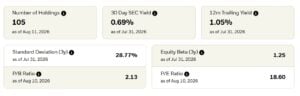
The portfolio is globally diversified. The United States accounted for about 37% of the portfolio, followed by China at about 23%. India represented roughly 5.6% of assets.
Top Holdings
ICLN’s largest holdings include Nextpower, First Solar, China Yangtze Power, Bloom Energy and Enphase Energy. First Solar accounted for roughly 7.8% of the portfolio in late July, while Nextpower represented about 8%.
The fund provides broader clean-energy exposure than a pure solar or wind ETF, making it one of the more diversified options in this group.
2. Invesco Solar ETF (TAN): Targeted Solar Energy Exposure
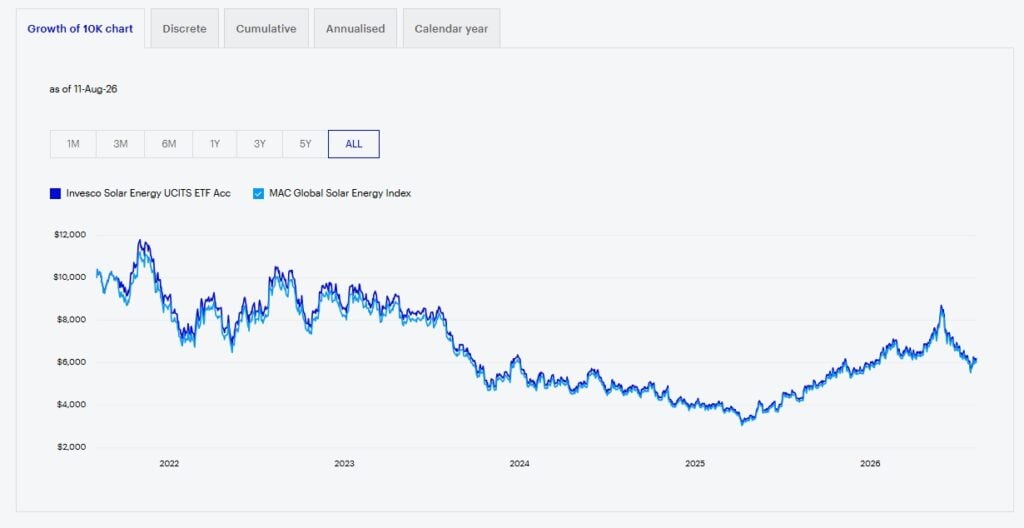
The Invesco Solar ETF (TAN) provides focused exposure to companies across the global solar-energy industry. It tracks the MAC Global Solar Energy Index and generally invests at least 90% of its assets in securities included in the underlying index.
TAN had approximately $1.5 billion in assets in mid-2026 and an expense ratio of 0.70%. The fund held around 45 companies in July 2026.
The ETF gives investors exposure to manufacturers, developers, installers and other companies operating across the solar value chain.
ETF Performance
Top Holdings
As of July 21, 2026, the largest holdings included Nextpower, First Solar, Enlight Renewable Energy, Enphase Energy, SolarEdge Technologies and Sunrun. Nextpower accounted for about 10% of the portfolio, while First Solar represented roughly 8.9%.
TAN is more concentrated than a broad clean-energy ETF. That can give investors stronger exposure to the solar sector but also increases the impact of sector-specific market movements.
3. First Trust Global Wind Energy ETF (FAN): Focused Wind Power Exposure
The First Trust Global Wind Energy ETF (FAN) focuses on companies involved in the global wind-energy industry. The fund provides exposure to both companies that generate a significant portion of their revenue from wind energy and diversified companies with exposure to the sector.
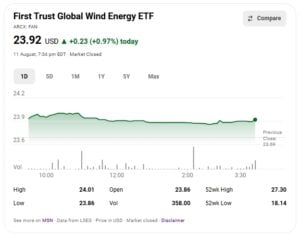
As of July 24, 2026, FAN had approximately $281.9 million in net assets and 47 holdings. Its net expense ratio was 0.60%, with the expense cap in place through at least January 31, 2027.
The ETF traded at about $24.04 on July 24, with a NAV of $24.09. Its 52-week market-price range was approximately $18.18 to $27.23.
Top Holdings
FAN’s largest holdings included Vestas Wind Systems, Ørsted, Nordex, EDP Renewables, Northland Power, and Enlight Renewable Energy. Vestas represented about 8.4% of the portfolio, while Ørsted accounted for about 7.9%.
FAN is therefore a more specialized option for investors seeking exposure to wind power rather than the broader renewable-energy sector.
4. SPDR S&P Kensho Clean Power ETF (CNRG): Clean Power and Emerging Technologies
The SPDR S&P Kensho Clean Power ETF (CNRG) invests in companies involved in technologies supporting the transition toward cleaner electricity and energy infrastructure.
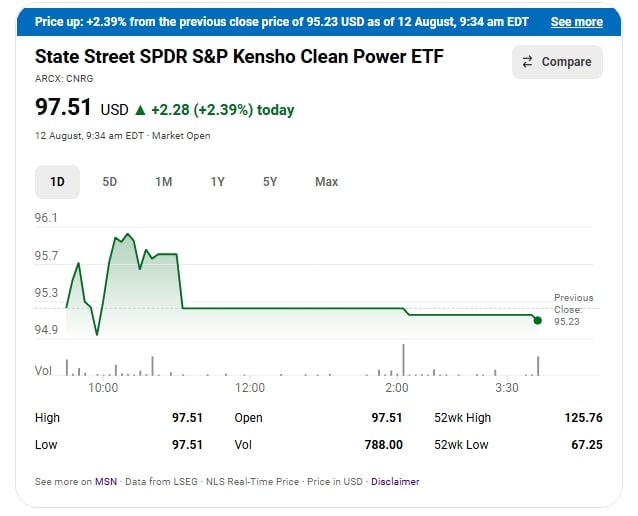
As of July 27, 2026, CNRG had approximately $201.5 million in assets under management, with 40 holdings. The fund’s NAV was $92.66. Its gross expense ratio was 0.45%.
The fund tracks the S&P Kensho Clean Power Index and provides exposure across areas including electrical equipment, utilities, semiconductors, renewable electricity, and energy infrastructure.
Top Holdings
As of July 24, 2026, the largest holdings included FuelCell Energy, Arcosa, GE Vernova, Constellation Energy, TransAlta, NextEra Energy and Shoals Technologies.
CNRG has a broader technology focus than a pure-play solar or wind ETF. Its portfolio includes companies involved in power generation, grid infrastructure, electrical equipment and emerging clean-energy technologies.
5. Global X Lithium & Battery Tech ETF (LIT): Electrification and Energy Storage
The Global X Lithium & Battery Tech ETF (LIT) gives investors exposure to the lithium and battery supply chain. Unlike the renewable-energy ETFs above, LIT focuses on electrification, battery manufacturing and the materials needed for energy storage.
As of July 27, 2026, LIT had approximately $1.51 billion in net assets, 41 holdings and a 0.75% expense ratio. Its NAV was $69.12.
The ETF tracks the Solactive Global Lithium Index and invests across the lithium cycle, including mining, refining and battery production.

Top Holdings
LIT’s largest holdings in July included Rio Tinto, NAURA Technology, TDK, Panasonic Holdings, Albemarle, Samsung SDI, Tesla, and Contemporary Amperex Technology (CATL). Rio Tinto accounted for about 21.7% of the portfolio as of July 17, while NAURA represented about 6.9%.
LIT provides indirect exposure to the electrification trend rather than directly tracking lithium prices or carbon credits.
Quick Check: Why Consider ETFs?
ETFs can offer several advantages over buying individual clean-energy stocks:
- Diversification: A single ETF can provide exposure to dozens of companies across industries and countries.
- Sector exposure: Investors can target themes such as solar, wind, clean power or battery technology without selecting individual stocks.
- Convenience: ETFs trade on stock exchanges throughout the trading day.
- Risk distribution: Losses in one company can have less impact when the fund holds many securities.
- Simpler access: Investors can gain exposure to complex energy-transition supply chains through a single investment.
However, ETFs are not risk-free. Clean-energy and technology-focused funds can be volatile, and their performance can be affected by interest rates, commodity prices, government policies, technology costs and broader market conditions.
A Key Distinction for Carbon Investors
Investors should also distinguish between carbon-credit exposure and clean-energy exposure.
None of the five ETFs above directly represents a portfolio of carbon credits. Instead, they invest in publicly traded companies involved in renewable energy, power infrastructure, batteries, electrification and other technologies that support decarbonization.
For direct exposure to carbon markets, investors need to look at carbon-credit funds, carbon allowances, carbon futures, or other financial products specifically designed to track carbon prices. The five ETFs above are better viewed as energy-transition investment vehicles rather than carbon-credit investments.