


Boeing, one of the world’s largest aerospace manufacturers, shared its first quarter (Q1) 2025 financial results this week, revealing signs of improvement despite continued challenges. Meanwhile, the company reaffirmed its commitment to the environment. Boeing has long-term plans to cut emissions toward net zero and promote sustainability in aviation.
Let’s look at how the company performs this quarter and its carbon emission reduction strategy.
Earnings on the Ascent: Boeing Narrows Its Losses
In Q1 2025, Boeing reported a loss of 49 cents per share. While still a loss, this was an improvement from the $1.13 per share loss reported in the same quarter of 2024. The company’s total revenue rose 18%, reaching nearly $19.5 billion.
Analysts expected a loss of $1.18 per share and revenue of $19.38 billion. So, these results came as a positive surprise for investors.
Boeing’s CEO, Kelly Ortberg, noted that the company is beginning to see improvements in its operations due to a focus on safety and quality. He noted that,
“We are seeing early positive results and remain committed to making the fundamental changes needed to fully recover.”
Commercial airplane revenue grew significantly, increasing 75% to $8.15 billion. Boeing delivered 130 commercial aircraft during the quarter, a 57% increase compared to the same period last year. Part of this growth came from the company ramping up production after the previous year’s temporary grounding of its 737-9 aircraft.
The company aims to produce 38 of its 737 jets per month by the end of 2025. The 787 production line, which had stabilized at 5 jets per month earlier this year, could rise to 7 per month later in the year.
Boeing’s 777X program is now in an important testing phase with the FAA. The first delivery of the 777-9 is set for 2026.

Jet Set: Orders Fly In as Production Ramps Up
Boeing secured 221 net commercial airplane orders during Q1, including:
- 20 777-9 jets
- 20 787-10 jets
- 50 737-8 jets
This strong order activity boosted the company’s commercial backlog to over 5,600 aircraft, with a total value of about $460 billion.
In terms of cash flow, Boeing reported a free cash outflow of $2.29 billion. While still negative, it is better than the $3.93 billion outflow from the same period last year.
Boeing made headlines when President Trump chose them in March to build the new F-47 sixth-generation fighter jet. This decision replaced Lockheed Martin in this important role. This deal, however, is not yet included in the backlog figures.
Cash and Core: Boeing Sells Digital Unit for $10.6B Boost
In a significant move, Boeing announced a $10.55 billion all-cash deal with Thoma Bravo, a private equity firm. The agreement includes the sale of the company’s Digital Aviation Solutions business, which contains several key software platforms: Jeppesen, ForeFlight, AerData, and OzRunways.
Boeing plans to keep the parts of its digital business that provide aircraft and fleet data for both commercial and defense customers. These tools support diagnostics, maintenance, and repair services.
Following this news and the Q1 earnings release, Boeing’s stock rose by 6% on Wednesday. The company’s shares have recovered from earlier losses in April and are now down less than 3% for the year.

Flying Green: Boeing’s Net Zero Strategy
Beyond its financial performance, Boeing continues to push forward with environmental initiatives. The company has taken many steps to cut its carbon footprint worldwide to reach net-zero emissions.
In 2023, Boeing reached net-zero carbon emissions for the fourth year in a row. This includes Scope 1 and Scope 2 emissions, along with some Scope 3 emissions like business travel. It achieved this through a mix of energy efficiency upgrades, expanded use of renewable energy, and certified carbon offsets.
At its major manufacturing sites—known as Core Metric Sites—Boeing closely monitors emissions and energy use. These locations represent 70% of the company’s total operational emissions.
Boeing verifies its data using utility bills and third-party assessments. This helps ensure transparency and accuracy.
The company’s strategy follows an “Avoid First, Remove Second” approach:
- Avoid emissions by improving efficiency and switching to renewable energy, such as sustainable aviation fuel (SAF).
- Remove remaining emissions through permanent carbon removal solutions and offsets.
Boeing also aims to reduce its use of offsets by 2024, especially for Scope 1 and Scope 2 emissions. However, offsets will continue to play a role for Scope 3 emissions, such as business travel, and in supporting voluntary carbon markets.
Cascade: A Tool for Industry-Wide Impact
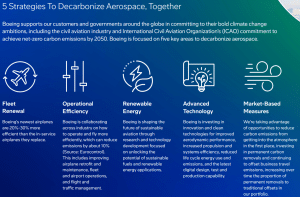
In May 2023, Boeing introduced the Cascade Climate Impact Model as part of its net zero roadmap. Cascade is a data-based tool designed to help reduce emissions across the aviation industry. It shows how different strategies can reduce emissions. For example, replacing older planes with newer, efficient ones or optimizing flight paths can help.
Cascade also looks at the use of SAF, aircraft innovation, and market-based mechanisms. It is publicly available and backed by partners like NASA, IATA (the International Air Transport Association), and universities.
Boeing works with these partners to improve the tool and make it more useful for the aviation industry. The company is using these five ways to help the industry decarbonize.
The company also teamed up with Norsk e-Fuel to build one of Europe’s first big Power-to-Liquids (PtL) plants in Mosjøen, Norway. This collaboration will create sustainable aviation fuel (SAF). It combines green hydrogen with captured CO₂ to produce electro-SAF (e-SAF).
The initiative supports the EU’s RefuelEU targets, aiming for 6% SAF use by 2030 and 70% by 2050, with specific goals for e-SAF. Boeing’s investment accelerates SAF production, contributing to aviation’s net-zero emissions goal by 2050.
Boeing is sharing tools like Cascade and promoting sustainable aviation fuels. This helps the industry work towards its goal of net-zero emissions by 2050.
Flight Path Forward
Boeing’s Q1 2025 performance suggests progress in its efforts to recover financially. At the same time, its environmental strategy reflects a long-term commitment to making air travel more sustainable.
Boeing faces a growing backlog of orders and has major aircraft development programs in progress. The company is also investing in renewable energy and innovation. These steps aim not just to return to profits but to lead the aviation industry toward cleaner and greener skies.