


Artificial intelligence (AI) is growing at a pace few technologies have ever matched. In May 2026, ChatGPT became the fastest app in history to reach 1 billion monthly active users, as reported by Reuters. The milestone came just three years after the chatbot launched in late 2022.
Soon after, OpenAI confirmed it had confidentially filed paperwork for a potential initial public offering (IPO). This sets the stage for one of the most closely watched public listings in the technology sector.
Together, these developments highlight the extraordinary growth of generative AI. They also reveal a less discussed challenge: powering the infrastructure behind that growth.
For climate and carbon markets, the story goes beyond users and valuations. AI is driving a surge in electricity demand, data center construction, and computing capacity. That growth raises new questions about emissions, clean energy supply, and how the world can meet rising digital demand while staying on track with climate goals.
ChatGPT’s Rise: The Fastest Consumer Tech Adoption in History
ChatGPT’s growth has few parallels in the technology industry. Sensor Tower estimates the platform surpassed 1 billion monthly active users in May 2026, making it the fastest application ever to reach that milestone.
- By comparison, TikTok took about five years to reach 1 billion monthly users, while Instagram needed nearly eight years.
The growth has accelerated rapidly over the past two years. OpenAI reported in early 2026 that ChatGPT reached over 900 million weekly active users and more than 50 million paying subscribers.
The platform’s reach now extends across consumers, businesses, education, software development, healthcare, and financial services. Generative AI tools are increasingly becoming part of daily workflows rather than standalone applications.
This explosive adoption has helped establish OpenAI as the leading company in the generative AI market. Yet, user growth is only part of the story. The infrastructure required to support those users is expanding just as quickly.
OpenAI’s IPO Filing: A Trillion-Dollar AI Race Takes Shape
OpenAI’s confidential IPO filing reflects the enormous investor interest surrounding artificial intelligence. The company has not disclosed the timing or size of a potential offering. However, the filing gives OpenAI the flexibility to move forward when market conditions are favorable.
The company wrote:
“We have not decided on timing yet; it may be a while because there are things we want to do that are likely easier as a private company. But it’s a complicated set of tradeoffs, and this gives us the option to go public sooner if that ends up being best.”
The numbers behind the company help explain why investors are paying attention.
OpenAI was valued at about $852 billion after its March 2026 funding round. This made it one of the most valuable private companies globally. Some analysts believe a future public listing could eventually push the company’s valuation closer to $1 trillion.
Revenue is also growing rapidly. Industry estimates put OpenAI’s annual revenue at over $20 billion in early 2026. This is a big jump from about $6 billion in 2024. These figures reflect a broader AI investment boom.

Goldman Sachs says that Meta, Microsoft, Amazon, and Alphabet will spend about $5.3 trillion on capital from 2025 to 2030. That forecast is up from an earlier estimate of $4.5 trillion.
Much of that spending will support AI infrastructure, including data centers, advanced chips, networking equipment, and power systems. As a result, the future of AI is becoming closely tied to the future of energy.
The Power Problem Behind AI: From Queries to a Forest
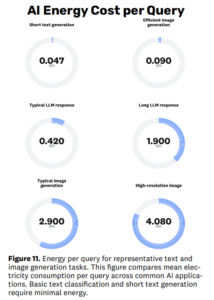
Every AI query requires computing power. Training advanced models requires even more. So as AI adoption grows, electricity demand is becoming one of the industry’s biggest challenges.
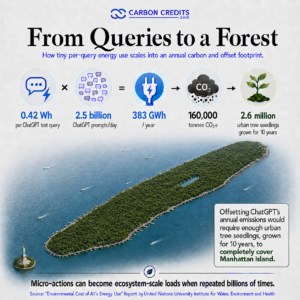
Putting that into perspective, a single text query using ChatGPT that uses 0.42 Wh of energy will translate into a carbon footprint that needs around 2.6 million tree seedlings grown for ten years to offset. That number of trees can already cover the entire Manhattan Island.
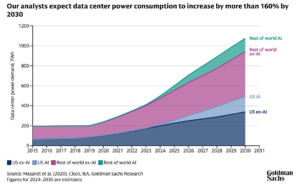
Goldman Sachs Research estimates global data center electricity demand could increase by as much as 165% by 2030 compared with 2023 levels. AI applications could account for a large share of that increase.
The International Energy Agency (IEA) warns that electricity use from data centers, AI, and cryptocurrencies might double from 2022 to 2026. In some advanced economies, data centers could account for more than 20% of electricity demand growth by the end of the decade.
This trend is already affecting energy planning. Utilities are upgrading grids. Governments are reviewing power infrastructure needs. Technology companies are seeking long-term electricity supplies for future data centers.
Access to reliable power is becoming a strategic issue for AI development. In some areas, energy availability will play a bigger role in deciding where future AI infrastructure can be set up.
Why Big Tech Is Scrambling for Clean Energy
The rapid growth of AI is also raising concerns about emissions. If the world meets future electricity demand mostly with fossil fuels, the carbon footprint could increase a lot. This is pushing technology companies to secure cleaner sources of power.
Many of the world’s largest technology firms are already among the biggest corporate buyers of renewable energy. Long-term agreements for wind and solar power have become common across the industry.
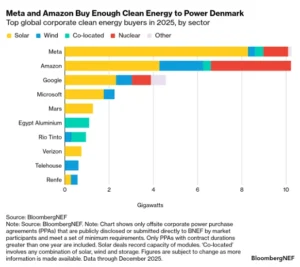
Interest in nuclear energy is also increasing.
Many tech companies are looking into advanced nuclear reactors and small modular reactors (SMRs). They see these as reliable, carbon-free options for future data centers. Nuclear power can operate around the clock, making it attractive for AI workloads that require continuous power.
This shift could have important implications for carbon markets.
Rising electricity demand from AI could boost investments in several areas. These include renewable energy, battery storage, advanced nuclear tech, grid upgrades, and carbon removal solutions. These sectors are all expected to play a role in supporting a lower-carbon digital economy.
The challenge, however, will be scaling clean energy fast enough to keep pace with AI growth.
Can OpenAI Match Its AI Leadership With Climate Leadership?
OpenAI is now a leading AI company, but its climate commitments are not as strong as those of some tech peers. The company has not announced a formal net-zero target or a detailed emissions reduction roadmap.
However, OpenAI’s infrastructure relies heavily on cloud providers and partners that have made major climate commitments.
Microsoft, one of OpenAI’s largest partners and investors, has pledged to become carbon negative by 2030 and remove all of its historical emissions by 2050. The company is investing a lot in renewable energy, carbon removal projects, and advanced nuclear tech. These efforts aim to boost future AI growth.
Across the technology sector, sustainability is becoming an increasingly important issue. Investors, regulators, and customers are paying closer attention to the environmental impact of data centers and AI operations.
That scrutiny is likely to increase if OpenAI eventually becomes a publicly traded company. This is because public markets focus more on environmental, social, and governance (ESG) disclosures. This includes emissions reporting and risks related to climate change.
The Collision Course Between AI Expansion and Net Zero
OpenAI’s growth, its potential IPO, and the broader AI investment boom are driving demand for new infrastructure on a massive scale. Data centers, computing hardware, transmission networks, and electricity generation will all need to expand to support future growth.
That creates both risks and opportunities.
More power demand could increase emissions if clean energy deployment falls behind. It could also speed up investment in renewable energy, advanced nuclear power, energy storage, grid updates, and carbon removal technologies.
The stakes are significant.
The same AI revolution that is reshaping industries could also influence the future direction of energy markets and global emissions. How governments, utilities, and tech companies respond will shape the next decade of digital growth. This can either support or complicate the shift to a lower-carbon economy.