

The aviation industry is under pressure to cut emissions, and carbon credits are crucial in this effort. A recent report from Abatable suggests that Southeast Asia has a strong chance of benefiting. If the Association of Southeast Asian Nations (ASEAN) governments approve more carbon credits under the global offsetting scheme, the region could earn between US$1.6 billion and US$8.5 billion in the next decade.
ASEAN is already a vital source of carbon credits under the Carbon Offsetting and Reduction Scheme for International Aviation (CORSIA). However, much of its potential remains untapped. With the right policies, ASEAN can help airlines meet climate goals while attracting investment, creating jobs, and promoting sustainable development.
CORSIA Is Creating a New Global Carbon Market for Aviation
Aviation has limited options for quickly cutting emissions, especially for long-haul flights. While sustainable aviation fuel (SAF) and cleaner aircraft will help over time, airlines will still depend on carbon credits to meet targets.
CORSIA allows airlines to offset emissions from international flights by buying high-quality carbon credits that meet ICAO’s strict rules. As more countries join and airline traffic recovers, demand for these credits is expected to rise sharply. This presents a significant opportunity for countries that can develop credible carbon projects.
ASEAN Holds a Strong Position
CORSIA, set up by the International Civil Aviation Organization (ICAO), requires airlines to offset a portion of their emissions using approved carbon credits called CORSIA Eligible Emissions Units (CEEUs).
Currently, ASEAN contributes a small share of the global supply, but this could grow significantly.
The report categorizes ASEAN’s carbon credit supply into three groups:
- CORSIA-eligible credits that airlines can use right away.
- CORSIA-aligned credits that meet ICAO’s standards but need government approval.
- Pipeline projects that could issue credits in the future.
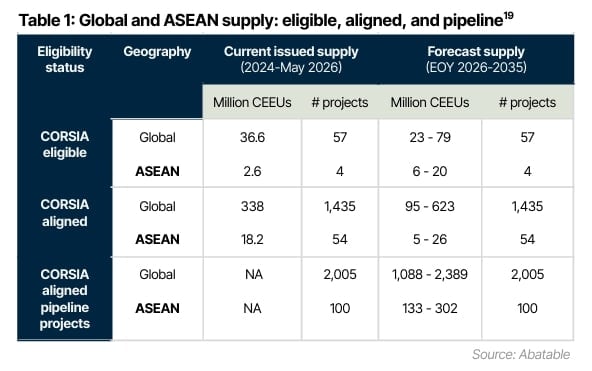
Right now, ASEAN has four CORSIA-eligible projects in Cambodia and Laos. Together, they have issued 2.6 million eligible carbon credits, making up 7.1% of the global supply as of June 1, 2026.
Though this is only 1.3% of expected global demand during CORSIA’s First Phase, these projects have room to grow. If they continue operating, they could generate an additional 6 million to 20 million carbon credits by 2035.
- At today’s prices, these credits are worth around US$26 million to US$59 million.
Millions of Credits Are Waiting for Government Approval
The biggest opportunity lies in credits not yet approved.
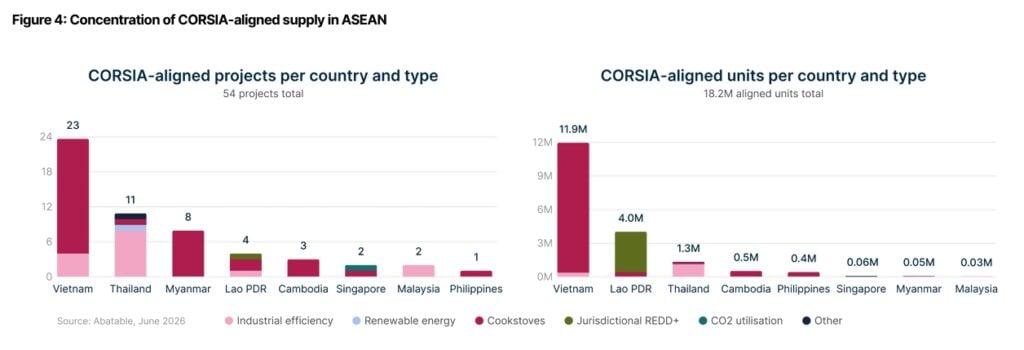
Across ASEAN, 54 carbon projects already meet ICAO’s standards but lack the necessary Letter of Authorization (LoA) from their governments. Without this approval, airlines cannot use these credits for CORSIA compliance.
- These projects have already issued 18.2 million carbon credits.
If governments authorize them in the next 18 months, these credits could enter the market and add an estimated US$182 million to US$419 million in value.
- Furthermore, extending these projects through 2035 could yield another 5 million to 26 million eligible credits, providing airlines with more supply as demand rises.
Most of these projects are in Vietnam, Laos, and Thailand, which together account for over 90% of ASEAN’s CORSIA-aligned supply. Clean cookstove initiatives contribute 13.1 million credits from 35 projects, mainly in Vietnam.
Pipeline Projects Could Transform ASEAN Into a Global Supplier
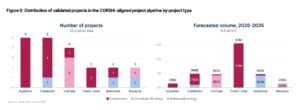
The report suggests ASEAN’s long-term potential is much greater than its current supply. The region has around 100 pipeline carbon projects that could produce up to 302 million carbon credits by 2035 if authorized.
Combined with current eligible credits, ASEAN could potentially supply 348 million CORSIA-eligible credits over the next decade.
- At current market rates, this could be worth between US$1.6 billion and US$8.5 billion.
This would significantly boost the global supply of aviation carbon credits as airlines face rising compliance demands.
However, governments must balance these exports with their climate commitments under Nationally Determined Contributions (NDCs). Authorizing credits may have limited effects on national climate targets, especially if projects yield reductions beyond existing policies.
Beyond Carbon Credit Sales
The opportunity extends beyond just selling carbon credits. It also includes strengthening ASEAN’s role in global carbon markets. Much of the CORSIA-eligible supply currently comes from Africa, with one project in Guyana providing nearly 68% of all eligible credits.
Expanding ASEAN’s project pipeline would diversify global supply and reduce reliance on a few regions. This could enhance market stability and give airlines more options for sourcing high-quality credits.
Demand for Carbon Credits Is Rising Rapidly
While supply is limited now, airline demand is expected to grow sharply over the next decade.
Globally, CORSIA demand is projected to reach between 201 million and 219 million carbon credits during its First Phase, then surge to between 1.25 billion and 1.78 billion credits in the Second Phase by 2035.
Europe is expected to be the largest demand source, but Asia and the Middle East will become increasingly important as more countries get involved.
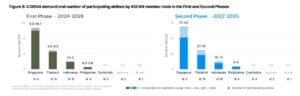
In ASEAN, 39 airlines participate in CORSIA, though emissions data is available for only 26. These airlines are expected to need around 17 million to 18 million carbon credits in the First Phase.
By 2035, demand could rise nearly five to seven times, reaching as much as 118 million credits.
Three countries lead regional demand:
- Singapore
- Thailand
- Indonesia
Together, they represent over 95% of ASEAN’s offset needs.
Four airlines—Singapore Airlines, Thai Airways, Scoot, and Garuda Indonesia—will likely account for about 75% of ASEAN’s total CORSIA demand, needing around 13 million credits in the First Phase and 65 million in the Second Phase.
This concentration means decisions by a few major airlines could significantly impact the regional carbon market.
Unlike many emerging carbon markets, ASEAN airlines have started buying eligible credits.
- Singapore Airlines and Scoot retired 150,000 CORSIA-eligible credits from a clean cookstove project in Laos. This is the second-largest retirement of CORSIA credits by any airline globally, following Japan Airlines’ retirement of 250,000 credits.
- Malaysia Aviation Group has also completed pilot transactions, showing growing interest in the region.
These early purchases help build market confidence and encourage developers to invest in new carbon projects.
Supply Could Still Fall Behind Future Demand
Despite ASEAN’s potential, the report warns that the region may face a supply gap if new projects aren’t developed quickly.
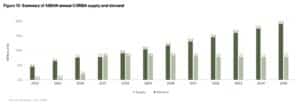
Modeling shows that available supply could briefly exceed ASEAN airline demand in 2027, reaching around 8 million credits, slightly above the expected demand of 7.7 million tonnes.
However, from 2028 onward, airline demand will keep rising, eventually hitting 18.9 million tonnes by 2035. Meanwhile, annual supply will stay around 8 million credits through 2030 before declining as existing projects reach the end of their crediting periods.
Without new investments and project approvals, ASEAN’s supply would only cover about 60% of aviation demand by 2035.
The outlook varies by country.
Singapore and Thailand are expected to remain net buyers, hosting large international airlines but having limited domestic CORSIA-eligible supply. In contrast, Vietnam and Laos are set to become net suppliers, while Cambodia, Indonesia, and the Philippines could balance both demand and supply by expanding domestic carbon projects.
Carbon Markets Could Deliver Broader Economic Benefits
Beyond aviation compliance, expanding CORSIA participation could yield broader economic and social benefits for ASEAN.
Many current projects focus on distributing clean cookstoves, improving energy efficiency, and conserving forests. These efforts reduce indoor air pollution, lower fuel costs, enhance public health, and create new income for local communities.
The report says that current and future CORSIA projects might create about 32,000 direct jobs in the region over the next ten years. This could also draw in new private investment for sustainable development.
Outlook: ASEAN Has the Building Blocks to Become a Carbon Market Leader
ASEAN already has the projects, growing airline demand, and favorable conditions to become a leading supplier of aviation carbon credits. However, seizing this opportunity requires government action.
Faster approvals for current projects and ongoing investment in new initiatives will influence how much of the US$1.6 billion to US$8.5 billion opportunity ASEAN can capture. Clear policies that connect international trade with national climate goals will also play a key role.
As CORSIA enters its next phase and airline demand grows, ASEAN has a chance to boost its carbon markets and low-carbon economy. If countries act quickly, the region could become a key hub for high-quality aviation carbon credits. This move could bring lasting environmental, economic, and social benefits.