

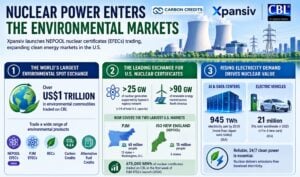
Nuclear power is gaining new attention. It is not only producing clean electricity but is also becoming a valuable asset in environmental markets. Xpansiv has launched trading for New England Power Pool (NEPOOL) Emission-Free Energy Certificates (EFECs) on its CBL spot exchange. The new certificates will trade alongside PJM EFECs, Renewable Energy Certificates (RECs), carbon credits, and alternative fuel credits.
CBL is the world’s largest environmental commodity spot exchange, giving buyers and sellers one place to trade a wide range of environmental products. Over U1 trillion in environmental commodities have been traded through the platform.
The Leading Exchange for U.S. Nuclear Certificates
The move comes as electricity demand rises quickly. Artificial intelligence (AI), cloud computing, and electric vehicles (EVs) all need huge amounts of reliable, carbon-free electricity. As a result, companies are placing greater value not only on clean power itself but also on certificates that prove where that power came from.
Xpansiv says its registry network already supports more than 25 gigawatts (GW) of nuclear generation. That represents about one-quarter of total U.S. nuclear capacity. The company also tracks more than 90 GW of renewable energy across North America through its registry network.
According to the company, it has achieved this milestone:
- During the first week after launching PJM Emission-Free Energy Certificates (EFECs) in 2024, 675,000 MWh of nuclear certificates were traded on CBL.
- That represented one of the fastest starts for a new environmental commodity on the exchange.
Now, with NEPOOL EFECs added, the exchange covers two of the largest U.S. competitive electricity markets:
- PJM serves 65 million people across 13 states plus Washington, D.C.
- ISO New England (NEPOOL) serves about 15 million people across six New England states.
SEE MORE: Xpansiv and BEClimate Launch Platform to Turn Building Upgrades Into Carbon Credits
AI Fuels a New Wave of Electricity Demand
AI is changing the global power market. The International Energy Agency (IEA) says data center electricity use will more than double by 2030. It will hit around 945 terawatt-hours (TWh) each year. That is more electricity than Japan uses today, and AI will be the biggest reason for this growth.
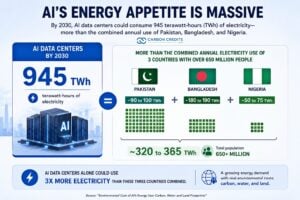
Electric vehicles are adding to demand as well. The IEA estimates that about 21 million EVs were sold worldwide in 2025, or nearly 1 in 4 new passenger cars sold globally was electric.
Together, AI and EVs are putting more pressure on power grids. Utilities must supply more electricity while also cutting emissions.
Solar and wind are growing fast, but they depend on the weather. Data centers, hospitals, factories, and other large users need electricity every hour of the day. That is bringing new attention to nuclear power because it can provide 24/7 emissions-free baseload electricity.
Why Nuclear Energy Certificates Are Becoming More Valuable
Emission-Free Energy Certificates, or EFECs, work much like Renewable Energy Certificates. The difference is that they represent electricity produced from nuclear and other qualifying emission-free sources.
Companies buy these certificates to support their climate goals and show they are using carbon-free electricity. Utilities, large manufacturers, and technology companies could become major buyers as demand for clean electricity continues to grow.
The launch of NEPOOL EFEC trading also expands the environmental markets available through Xpansiv. Bringing nuclear certificates into New England could improve market liquidity, price transparency, and trading activity. It also gives companies another way to support clean electricity while meeting voluntary sustainability commitments.
Russell Karas, Senior Vice President, Xpansiv, remarked:
“The launch of our NEPOOL EFEC contract is an important step in our strategy to support the development of robust, dispatchable, emissions-free electricity as the industry works to keep pace with rising demand and energy transition goals.”
More importantly, it reflects a broader trend. As electricity demand grows, environmental markets are expanding beyond traditional carbon credits and renewable certificates. Nuclear energy is now part of this transition. It gives businesses more ways to cut their carbon footprint while also supporting reliable, emissions-free power.
Nuclear Is Returning to the Climate Conversation
Nuclear power is making a comeback as countries look for reliable clean electricity.
The International Energy Agency (IEA) says that global nuclear power generation will hit a record high in 2025. It will keep growing in 2026, too. New reactors in China, India, and South Korea, along with reactor restarts in Japan and strong output in the United States and France, are driving that growth.
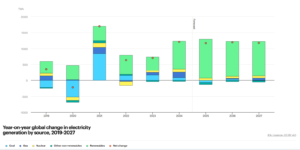
The technology already plays a major role in cutting emissions. The IEA says nuclear provides about 9% of the world’s electricity and around one-quarter of global low-emissions electricity. It is one of the largest sources of carbon-free power after hydropower.
Nuclear plants in the United States generate about one-fifth of the nation’s electricity. They provide nearly half of the carbon-free electricity, which is vital for the country’s clean energy goals. Bloomberg Intelligence projects that nuclear capacity in the U.S. will double by 2050.
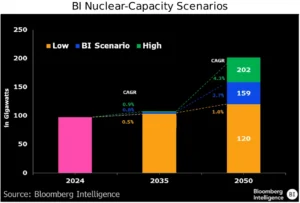
Large technology companies are also helping revive interest in nuclear energy. Microsoft, Amazon, Google, and Meta are teaming up with nuclear energy firms. They want reliable, constant power for their AI data centers and cloud computing needs.
Environmental Markets Expand Beyond Traditional Carbon Credits
The launch of NEPOOL EFECs also shows how environmental markets are changing.
For years, voluntary carbon credits have dominated these markets. Today, companies are purchasing more environmental products. This includes Renewable Energy Certificates (RECs), nuclear certificates, methane certificates, and sustainable aviation fuel (SAF) certificates.
This shift reflects changing corporate climate strategies. Many companies now want proof that the electricity they use comes from low- or zero-carbon sources. Environmental certificates provide that evidence and help companies report progress toward their climate goals.
By adding New England nuclear certificates, Xpansiv is expanding the range of environmental products available on its exchange. More trading can improve market liquidity, price discovery, and transparency, making it easier for buyers and sellers to value carbon-free electricity.
A Growing Role for Nuclear in Net Zero
The launch of NEPOOL EFEC trading may seem like a niche market development, but it points to a much bigger trend.
As AI, cloud computing, and transport electrification increase electricity demand, the need for reliable clean power is also growing. Solar and wind energy will keep growing fast. However, many experts think nuclear power will stay key in the energy mix. It provides reliable electricity all day long.
That is also changing environmental markets. Companies are no longer looking only for carbon offsets. They are increasingly buying verified environmental attributes linked to clean electricity generation.
For Xpansiv, the expansion into New England strengthens a growing market for nuclear certificates. For the wider energy sector, it shows that environmental commodities are evolving alongside the global transition to cleaner power.
As countries work toward net-zero emissions, the value of carbon-free electricity—and the certificates that verify it—is likely to keep growing. Nuclear energy is becoming part of that story once again.