

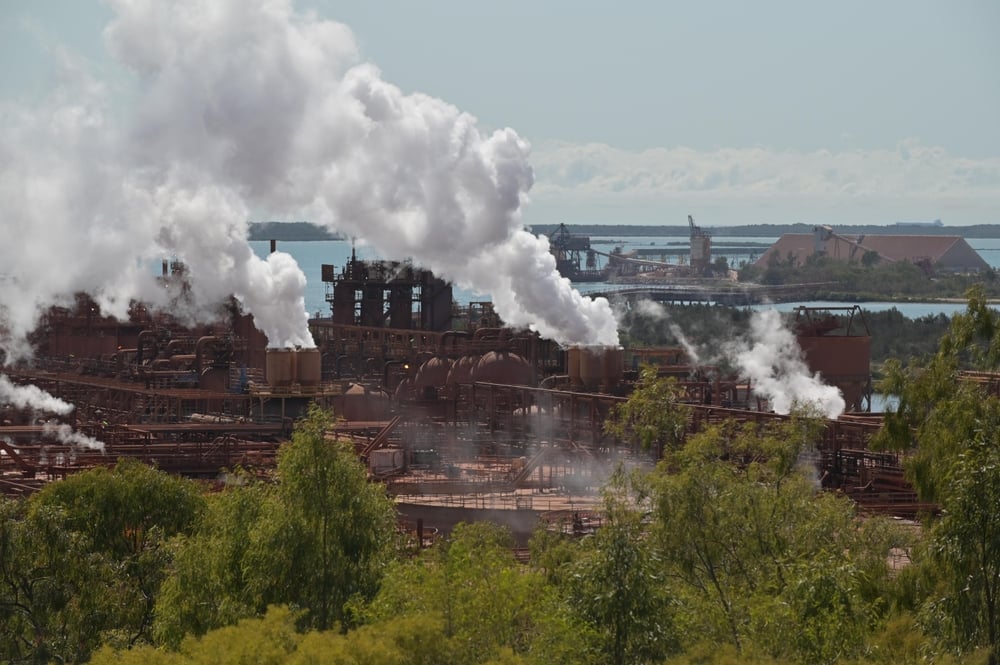
Heavy industry needs cleaner ways to make the materials the world depends on. Rio Tinto believes biochar can help. The mining giant has signed a five-year offtake agreement with Australian bioenergy company Superchar Limited (SCL) to supply locally made bio pellets for its alumina refineries in Gladstone, Queensland. Deliveries will begin in 2028 after the company completes operational trials and a feasibility study.
The deal is another step in Rio Tinto’s plan to cut fossil fuel use at one of the most carbon-intensive stages of aluminum production. Instead of replacing coal all at once, the company will slowly increase the amount of bio pellets used in its refinery boilers. This approach lets engineers test how the fuel performs under normal operating conditions.
The agreement also reflects a wider trend. Steelmakers, cement producers, and aluminum companies are investing in renewable fuels, hydrogen, electrification, and carbon capture as they work to lower emissions.
Why Alumina Refining Matters for Net Zero
Aluminum is becoming more important as countries move toward cleaner energy. It is used in electric vehicles, solar panels, wind turbines, battery systems, and power grids because it is lightweight, strong, and easy to recycle.
Making aluminum, however, creates significant emissions.
The International Aluminium Institute (IAI) estimates that the aluminum value chain produces about 2% of global greenhouse gas emissions. Nearly 90% of those emissions come from alumina refining and aluminum smelting, making them the industry’s biggest climate challenge.
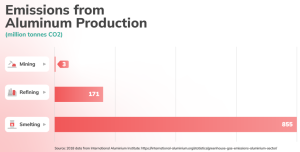
Refining alumina is especially difficult to clean up. The process needs large amounts of high-temperature steam to turn bauxite into alumina. Most refineries still produce that steam by burning coal or natural gas.
Rio Tinto’s Climate Action Plan shows that its Gladstone refineries—Yarwun and Queensland Alumina Limited (QAL)—are the company’s largest source of process heat emissions. About 75% of emissions come from steam used in digestion. The other 25% results from the high-temperature calcination process.
Testing Biochar to Replace Coal
Rio Tinto is looking for ways to cut emissions without replacing its existing refineries. The mining company has already tested different blends of coal and bio pellets.
Operations Managing Director Armando Torres stated:
“Reducing our alumina refineries’ reliance on fossil fuel will require a mix of technologies, innovation and partnerships, and bio pellets are one of the practical options we are exploring as part of that. The recent trials and feasibility study have given us valuable insights, and this agreement allows us to take the next step in understanding how bio-pellets could work in practice and be scaled for use at our Gladstone operations.”
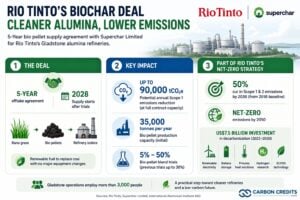
During the trials, bio-pellets replaced up to 30% of the coal used to produce steam in refinery boilers. The fuel worked without major changes to existing equipment.
The new agreement allows Rio Tinto to expand those trials. Engineers will test bio-pellet blends ranging from 5% to 50%. They will measure fuel performance, emissions reductions, operating costs, and long-term supply.
The $30 million bio pellet production facility that SCL aims to establish will initially produce 35,000 tonnes of bio pellets annually. Once operating at full contract capacity, the pellets could help Rio Tinto cut its reported Scope 1 emissions by up to 90,000 tonnes of CO₂ equivalent each year. This reduction falls under Australia’s National Greenhouse and Energy Reporting (NGER) framework.
The project builds on several other decarbonization efforts in Gladstone. The Australian miner is also investing in renewable electricity, battery storage, hydrogen research, and energy efficiency across its aluminum business.
The Gladstone industrial hub includes the Yarwun refinery, Queensland Alumina Limited—one of the world’s largest alumina refineries—and the Boyne aluminium smelter. Together, these operations employ more than 3,000 people.
Superchar’s Bio Pellets Use Fast-Growing Bana Grass
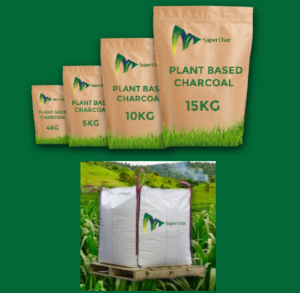
Superchar Limited is an Australian company that turns bana grass into bio pellets using a process called pyrolysis, which heats biomass with little or no oxygen. The company claims bana grass is a fast-growing perennial that can be harvested multiple times a year. Plus, it grows on marginal land, which helps reduce competition with food crops.
SCL created bio pellets to replace coal in industrial boilers. This helps manufacturers reduce fossil fuel use easily, without needing big changes to their current equipment. The facility the company will build near Gladstone will supply Rio Tinto’s refineries and meet future needs from other heavy industries.
Biochar Gains Ground in Heavy Industry
Rio Tinto is part of a growing push to use biochar and biomass to cut industrial emissions.
Heavy industries need very high temperatures, making it hard to replace fossil fuels with electricity alone. The International Energy Agency (IEA) reports that modern bioenergy supplies about 55% of the world’s renewable energy, making it the largest renewable energy source today. It already plays an important role in industries such as steel, cement, chemicals, and refining.

For Rio Tinto, bio pellets offer a practical advantage. They can be blended with coal and used in existing refinery boilers, helping reduce emissions without major changes to infrastructure or operations.
Rio Tinto Expands Its Net-Zero Strategy
The bio-pellet agreement fits into Rio Tinto’s broader climate strategy. The company aims to cut its Scope 1 and 2 emissions by 50% by 2030 from a 2018 baseline and reach net-zero emissions by 2050.

To support those goals, Rio Tinto has committed about US$7.5 billion between 2022 and 2030 for decarbonization projects across its global operations. These investments cover:
- Renewable electricity,
- Battery storage,
- Process heat solutions,
- Hydrogen research, and
- ELYSIS technology, which makes aluminum without direct carbon emissions during smelting.
The company is also expanding its business in minerals needed for the energy transition, including lithium and copper, while lowering emissions from its own operations.
Demand for Low-Carbon Aluminum Is Rising
Rio Tinto’s investment comes as demand for low-carbon aluminum continues to grow.
The International Aluminium Institute predicts a nearly 40% rise in global aluminum demand by 2030. This growth will be fueled by electric vehicles, renewable energy, electricity networks, and lightweight construction materials.
The IEA also identifies aluminum as one of the most important materials for clean energy technologies. Expanding power grids, solar farms, and wind turbines need a lot of aluminum. This puts pressure on producers to reduce the carbon footprint of each tonne they produce.
This creates a new challenge for the industry. Aluminum production must grow to support the energy transition, but it must also produce fewer emissions.
A Practical Step Toward Cleaner Refineries
Rio Tinto’s bio-pellet agreement shows that industrial decarbonization is moving beyond long-term research projects.
Instead of waiting for breakthrough technologies, companies are finding practical ways to reduce emissions today. Replacing part of the coal used in refinery boilers with renewable fuels is one example.
The agreement will not eliminate emissions on its own. But it could help prove that biochar and bio-based fuels can reduce emissions at large industrial facilities without requiring entirely new plants.
If the trials succeed, Rio Tinto could create a model that other alumina producers can follow. That would make renewable fuels another important tool alongside renewable electricity, hydrogen, and carbon capture as heavy industry works toward net zero.