

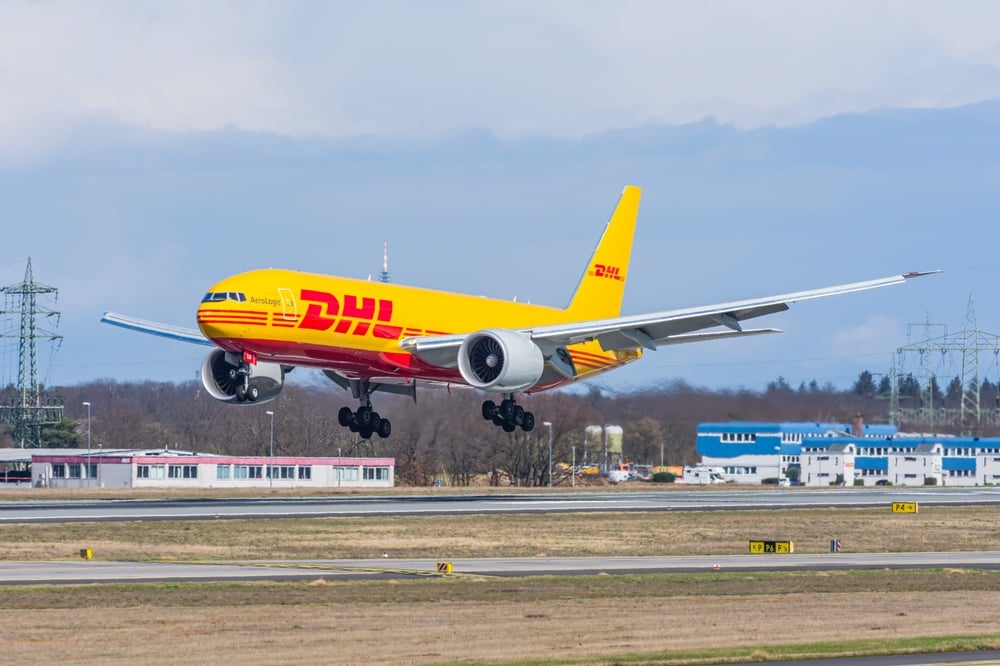
As countries invest heavily in clean energy, the equipment needed to build that future is becoming larger, heavier, and more complex to transport. DHL Group believes this challenge represents one of the biggest growth opportunities in logistics.
At the New Energy Conference in Amsterdam, the company shared its goal to boost revenue from its new energy logistics business. They aim to grow it from about €600 million in 2025 to €3 billion by 2030. That would represent a fivefold increase in just five years.
The target shows a rising need for specialized logistics services. This includes renewable energy, battery storage, electric vehicles, hydrogen, and grid infrastructure.
Tobias Meyer, CEO, DHL Group, remarked:
“The energy transition is not happening through a single technology and a single supply chain. It is a set of different assets that help countries to shift. DHL has the capabilities to help establish this new supply chain end-to-end, from parts and components to aftermarket support, at a global scale like no one else… Our combination of reach, reliability, and sector expertise is what companies and countries can lean on to facilitate the energy transition and bolster resilience.”
The timing is significant. The International Energy Agency (IEA) says global energy investment will hit a record $3.3 trillion. About $2.2 trillion of this will go to clean energy technologies. This includes renewables, grids, batteries, nuclear power, and electrification. That is roughly double the amount expected to flow into fossil fuels.
As the clean energy buildout accelerates, companies like DHL are positioning themselves as critical enablers of the transition.
Bigger Turbines, Bigger Batteries, Bigger Logistics Challenges
One reason DHL sees such strong growth potential is the increasing complexity of clean energy supply chains. Wind turbines have grown dramatically over the past three decades.
Modern turbine rotors can generate roughly 15 times more electricity than those built in the 1990s. While that improves efficiency, it also creates major transportation challenges. Larger blades, towers, and nacelles require specialized trucks, vessels, cranes, and route planning.
Battery storage presents another challenge. Lithium-ion batteries are crucial for electric vehicles and large storage systems. However, they need strict safety measures during transport due to fire risks. Moving large battery systems by air remains particularly difficult.
At the same time, geopolitical disruptions are reshaping global logistics networks.
Conflicts in Ukraine and the Middle East, shipping disruptions, airspace restrictions, and trade tensions have forced companies to redesign supply chains that once operated smoothly. These changes have increased demand for logistics providers that can manage complex international projects.
DHL believes these challenges will continue to grow as energy infrastructure expands around the world.
A $17 Trillion Buildout Creates a Logistics Gold Rush
The scale of future demand helps explain DHL’s optimism. The Energy Industries Council reports about 17,000 energy projects worldwide. These projects have a total investment value of around $17 trillion.
Much of that investment is flowing into renewable energy and supporting infrastructure.
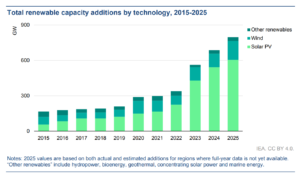
The IEA expects renewable energy deployment to continue expanding rapidly this decade. Global renewable power capacity additions hit a record 800 GW in 2025, while global battery storage investments climbed rapidly to surge above $65 billion. This growth supports countries in creating more flexible electricity systems.
Grid infrastructure is becoming equally important.
The IEA estimates that global grid investment is around $400 billion each year. However, it warns that spending needs to rise a lot to meet increasing electricity demand and boost renewable energy use.
Each solar farm, wind project, battery system, transmission line, and hydrogen facility needs equipment. This equipment must be transported, stored, and delivered on time.
That growing need is creating a new market for specialized logistics services.
DHL Is Building a New Energy Logistics Platform
To capture that opportunity, DHL has expanded its capabilities across multiple clean energy sectors. The company now provides logistics services for:
- Wind energy,
- Solar power,
- Battery energy storage systems,
- Electric vehicles,
- EV batteries,
- Hydrogen,
- Alternative fuels, and
- Grid infrastructure.
DHL has combined these features in its Express, Global Forwarding, and Supply Chain divisions. This forms what they call a completely new energy logistics platform.
One of the company’s latest offerings is Time Definite Plus, a specialized service designed for time-critical deliveries in the renewable energy sector. The service covers 22 European countries. It quickly delivers replacement parts to keep renewable energy assets running.
For wind farm operators, minimizing downtime can have a major impact on electricity generation and project economics.
DHL is also investing in infrastructure. The company plans to open a new European battery logistics hub in Holtum, Netherlands, in early 2027. The facility will meet the rising need for battery transport, storage, and handling. This comes as Europe boosts electric vehicle production and energy storage use.
DHL Is Also Decarbonizing Its Own Operations

The company’s clean energy push aligns with its broader sustainability strategy. DHL has committed to achieving net-zero greenhouse gas emissions by 2050, a target approved by the Science Based Targets initiative (SBTi).
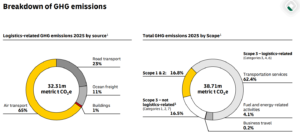
The company’s total GHG emissions for 2025 by scope are 38.71m metric t CO2e. Here is the breakdown.
As part of its 2030 roadmap, DHL aims to reduce emissions from 40 million metric tons of CO₂e in 2021 to below 29 million metric tons. The company is pursuing a 42% reduction in Scope 1 and Scope 2 emissions and a 25% reduction in key Scope 3 emissions categories.
Several major initiatives support those goals. DHL plans to:
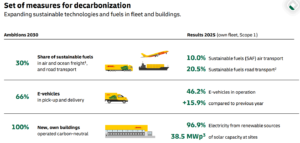
- Achieve more than 30% sustainable aviation fuel (SAF) blending across its Express and Global Forwarding businesses by 2030.
- Electrify more than 66% of its last-mile delivery vehicles.
- Ensure all newly-owned buildings operate with carbon-neutral designs.
The company has also signed several major SAF agreements.
In 2025, DHL secured more than 314 million liters of SAF through a large supply agreement with Phillips 66. In 2026, it signed another long-term agreement with SAF One in Bahrain covering 250,000 metric tons of SAF over ten years beginning in 2028.
These efforts highlight a broader challenge facing logistics companies: helping customers reduce emissions while lowering their own carbon footprints.
Logistics Could Become a Critical Piece of the Energy Transition
The clean energy transition is often discussed in terms of technological breakthroughs or investment levels. However, infrastructure deployment depends on supply chains working efficiently.
Solar panels must reach project sites. Wind turbine components must cross oceans and highways. Batteries must move safely through global transportation networks. Grid equipment must arrive on schedule.
As projects become larger and more complex, logistics is becoming a strategic part of the energy transition rather than a supporting function.
The trend is creating new opportunities for logistics providers with specialized expertise.
Companies that handle oversized cargo, battery transport, renewable energy gear, and strong supply chains will become more important. This is as countries work towards climate goals and energy security.
A Growing Market Beyond Traditional Freight
DHL’s €3 billion target reflects more than just a new business segment. It signals how the logistics industry itself is evolving alongside the energy transition.
The company sees strong demand emerging from battery storage, electric vehicles, renewable energy, hydrogen, and grid modernization. These sectors are expected to attract trillions of dollars in investment over the coming decade.
At the same time, clean energy infrastructure is becoming larger, more valuable, and more difficult to move. This combination is creating a rapidly growing market for specialized logistics services.
For DHL, the opportunity could generate billions in new revenue by 2030. For the broader clean energy sector, it highlights an important reality: building a low-carbon economy requires not only new technologies but also the supply chains capable of delivering them.