

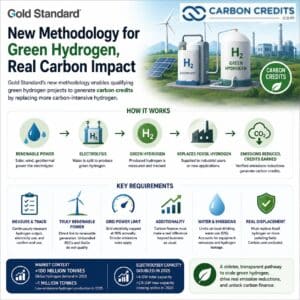
Gold Standard has launched a new methodology that allows qualifying green hydrogen projects to generate carbon credits when they replace more carbon-intensive hydrogen production. The methodology covers hydrogen made through water electrolysis using renewable electricity. It can support both new projects and upgrades at existing industrial sites.
The new framework gives hydrogen developers another way to attract carbon finance. It also sets strict rules for renewable power, additionality, water use, and emissions accounting.
The move comes as global hydrogen demand grows, while low-emissions production remains small. The International Energy Agency (IEA) reports that global hydrogen demand exceeded 100 million tonnes in 2025. Meanwhile, low-emissions hydrogen production stayed around 1 million tonnes.
Gold Standard Targets Hydrogen’s Fossil Footprint
Gold Standard’s Green Hydrogen Production methodology applies to projects that make hydrogen through electrolysis and use renewable electricity. The rules cover both greenfield projects, which build new green hydrogen plants, and brownfield projects, which add electrolysers to existing industrial facilities and replace fossil-based hydrogen.
Eligible projects can serve existing industrial users that previously relied on hydrogen made from coal, oil, or natural gas. The methodology can also cover new uses where green hydrogen replaces a more polluting fuel.
Credits depend on the amount of qualifying green hydrogen actually produced and used. A project, therefore, cannot claim credits simply because it has an electrolyzer or uses renewable power.
Every Kilogram of Hydrogen Must Be Accounted For
Gold Standard puts a strong emphasis on direct measurement. Projects must measure the electricity used and the amount of hydrogen produced. They must also show where the hydrogen goes and confirm that the end use qualifies for credit.
The methodology requires continuous measurement of hydrogen production using equipment such as mass flow meters or precision load cells. Projects must also track hydrogen delivered or sold to eligible users.
If developers cannot prove that a certain volume went to a qualifying end use, that volume cannot generate credits. This approach helps reduce the risk of overstating emissions reductions.
Green Hydrogen Must Prove Its Power Is Truly Renewable
The methodology also sets detailed rules for renewable electricity. Projects can use renewable power from sources such as solar, wind, and geothermal energy. They must prove where the power comes from and show a clear link between renewable generation and hydrogen production.
Simply buying unbundled renewable energy certificates, or RECs, does not qualify.
Gold Standard states that unbundled RECs and guarantees of origin can’t count as renewable electricity. This is because they lack a direct link to the electricity used by the hydrogen plant.
Off-site renewable projects can provide power with a power purchase agreement (PPA); however, they need to meet extra requirements.
For example, the renewable project generally must begin commercial operation within 24 months of the hydrogen facility’s start date. Gold Standard can extend that period by up to 12 months, giving a maximum of 36 months in documented cases outside the developer’s control.
The methodology also moves toward hourly matching between renewable generation and hydrogen production as tracking systems become available.
Grid Power Gets a Strict 10% Limit
Some grid electricity is allowed, but only in limited amounts. A project can use grid power when renewable supply is not enough, but grid electricity cannot exceed 10% of total annual electricity use.
Gold Standard also applies different emissions rules based on the grid’s carbon intensity. If the grid emissions factor is below 0.2 tonnes of CO2e per MWh, related hydrogen can still qualify as green under the methodology.
If the grid factor reaches or exceeds 0.2 tCO2e/MWh, the project must count the actual emissions linked to that grid electricity. These rules lower the risk of a project using lots of fossil-heavy grid power. This way, it can’t falsely claim credits for zero-emission hydrogen.
Carbon Finance Must Make a Real Difference
Gold Standard also requires developers to show that carbon finance helps make the project possible. The methodology looks at financial conditions, common practices, legal requirements, and lock-in risks.
Projects must also complete an ongoing assessment of their financial needs. This matters because green hydrogen projects may receive subsidies, tax benefits, or other government support.
The rules aim to prevent credits from rewarding emissions reductions that would have happened anyway.
Gold Standard also applies a Downward Adjustment Factor (DAF) to the crediting baseline. The factor considers the host country’s official net-zero target and lowers the baseline over time. This makes the crediting system more conservative as national climate policies strengthen.
Water and Supply Chain Emissions Matter
Water use is another part of the methodology. Electrolysis needs water, which can create pressure in areas that already face water shortages. Gold Standard limits the share of local drinking water use to 5% and requires checks on water availability and hydrological risks.
The methodology also accounts for emissions from equipment used to produce green hydrogen. Developers must consider emissions linked to the manufacture and transport of electrolysers, solar panels, wind turbines, and battery systems during the first crediting period.
The rules also account for hydrogen leakage. Gold Standard uses a 100-year global warming potential of 14.4 for hydrogen when calculating those emissions. That makes the methodology broader than simply comparing green hydrogen with fossil hydrogen at the production plants.
Credits Require Proof of Real Fossil Fuel Displacement
The methodology focuses on actual changes in how hydrogen and energy are produced. Developers must prove that current industrial users have used fossil-based hydrogen for at least three years before they can switch to green hydrogen.
Some uses are excluded entirely. Projects can’t get credits for green hydrogen used in:
- enhanced oil recovery,
- unconventional fossil fuel extraction or processing, and
- untargeted blending into natural gas networks.
For new hydrogen demand, developers must show that green hydrogen replaces a more emissions-intensive fuel or conventional hydrogen. These rules make the emissions benefit easier to measure and help strengthen the additionality case.
Hydrogen Demand Surges While Clean Supply Lags
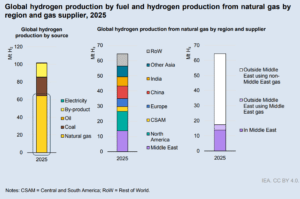
The new methodology enters the market as hydrogen demand continues to rise. The IEA reports that global hydrogen demand topped 100 million tonnes in 2025. However, low-emission hydrogen production was only about 1 million tonnes. The agency says low-emissions production grew 20% in 2025, showing progress but also a large gap with overall demand.
Electrolysis capacity is also growing. The IEA reports that global electrolyser capacity doubled in 2025, exceeding 4 GW. Additionally, over 2.5 GW of new capacity is being built for operation in 2026.
However, the industry still faces high costs, limited infrastructure, and uncertain demand. Carbon finance could help some projects close part of the cost gap. Still, carbon credits alone are unlikely to make green hydrogen competitive in every market.
Green Hydrogen Gets a New Carbon Finance Route
Gold Standard’s new methodology gives green hydrogen developers a clearer path to carbon finance. The rules call for directly measuring hydrogen output. They also set strict renewable power needs. Lastly, projects must prove they replace more carbon-heavy hydrogen or fuels.
If carbon finance can support more green hydrogen projects, the methodology could help expand low-carbon supply in industries such as refining, chemicals, ammonia, and steel. Yet, developers still need customers, renewable electricity, infrastructure, and financing.
Gold Standard’s framework does not guarantee a flood of new credits. It creates a stricter path for projects to prove that green hydrogen replaces real sources of emissions and delivers measurable climate benefits.